题目内容

交际运用。(每小题1分,共5分)

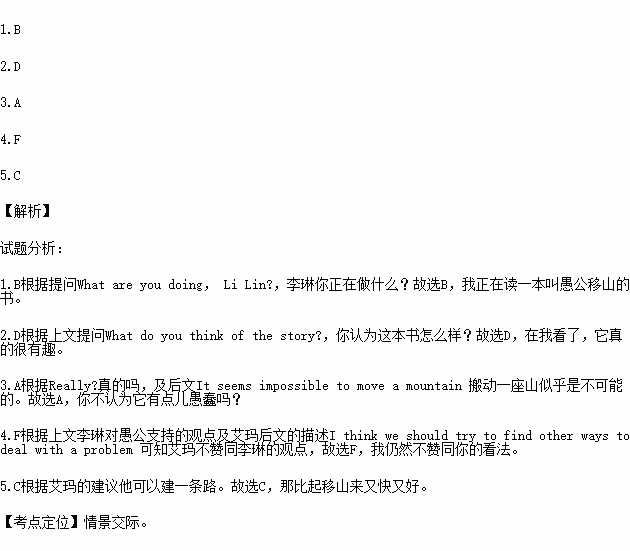
补全对话:根据对话内容,从方框中选择适当的选项补全对话,其中有两项为多余选项。

A. Don’t you think it’s a little silly?

B. I’m reading a book called YU Gong Moves a Mountain(愚公移山).

C. That’s better and faster than moving a mountain.

D. In my opinion, it’s really interesting.

E. Do you prefer to read stories?

F. I still don’t agree with you.

G. How about you?

Emma: What are you doing, Li Lin?

Li Lin: 1.

Emma: I have read it before. What do you think of the story?

Li Lin: 2. Yu Gong found a good way to deal with his problem.

Emma: Really? 3. It seems impossible to move a mountain.

Li Lin: But the story is trying to show us that anything is possible if you work hard. Yu Gong kept trying and didn’t give up.

Emma: 4. I think we should try to find other ways to deal with a problem.

Li Lin: But what could YU Gong do except moving the mountains.

Emma: He could build a road. 5.

Li Lin: We have different opinions about the story. There’re many sides to a story and many ways to understand it.

Emma: Yes, that’s fine.
练习册系列答案
相关题目

It was a cold winter day. A woman drove up to the Rainbow Bridge tollbooth. “I’m paying for myself, and for the six cars behind me,” she said with a smile, handing over seven tickets. One after another, the next six drivers arriving at the tollbooth were informed, “Some lady up ahead already paid your fare.”

It turned out that the woman, Natalie Smith, had read something on a friend’s refrigerator: “Practice random (随意的) kindness and senseless acts of beauty.” The phrase impressed (使某人印象深刻) her so much that she copied it down.

Judy Foreman saw the same phrase on a warehouse wall far away from home. When it stayed on her mind for days, she gave up and drove all the way back to copy it down. “I thought it was beautiful,” she said, explaining why she’d taken to writing it at the bottom of all her letters, “like a message from above.” Her husband, Frank, liked the phrase so much that he put it up on the classroom wall for his students, one of whom was the daughter of Alice Johnson, a local news reporter. Alice put it in the newspaper, saying that though she liked it, she didn’t know where it came from or what it really meant.

Two days later, Alice got a call from Anne Herbert, a woman living in Marin. It was in a restaurant that Anne wrote the phrase down on a piece of paper, after turning it around in her mind for days.

“Here’s the idea,” Anne says. “Anything you think there should be more of, do it randomly.” Her fantasies include painting the classrooms of shabby schools, leaving hot meals on kitchen tables in the poor part of town, and giving money secretly to a proud old lady. Anne says, “Kindness can build on itself as much as violence (暴力) can build on itself.”

The acts of random kindness spread. If you were one of those drivers who found your fare paid, who knows what you might have been encouraged to do for someone else later. Like all great events, kindness begins slowly, with every single act. Let it be yours!

1. Why did Natalie Smith pay for the six cars behind her?

A. She had seven tickets.

B. She hoped to please others.

C. She wanted to show kindness.

D. She knew the car drivers well.

2. Judy Foreman copied down the phrase because she ___ .

A. thought it was beautifully written

B. wanted to know what it really meant

C. decided to write it on a warehouse wall

D. wanted her husband to put it up in the classroom

3.Who came up with the phrase according to the passage?

A. Judy Foreman. B. Natalie Smith.

C. Alice Johnson. D. Anne Herbert.

4. What can we infer from the last paragraph?

A. People should practice random kindness to those in need.

B. People who receive kindness are likely to offer it to others.

C. People should practice random kindness to strangers they meet.

D. People who receive kindness are likely to pay it back to the giver.

It is reported that some developed counties have shipped broken parts of computes to China.Such a thing can be founded every day although it is against international laws. Last month Hong Kong officers found 131,000 kilograms of broken computers, TVs and phones send from Japan.

Things like these are called electronic waste, or e-waste. Dealing with is not an easy job because dangerous poison like mercury(汞)and lead (铅)can be found in them. Every time an old computer breaks down, it needs to be deal with safely. But at present, broken computer parts are usually buried. It may be hundreds of years before they are really goes in the earth.

Many places in China are polluted by e-waste. Guiyu in Guangdong province is one of them. This town is named as”the e-waste capital of the world”. It has to deal with 1.5mllion kilograms of e-waste each year, from which it makes 75 million years. But it comes at a cost. Many of the poison in e-waste find their way into the environment. Plastic is burned outdoors and chemical water is poured into rivers, Greenpeace, an environmental group, has found the air, the earth and the rivers in Guiyu badly polluted.

The Chinese government wants the country to develop, but in a way that doesn;t do harm to the environment and people’s life. This year,China presents a new protection law, the strictest one we have ever had. Computer complies like Lenovo and Dell will be asked to take back their old computers. This is because the complies that make computers know best to deal with them safely. Hopefully, the problem with e-waste will be solved in near future.

1.The e-waste found in Hong Kong last month was from________.

A.France B.Japan C.Germany D. Australia

2.The underlined word buried probably means ______in the passage.

A.焚烧 B.障碍 C.回收 D.掩埋

3.The town of Guiya in Guangdong Province_________.

A.is the e-capital of the world

B.has serious e-waste pollution

C. Deals with e-waste safely

D.speeds much money on e-waste

4.This year,the Chinese government__________.

A.tried to change people’s life

B.closed some computer complies

C.make a new environment protection law

D.asked people to hand in their old computers

5.The passage is mainly about________.

A.the way in deal with e-waste

B.the cost of burning e-waste

C.the e-waste problem in China

D.the need to pass a law against e-waste

违法和不良信息举报电话:027-86699610 举报邮箱:58377363@163.com

精英家教网