The Exploration of Antarctica(南极洲)

1773

James Cook crossed the Antarctic Circle, but he didn’t see land.

1898

Adrien de Gerlache and his members were trapped in the Antarctic. They became the first to spend an Antarctic winter.

1911

Norwegian Roald Amundsen led a five-man expedition that reached the South Pole for the first time.

1929

Richard E.Byrd and three others from the US became the first to fly over the South Pole

1935

Caroline Mikkelsen from Norway became the first woman to arrive in Antarctica with her husband.

1947

The US sent the largest ever expedition of over 4,700 men, 13 ships and 23 airplanes to Antarctica. They took many photos to make a map.

1957-1958

12 countries built over 60 space stations in Antarctica. It became the beginning of international work in Antarctica.

1997

Boerge Ousland from Norway became the first person to cross Antarctica unsupported.

March 2007-

March 2009

International Polar Year-Researchers got the opportunity to work in both polar places or work in summer and winter.

1. _______ is from the United States of America.

A. Boerge Ousland B. Richard E. Byrd

C. Roald Amundsen D. James Cook

2.The underlined word “opportunity” means “______”.

A. chance B. advice C. guide D. plan

3. ______ is the first woman to get to Antarctica.

A. Roald Amundsen B. Boerge Ousland

C. Caroline Mikkelsen D. Adrien de Gerlache

4.Which is WRONG according to the passage?

A. There were more than 60 space stations in Antarctica in the 1950s

B. Roald Amundsen was the first to fly over the South Pole.

C. Americans took many photos in the Antarctic to make a map.

D. Adrien de Gerlache was the first to spend an Antarctic winter.

5.The main idea of the passage is _____.

A. how to get to the Antarctic

B. the way of the exploration of Antarctica

C. the people who got to the Antarctic

D. the history of the exploration of Antarctica
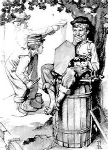
On Saturday morning, every boy in town was happy, except Tom Sawyer. Tom was by his aunt for causing some trouble. And he had to paint their fence(篱笆) which was 30 yards long. He knew other boys would him. He didn’t want to become a joke, so he thought hard. Then he came up with an idea and his brush to start the work.

A moment later, Ben Rogers came with an apple in his hand.

“You did something wrong again, right?” Ben asked.

“Of course not. I’m enjoying myself. Does a boy get a to paint a fence like this every day?” Tom said and went on painting.

Ben watched in silence for a while and became more and more . “Tom, will you let me have a try?” He asked.

But Tom , “Sorry, but Aunt Polly trusted me to do the painting. She said only I could do the job .”

“Oh, please, Tom,” said Ben. “I’ll be really careful. I’ll give you half my . Wait, I’ll give you all of it.”

“That’s a deal,” said Tom. “But you must be careful.”

Tom gave Ben his brush with worry on his face joy in his heart. He sat down and started to eat the apple.

When Ben got , Billy was waiting for his turn. He gave Tom a kite for the chance to paint. Behind Bill, there were many others…

Soon Tom got lots of “treasure”, and the fence got three coats of paint. Aunt Polly was so pleased that she gave Tom a big apple!

1.A. chosen B. guided C. praised D. punished

2.A. connect with B. laugh at C. wait for D. take care of

3.A. picked up B. brought up C. gave up D. kept up

4.A. competition B. journey C. decision D. chance

5.A. nervous B. interested C. lonely D. sleepy

6.A. refused B. agreed C. stopped D. succeeded

7.A. sadly B. comfortably C. perfectly D. poorly

8.A. brush B. kite C. apple D. toy

9. A. but B. so C. and D. or

10. A. worried B. sick C. relaxed D. tired

Although most people believe that laughter is one of the nature’s great treatments for a whole range of mental and physical diseases, it is still a serious scientific subject that researchers are trying to figure out.

“Laughter above all else is a social thing,” says Baltimore neuroscientist(神经科学家), Robert Provine, who has studied laughter for many years. “All laughter groups laugh ‘ha-ha-ha’ basically the same way. Whether you speak Mandarin, French or English, everyone will understand laughter. There is a pattern generator(发生器) in our brain that produces this sound.”

Laughing is our first way of communicating. Babies laugh long before they speak. No one teaches them how to laugh. They just do. People may laugh at a prank(恶作剧) on April Fools’ Day. But surprisingly, only 10 to 15 percent of laughter is the result of someone making a joke. Laughter is mostly about social responses rather to a joke. Deaf people laugh without hearing and people on cell phones laugh without seeing, showing that laughter isn’t dependent on single sense but on social interactions.

And laughter is not just a people thing. Chimps tickle(挠痒) each other and even laugh when another chimp pretends to tickle them.

Jaak Panksepp, a Bowling Green University Psychology professor, studies rats that laugh when he tickles them. It turns out rats love to be tickled — they return again and again to the hands of researchers tickling them.

By studying rats, scientists can figure out what’s going on in the brain during laughter. Northwestern University biomedical engineering professor, Jeffrey Burgdorf has found that laughter in rats produces a chemical that acts as an antidepressant(抗抑郁药). He thinks the same thing probably happens in humans, too. This would give doctors a new chemical target to develop drugs that can fight depression.

Even so, laughter itself has not been proved to be the best medicine, experts said. Margaret Stuber, a professor at University of California, studied whether laugher helped patients. She found that distraction(分心) and mood improvement helped, but she could not find a benefit of laughter alone.

“No study has shown that laughter produces a direct health benefit,” Provine said, mainly because it’s hard to separate laughter from just feeling good. But he thinks it doesn’t really matter: “Isn’t the fact that laughter feels good when you do it enough?”

1.The underlined word “figure out” in Paragraph 6 means “________”.

A. deal with B. work out

C. look out of D. come up with

2.According to the passage, scientists studied rats in order to find ______.

A. how they laugh

B. if they like laughing

C. what laughter in rats produces

D. how rats react while being tickled

3.What can we know from Robert Provine’s research?

A.Laughter makes a person feel good.

B.Laughter produces a direct health benefit.

C.Laughter depends on all kinds of senses.

D.Laughter is a way of communicating.

4.What is probably the best title for this passage?

A. Why Rats Laugh

B. When Laughter Happens

C. How Laughter Works

D. Why Laughter Matters

违法和不良信息举报电话:027-86699610 举报邮箱:58377363@163.com

精英家教网