题目内容
Seven years ago, Starbucks closed a shop in Beijing’s Forbidden City after a well-known TV host talked about if the US coffee fits into the old Chinese building.
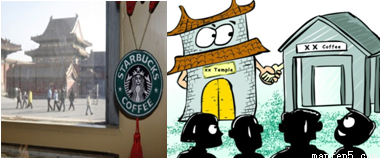
Five years later, Starbucks seemed to regain its confidence(自信). It opened a shop beside Lingyin Temple in Hangzhou with more than 1,600 years of history. People started to talk about it online. They were not sure if the coffee business would do bad to this old temple(庙).
Some people still think that the Starbucks shop should not be opened near temples. They think it is not only a coffee shop, but a cultural invasion(文化侵略). Let us take a look at the practices in other countries. In the Forbidden City of South Korea, Gyongbokkung Palace(景福宫), there are no food or drink stores, except the food-selling machine at the gate. In Japan, the place of interest may be taken away from the list of country’s treasure if it brings in modern shops.
However, many old sights in China try to look for a balance(平衡) between traditions and business. As for Nanjing, the Starbucks shop near the Confucius Temple has been there for years. Visitors are used to enjoying the sights and the coffee at the same time. The shop here plans to meet the need of growing numbers of foreign and younger Chinese visitors. There may be more win-win deals in the future like this.
1. What is the reading passage mainly about?
A.How Starbucks has grown.
B.Starbucks and temples.
C.What Starbucks makes.
D.Traditions and business.
2. According to the passage, what happened in 2012?
A.A Starbucks shop closed in Beijing’s Forbidden City.
B.Starbucks opened a shop beside Lingyin Temple in Hangzhou.
C.Starbucks opened a shop beside the Confucius Temple in Nanjing.
D.A Starbucks shop closed in Gyongbokkung Palace.
3. According to the passage, which of the following statements is true?
A. Starbucks is sure to bring bad to old temples a lot and changes them.
B. People think Starbucks is only a coffee shop and it has nothing bad.
C. In South Korea, there are many coffee shops in Gyongbokkung Palace.
D. In Japan, places may be out of the list of country’s treasure for modern stores.
4. What do many old sights in China try to do?
A. They try to keep all the business shops away from the old sights.
B. They try to open business shops without doing bad to old sights.
C. They try to open more business shops to make more money.
D. They try to keep in the list of country’s treasure without opening shops.
5. What is the meaning of regain in paragraph 2 in the passage?
A. 恢复 B.得到
C. 反复磨练 D. 失去
1.D
2.B
3.D
4.B
5.A
【解析】
试题分析:这篇文章主要是讲述了Starbucks在杭州有1600多年的历史的灵隐寺旁边开了一家店,许多人们认为不应该在寺庙旁边开店。这个店增加了游客的数量。主要讲述了传统文化和生意之间的关系。
1.细节理解题。通读全文可知这篇文章主要是讲述传统的文化和生意之间的关系;可知选D
2.细节理解题。根据文中Five years later, Starbucks seemed to regain its confidence(自信). It opened a shop beside Lingyin Temple in Hangzhou with more than 1,600 years of history.可知Starbucks在杭州寺庙旁边开了一个店。可知选B
3.细节理解题。通读全文可知只有D In Japan, places may be out of the list of country’s treasure for modern stores.在日本,现代商店地方可能从国家珠宝列表排除。可知故选D。
4.细节理解题。根据文中However, many old sights in China try to look for a balance(平衡) between traditions and business.中国景点尝试开生意商店对古代风景没有损害,故选B
5.词义猜测题。根据句意;五年之后,星巴克似乎恢复了自信,故选A
考点:经济类短文阅读。

情景交际。 (5分)
A: Good morning, __1.__
B: Good morning. I want to buy a football.
A: Just a moment. __2._.
B: How much is this one?.
A: It is 50 yuan.
B: Oh really, __3.___.
A: __4._.
B: How much does it cost?
A: It is 30 yuan. And what do you think of it?
B: It is OK. But do you have other colours about this kind?.
A: Yes, they are over there. How about the blue one?.
B:_ 5.___.
A. That is too expensive. B. What about that one? C. Can I help you? D.OK. I will take it. E. There are some new footballs here. Please take a look. |
阅读填空(共20小题;每小题1分,满分20分)
Have you ever wondered what an American high school is really like? This article will describe a typical (典型的) high school and its students.
A typical American high school has several large buildings and enough space for about 1,500 students. Every student is given a locker. When students first arrive at school, they go straight to their lockers to put away or get their textbooks and to hang up their outdoor clothes. As American textbooks are expensive, students would rather loan(租借) than buy them. Students must pay back if they lost any of them.
American students have different types of school transport. They usually take a yellow school bus or walk to school if they live close enough. Sometimes their parents drive them to school. When they turn 16 years of age, most take a free driving class at school for one term. If students earn passing grades in the class and also pass their state driver’s exam, they can begin driving themselves to school.
Each day, students take six or seven classes. They must take science, math, English and social studies. They can choose art, homemaking, fashion design and other classes. In some schools students are required to take one or more of the following special classes: health education, physical education or foreign language studies. Students move to different classrooms for each subject. This is because each teacher has their own classroom. There is a five-minute break between classes, to give the students the time to hurry to their next class.
The regular school day usually ends early in the afternoon. After school more than half of the students are involved in after-school activities. These activities include sports-especially football, basketball, baseball and soccer or clubs, such as yearbook, speech, school newspaper, photograph or student government.
Title: 1. in an American High School
Outline | Details |
Introduction | ◇It gives an overview of a typical American high school and its 2. . |
Lockers and textbooks | ◇Every student has a locker for textbooks and 3. clothes. ◇They prefer loaning textbooks to 4. them. |
5. transport | ◇Students usually go to school by bus or on foot. Sometimes their 6.send them to school by car. ◇They can 7. themselves to school when they are over 16 and have passed the required tests. |
Classes and classrooms | ◇Students have to take main classes, elective classes and sometimes one or more8. classes. ◇They go to 9. classrooms for each subject. |
After-school activities | ◇After school most of the students take 10. in their faviourite activities, including sports and clubs. |