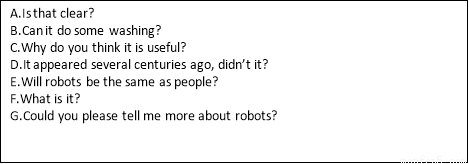
题目内容
1. Many people write on paper only one side. Why not try using both sides? Some students only use half the pages in their notebooks before getting new ones. Try to use up all the paper. People often give cards on festivals. How about trying to send e—mail instead? |
2. There’s many poor families in China. You may ask your parents to keep your unwanted clothes. Then you can pass them to poor kids. You’ll feel happy that you are helping someone else. Also, you can see if your friend wants them before throwing them away. |
3. In San Francisco of the US, there is a beautiful bridge. It cost more than four years to build it, and it was finished in 1937. You can cross the bridge by car or on foot, but you must pay. Do you know the bridge? Yes, it is the Golden Gate. |
4. Many people can use computers, but few of them know how to use them correctly. Remember the following when you use your computer. Keep your computer in a cool, dry room; don’t put water or food near your computer; keep your screen clean and not too bright. |
5. E—mail means messages sent from one computer to another. It is becoming more and more popular. You can send and receive e—mails everywhere. It is quick to use e—mails, and it is much cheaper than long—distance telephone call. |
A.Use computer in right ways.
B.Make old clothes useful.
C.The golden Gate.
D.A new way of sending messages.
E.How can paper be saved?
1.E
2.B
3.C
4.A
5.D
【解析】
试题分析:本文叙述了几条信息:如何节约用纸;使旧衣服变得有用;介绍美国的金门大桥;正确使用电脑的方法;新型的信息传递方式——电子邮件。
1.
2.
3.
4.
5.
考点:短文填空。

 阅读快车系列答案
假如你是王明,你将代表Hong Xin Middle School参加长春市中学生英语演讲比赛。演讲的题目是 We should help parents do housework. 请你用英诰写一篇演讲稿,号召同学们也要尽力承担起家庭的责任。(15分)
要点提示:
现 象 | 你常做的家务 | 你的体会和看法 |
许多学生懒惰,不愿做家务。 | ◆ 修理床铺 ◆ 浇花 ◆ 打扫房间 ◆ 倒垃圾 ◆…… | …… (至少两点) |
要求:1.短文须包含要点提示中的所有信息,并可适当发挥;
2.不少于80词,开头和结尾已给出,不计入总词数;
3.文中不得出现自己的真实姓名、校名和地名。
Hello, everyone!
My name is Wang Ming from Hong Xin Middle School. Today my speech topic is that we should help parents do housework.
A: Hello. Is that Uncle Sam’s Restaurant?
B: Yes. 1.
A: I want to know if you send take—away food.
B: Sure.
A: I’d like to order for dinner.
B: 2.
A: I’d like to have beef with potatoes and a hamburger.
B: OK. 3.
A: No, thanks. Please tell me how I can pay for you?
B: 4. By the way, what time do you expect your dinner?
A: About 6:00 pm.
B: Could you please leave your address?
A: Oh, yes. 5.
B: Thank you. See you then.
A. What would you like to have? B. What can I do for you, Madam? C. Anything else? D. How much would you like? E. Room 101 in Green Building. F. You can pay us when your food is sent. |