题目内容
Where are they talking?
A. At home. B. In a hospital. C. In a shop.
Thanks______ the photo ______ your school.
A. of;for B. for;of C. for;about D. about;for
![]()
There lived an old man in a small town of Germany. He had three sons and they all worked in the same factory where he had worked. After the Second World War began. his sons were all made to join the army and all of them died in the battle(战争). The old man was heartbroken. He didn't have enough food and often went hungry. Nobody helped him and he didn't know how to go on living.
One cold winter night, the old man couldn't go to sleep. He had been hungry for two days and it was so cold that ice could be seen in his room. He had to get up and began to run in the room until he lay down on the ground. The next morning he had to beg from door to door. He had been to a lot of cities ever since.
Once he came to a village, but the villagers were all poor and couldn't give him anything. He was too hungry to go to another village. He thought over and over and found a way. He came to a police station and called out. "Hitler is a foolish pig!”
Out came a policeman at once. He took the old man into a room, gave him some bread and a cup of tea. Then he said, "Don't say that in our village, sir!”
“I’m sorry, sir,” said the old man, “I don’ t know it's Hitler’ s hometown.”
“No, no, sir,” the policeman said in a hurry. “It’s the pig’s hometown!”
请根据短文内容,选择最佳选项。
1.Why was the old man heartbroken?
A. Because he had nothing to support his three sons
B. Because he was made to join the army
C. Because all his three sons lost their lives in the war
2.Finally, the old man got things to eat by _________.
A. asking the villagers for help
B. shouting to the police station
C. begging from door to door
3.Actually the policeman __________.
A. hated Hitler as well as the old man
B. didn’t want to help the old man
C. thought the old man was more foolish than pigs
4.We can infer(推断)that the “village” underlined in the passage is _______hometown.
A. the old man’s B. the pigs’ C. Hitler’s
5.The passage above is _________.
A. a science fiction B. a funny story C. a fairy tale
Michael is wearing _______ a cool windbreaker ________he looks great.
A. too; to B. such; that C. so; that
Welcome to Our Restaurant | ||
The most 1. food at the lowest price. | ||
Breakfast | Porridge, 2. and noodles. | |
Porridge(稀饭) | 3. yuan | |
Lunch and dinner | Rice, dumplings, 4. kinds of meat and vegetables. There are also some drinks for you. | |
Beef | 10 yuan. | |
Business hours | From six thirty a. m. to 5. o’clock p.m. |
A.
B.
C. ![]()
The Inuit people of North America used to be called Eskimos.1. Their lives have changed a lot in 30 years.
The Inuit people used to live in igloos (冰屋)in winter, but today, many of them live in houses in small towns. They used to hunt seals (海豹).2. Many of them still wear seal-skin clothes today because they are very warm. Remember, the weather is very cold for many months of the year.
Mariano Tagalik, a 65-year-old Inuit, told us a little about her past life. “Our
winter igloos were very warm. We cooked inside, so sometimes it got too hot. 3. In the short summers, we lived in seal-skin tents, but I spent as much time as possible playing outside. ”
To move over the snow, Inuit people wore special snowshoes on their feet.4.These machines can travel long distances(距离)in a short time. In the past, it took them days or weeks to travel the same distance.
5., and they learnt everything from their parents. Now, like all North
Americans,they go to school for about ten years. Life is not as hard as it used to be,but many of the older Inuits hate modem life and want to go back to the old days.
根据短文内容,将下面方框内的句子还原到文中空白处,使短文内容完整、通顺(每个选项只能用一次)
A. I took off most of my clothes when I was in our igloo
B. Inuit children never went to school
C. They are now named Inuits which means “the people”instead of Eskimos
D. Today many Inuits ride snowmobiles
E. They ate the meat and made clothes from the fur (皮毛)
![]()
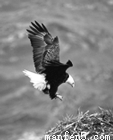
Once there was a baby eagle living in a nest (巢) on a cliff (山崖). The baby eagle loved his nest. It was warm, soft and comfortable. And even better, he had all the food and love that his mother could give. Whenever the baby eagle was hungry, his mother would always come just in time with the delicious food he liked.
He was growing happily day after day. But suddenly his world changed. His mother stopped coming to the nest. He was full of sadness and fear. He thought he would die soon. He cried, but nobody heard him.
Two days later his mother appeared with some nice food. The baby eagle was wild with joy. But his mother put the food at the top of the mountain and then looked down at her baby. The baby eagle cried out, “Mum, why did you do this to me? I'm hungry. Don't you know I will die if I have nothing to eat?”
“Here is the last meal I give you. Come and get it by yourself,” his mother said. Then she flew down and pushed the baby eagle out of the nest.
The baby eagle fell down, faster and faster. He looked up at his mum, “Why do you abandon me?” He looked down at the earth. The ground was much closer. Then something strange happened. The air caught behind his arms and he began to fly! He wasn't moving to the ground any more. Instead, his eyes were pointed up at the sun.
“You are flying! You can make it!” His mother smiled.
1.Which of the following is TRUE about the baby eagle's life before his mother stopped coming to the nest?
A. He lived in a nest in the tree.
B. His mother offered him nice food.
C. He was always cold and hungry.
D. He lived very happily with friends.
2.How did the baby eagle feel as soon as he saw his mother coming again?
A. Sad. B. Happy. C. Afraid. D. Angry.
3.What did the baby eagle's mother do when she came the last time?
A. She put some food in the nest.
B. She just came to see him again.
C. She shouted at the baby eagle and flew away.
D. She pushed her baby eagle out of the nest.
4.What does the underlined word “abandon” mean?
A. 抛弃 B. 保护 C. 歧视 D. 拯救
5.We can infer (推断) from the story that ________.
A. the baby eagle lost his mother
B. the baby eagle fell down and died
C. the baby eagle could get food himself
D. the baby eagle was still angry with his mother
—Taizhou is so beautiful, isn’t it?
—Yes. A river runs_______ the city, and there are lots of beautiful bridges_______ it.
A. across; through B. through; over
C. through; through D. across; over