题目内容
They will wear _______ costumes ______ this year.
A. monkeys, in B. monkey, in C. monkey, / D. monkeys, /
Take one book , boys and girls. And keep quiet in the reading room please.
A. in time B. at a time C. on time D. at times
When an animal helps another animal, it usually gets something valuable in return For a long time, many scientists thought that only people could act generously just because it felt good.
However, a new study in Germany suggests that chimpanzees (an animal like a large monkey without a tail ) also do good things for.no real reason And so do children who are as young as 18 months old. Maybe it is because humans and chimpanzees share an ancestor about 6 million years ago,
"People and chimpanzees appear to develop such features without any other
training," says Warneken, a scientist in Germany.
Warneken and his partners worked on adult chimpanzees that live on an island in
the African country of Uganda They also worked with 18-month-old children in Germany. The researchers performed three experiments on the adult chimpanzees and two experiments on the kids. In the first animal experiment, a person tried to reach his arm into a cage to get a stick, but he couldn't reach it. A chimpanzee was in the cage, and it could reach the stick if it wanted to.
Thirty-six chimpanzees took part in this experiment one by one, and no chimpanzee saw what the other chimpanzees had done. Even though the animals hadn't met the person before, they usually took the stick and gave it to the person What's more, they did this whether or not the person offered them bananas as a reward. In a similar experiment, 36 children acted in a similar way. They helped the person reach the stick, whether or not they were offered toys for their help.
Researchers did other experiments on chimpanzees and babies. No rewards were offered in either experiment. And still, both the chimpanzees and children went out of their way to help. Still, the new study is different from earlier findings. Researchers have found that chimpanzees don't give rewards of food to other chimpanzees, even if it costs them nothing to be generous.
1.A new study in Germany suggests that _ .
A. people also share information for good reasons
B. children know something at the age of 18 months
C. chimpanzees also do good things for no real reason
D. humans should develop their abilities 6 million years ago
2.Warneken and his partners worked with _ .
A. young chimpanzees that live on an island
B. 18-month-old children who live in Germany
C. kids who are living with adult chimpanzees
D. adult chimpanzees that live on the African mountain
3.Which of the following is NOT true according to the passage?
A. The animals hadn't met the person before the experiments.
B. No chimpanzee saw what the other chimpanzees had done.
C. The chimpanzees gave the person the stick in order to get a reward.
D. Thirty-six chimpanzees joined in this experiment one by one.
4.In a similar experiment, thirty-six children helped the person reach the stick
A. If they were offered toys for their work
B. when they were asked to give him a hand
C. after they were ordered to act in a similar way
D. whether they were given toys for their help or not
5.From the passage we know that _
A. children are more generous than chimpanzees m some ways
B. chimpanzees will reward good food to other chimpanzees
C. both chimpanzees and children can find their way to help others
D. both chimpanzees and children can do the difficult experiments
_______ important knowledge is to us ﹗
A. What an B. How an C. What D. How
Dad, my trousers are old. I want to buy a new ______.
A. trousers B. one C. it D. pair
----Why do you like the parrot__________? ----Because it has colourful feathers.
A. well B. better C. best D. good
My grandfather does well in ______ lanterns ______ oranges.
A. making;with B. make;out of
C. making ;out of D. make;with
看音标写单词
1.[ge?m] ______
2.[ 'prez?nt] _______
3.[?u:] ______
4.[bΛs] _______
5.[ta?m] ______
6.[plɑ:nt] _______
7.[sw?m] ______
8.[?'ba?t] _______
9.[kl?k] ______
10.[b?m'bu:] _______
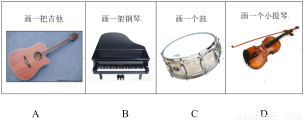
看图写单词,完成句子。
![]()
1.Cindy likes to play the ________.
2.Mum buys me a ______ for my birthday.
3.He often plays the_______ after school.
4.I want to learn to play the ________ with Lin Tao.