题目内容

On the Earth, everyone has a home. While in space, there is also a home. It is nearly as big as a soccer field and larger than a six-bedroom house. It is the International Space Station(ISS).

The ISS is home to astronauts. Usually, there are three to six astronauts on board. Astronauts in the space station are very busy. They do many science experiments in biology and physics, and study the effects on the human body after long exposure(暴露) to microgravity(微重力). Sometimes they go on spacewalks to work outside the station.

As a groundbreaking scientific research facility, the ISS benefits(使受益) people on the Earth. Robots on the ISS have inspired medical technology. Now it is possible for patients to receive certain surgery(外科手术) by a robotic arm, which performs better than humans. The ISS also helps to watch the Earth’s ecosystems(生态系统) and warns us of volcano eruptions(火山爆发) and earthquakes.

For children, the ISS plays an important part in education. Children can ask astronauts in the ISS any question with the help of satellites. For example, what do you eat? How do you sleep? This is a good way to improve children’s interest in science and technology.

The ISS is expected to remain in operation until at least 2020, China Daily reported. Russia may build a new space station to replace it at that time.

In the future, space will be home to more stations like the ISS. China is also planning to build its own space station, and the launch of Tiangong-1 in 2011 was the first step. It is expected that China will complete the space station by 2023.
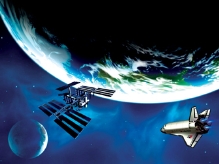
 

The International Space Station(ISS)

Home to astronauts

(5-6 astronauts 1.____ )

1.They do many experiments in different scientific fields.

2.They study2.___ on human body with nearly zero gravity.

3.They go on spacewalks.

Benefit people on the Earth

1. Robots on the ISS have inspired 3._____.

2. Help to watch the earth’s ecosystems.

3. Warns us of volcano eruptions and earthquake.

Help children in education

A good way to 4. children’s interest in science and technology.

5.______________ marks the first step of China to build its own space station.


1.on board

2.the effects

3.medical technology

4.improve

5.the launch of Tiangong-1 in 2011

【解析】

试题分析:这篇文章主要讲了太空站的情况,怎样使人们受益,在教育方面怎样帮助孩子们等。

1.细节理解题。根据The ISS is home to astronauts. Usually, there are three to six astronauts on board可知填on board

2.细节理解题。根据study the effects on the human body after long exposure(暴露) to microgravity(微重力).可知应填the effects

3.细节理解题。根据Robots on the ISS have inspired medical technology填medical technology

4.细节理解题。根据This is a good way to improve children’s interest in science and technology.可知故填improve

5.归纳理解题。通过the launch of Tiangong-1 in 2011 was the first step填the launch of Tiangong-1 in 2011

考点:故事类阅读

练习册系列答案
相关题目

“Who did this?” asked the teacher. Sixty children tried to think __ not only what they had done, but also what the teacher might have found out.

“Who did this?” she asked again. She never became__ , but she was this time. She __ a piece of broken glass and asked loudly, “Who broke the window?”

“Oh, oh,” I thought. It was I that broke the window. I didn’t do that on purpose(故意). It was caused by a __ throw of a basketball. Why did it have to be me?

If I said it was me, I would__ in a lot of trouble. How would I be able to pay for a big window like that? I didn’t want to put up my hand, __ something much stronger than me pulled me up. “I did it.” Then I didn’t know __ to say. It was hard enough saying what I had done.

My teacher went to the bookshelf and took down a book. She then began walking to my desk. I thought she was going to punish(惩罚) me.

“I know how you like birds,” she said as she stood looking down at my face. “Here is a __ about birds. It is yours now. You will not be punished. But remember, it’s only __ your honesty.”

I couldn’t __ it! I wasn’t punished and I was getting a book—the very one that I had been saving up all my money to buy!

1.A. back B. for C. up D. about

2.A. happy B. angry C. interested D. excited

3.A. held up B. brought up C. come up D. put up

4.A. good B. bad C. wonderful D. soft

5.A. have B. be C. take D. make

6.A. but B. and C. so D. or

7.A. who B. what C. how D. when

8.A. basketball B. window C. book D. glass

9.A. about B. of C. with D. for

10.A. believe B. think C. use D. take


One afternoon, I went to pick up my mother from work. I got there a little early, so I my car by a small park, and for her.

As I looked outside the car window, I saw a little boy, around two years old, running on the grass as his mother from a short distance. The boy had a big smile on his face as if he had just been free from some sort of prison. The boy would then fall to the grass, up, without looking back at his mother, run as as he could, again, still with a smile on his face, as if nothing had happened .

At that moment, I thought to myself, “Why aren’t most adults this way?” Most adults, when they fall down, make a big deal out of it and don’t even a second attempt. They would be so that they would not try again if someone saw them fall. Or, because they fall, they would find a good for themselves that they’re not fit for it. They would end up too afraid to attempt again for fear of failure.

However, with kids, when they fall down, they don’t consider their falling down as a failure, instead, they treat it as a experience. They try again and again until they . The answer must be that they have not connected “falling down” with the word “failure”. As a , they are not discouraged in any way. Besides, they _ think to themselves that it’s quite okay to fall down and that it’s not wrong to do so. In other words, they allow themselves to make , so they remain energetic.

I was deeply impressed by the boy’s persistence (坚持不懈) and the manner in which he did.

1.A. left            B. stopped      C. repaired

2.A. waited          B. cared            C. prepared

3.A. carefully       B. anxiously        C. freely

4.A. watched        B. noticed      C. surveyed

5.A. cut         B. kept             C. set

6.A. hold            B. get          C. end

7.A. well            B. long             C. fast

8.A. make            B. provide      C. practice

9.A. confused        B. embarrassed  C. excited

10.A. cause       B. sign             C. excuse

11.A. learning        B. running      C. teaching

12.A. progress        B. improve      C. succeed

13.A. decision        B. result           C. reason

14.A. hardly      B. perfectly        C. probably

15.A. mistakes    B. choices      C. plans


违法和不良信息举报电话:027-86699610 举报邮箱:58377363@163.com

精英家教网