题目内容
In some science fiction movies, evil robots refuse to die, no matter how hard people fight back.
Now science fiction has become science fact. For the first time, scientists have made a robot that can take a beating (挨打) and keep on going. Scientists from Cornell University made the robot, which looks like a spider with four legs.
Until now, even the most advanced (先进的) robot was almost certain to break down when it was damaged. That is because its computer inside simply doesn’t know how to make the machine work after its shape has changed.
To deal with this problem, the scientists put eight motors (发动机) and two sensors (传感器) that read how the machine is working. They all give signals to the machine’s software. Using this information, the computer can then figure out the machine’s shape at any moment.
The new technology is a big advance in robot-making, scientists say, and it’s far from scary. It may someday help scientists create better artificial (假的) arms and legs and give new freedom to people who lose them. It might also help scientists understand how people and animals figure out their own sense of place in space.
“It has been difficult to design robots that can work well when the environment changes or when it’s damaged,” says Olaf Sporns of Indiana University in US. “With this work, we are nearer to solving this problem.”
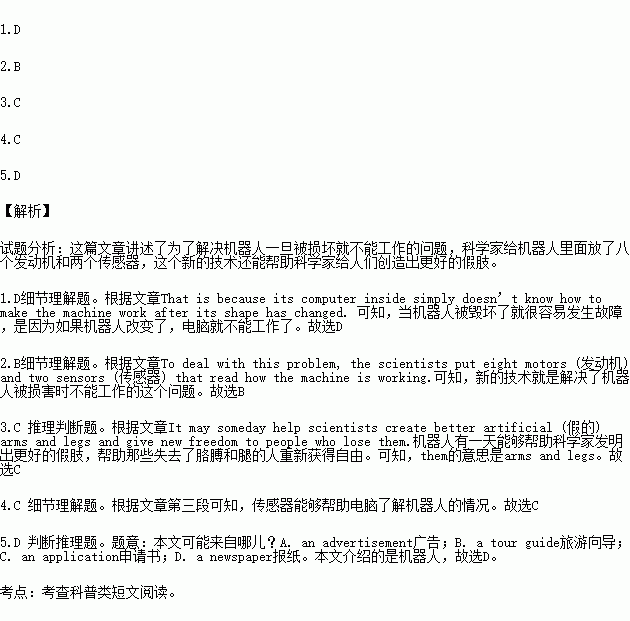
1.Why do robots easily break down when they are damaged?
A. They cannot repair themselves.
B. The computer has changed a lot.
C. They have no computers inside.
D. The computer cannot work if the robot changes.
2.The new technology allows the robot to _________.
A. do housework for humans
B. keep work ing after being damaged
C. remember a lot of information
D. tell people where it is
3.The underlined word “them” in Paragraph 5 refers to ________.
A. sensors B. robots
C. arms and legs D. scientists
4.How do the sensors in the robot work?
A. They can replace the computer when it’s broken.
B. They can find out where the damage comes from.
C. They help the computer learn the robot’s condition.
D. They can send signals to the person who uses the robot.
5. The passage is probably from_____________.
A. an advertisement B. a tour guide
C. an application D. a newspaper

Every place offers the possible dangers for getting hurt, even staying at work. We may face dangers like walking into desks or chairs, receiving unexpected cuts from a paper knife and so on. Industrial jobs have similar and more dangers like getting body parts hurt by machines or falling from a height.
No one wants to get hurt. Some accidents are avoidable(可避免的). Most accidents happen because of common things seen every day—an open desk drawer, a chair pulled out too far, water on the floor and so on. We slowly get used to these things we see every day and never think about what they could possibly become in the future.
Think about the following to prevent dangers to yourself and others:
1. If there is something you see and know may become a danger for yourself or others, do something about it. Close a desk drawer, clean up or put a sign over the water, turn off the power before leaving, and so on.
2. Get extra persons’ help and support on a task that is too hard for a single person.
3. Study the situation and think what could possibly happen and change if necessary. Do it before something happens and you won’t have to say some day, “ I should have… How sorry I feel…”
To use an old phrase “Safety is everyone’s duty.” Looking down on it could lead to being hurt. Keep the rule in mind every day “Everyone wants to go home in the same condition they came to work in –or better.”
Title: _1.__ at Work
_2.___ dangers | There are some dangers like tripping, unexpected _3.__ by a paper knife. |
___4.____ | 1. Most accidents are 5.___ by the common things seen every day. 2. Get used to _6.___we can see every day and never think about the dangers. |
Safety rules | 1. Turn off the power before you ___7._. 2. Get extra persons’ help and support if the task is too difficult for you to finish on your _8.___. 3. Make some __9.___based on the situation. |
Warning | Safety on the job is ___10.__duty. |