题目内容

People call the Winter Olympics the White Olympics. At this time, they publish(发行) many stamps to mark(标志) the great games. The first stamps came out on January 25th, 1932 in the United States for the 3rd White Olympics. From then on(从那时起), publishing stamps during the White Olympics became a rule.

During the 4th Winter Olympics, people published a group of stamps in November 1936. They drew five rings of Olympics. It was the first time that the rings appeared(出现) on the stamps of the White Olympics.

In the 1950s,the stamps of this kind became more colorful. When the White Olympics came, the host countries as well as non-host countries published stamps to mark those games. China also published four stamps in February 1980 when the Chinese sportsmen began to take part in the White Olympics.

In Asia, Japan was the only country to hold the White Olympics. They sold 14,500 million stamps during the Olympics.

People drew different kinds of sports on these small stamps, and they enjoyed the wonderful sports and some excellent players.

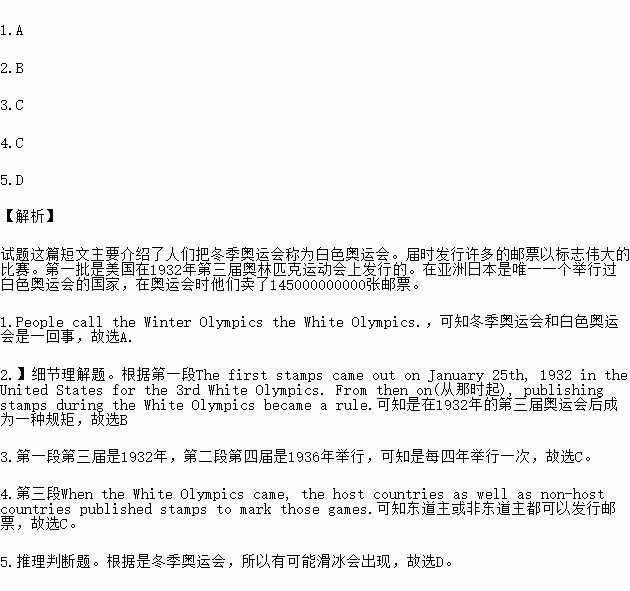
1.The White Olympics and the Winter Olympics ____.

A. are the same thing  B. are different games

C. are not held in winter D. are held in summer

2. The world made it a rule to publish stamps to mark the great world games ____.

A. after the year 1936

B. after the 3rd White Olympics

C. before the 3rd White Olympics

D. before the year 1932

3.The Winter Olympics is held(被举行) once ____.

A. every two years     B. every three years

C. every four years     D. every five years

4. Which of the following is TRUE?

A. Only the host countries can publish stamps to mark those games.

B. Only the non-host countries can publish stamps to mark those games.

C. All the countries can publish stamps to mark those games.

D. Japan can’t publish stamps to mark those games.

5. What may appear(出现)on the stamps of the White Olympics?

A. Basketball.  B. Table tennis.

C. Football.  D. Skating?
练习册系列答案
相关题目

"How are you?" is a nice question. It's a friendly way people in the United States greet each other. But "How are you? " is also a very unusual question. It's a question that often doesn’t have an answer.

When a person meets a friend on the street and asks "How are you?" the person doesn't really expect to hear an answer such as "I really, don't know what's wrong with me. I thought I had a cold. I took some medicine, but that didn't help much, so I have a doctor’s appointment." The person who asks "How are you?" expects to hear the answer "Fine," even if the other person isn't! The reason is that "How are you?" isn't really a question and "Fine" isn't really an answer. They are simply ways of greeting people and saying "Hello."

Sometimes, people also don't say exactly what they mean. For example, when someone asks "Do you agree?", the other person might be thinking "No, I disagree. I think you're wrong." But it isn't very polite to disagree so strongly, so the other person might say, "I'm not so sure." It's a nicer way to say that you don't agree with someone.

People also don't say exactly what they are thinking when they finish conversation with other people. For example, many conversations over the phone end when one person says, "I've got to go now." Often, the person who wants to hang up gives an excuse: "Someone's at the door." "I've got to put the vegetables away." "Something is burning on the stove!" The excuse might be real, or it might not be. Perhaps the person who wants to hang up simply doesn't want to talk any more, but it isn't very polite to say that. The excuse is more polite, and it doesn't hurt the other person's feelings.

Whether they are greeting each other, talking about an opinion, or ending a conversation, people often don't say exactly what they are thinking. It's an important way that people try to be nice to each other, and it's all part of the game of language!

1.Why is“How are you? ”an unusual question?

A. It is a nice question.

B. It is a question that has no answer.

C. People can’t not answer when they hear it.

D. It is used everywhere in English-speaking countries.

2.What will the person who asks“How are you?”expect to hear ?

A. Just something like“Fine”.

B. I really don’t know what’s wrong with me.

C. I have taken some medicine but it doesn’t help.

D. It is simply a way of saying “Hello”.

3.How can we make other people feel better if we don’t agree with them on something?

A. By telling them directly what we think.

B. By saying“I’m not quite sure about that ”.

C. By asking them“How are you? ”

D. By giving more good examples.

4.Why do people sometimes choose a roundabout way to end the telephone conversation?

A. They want other persons to feel nice. B. They are afraid of telling lies.

C. They try to find some polite excuses. D. They want the others feel their excuses real.

5.Which of the following is not right according to the passage?

A. When people ask "How are you?" they don't expect to hear about the other person's health.

B. "I'm not so sure" is a polite way to say you disagree.

C. "I've got to go now." is the only way to end all telephone conversations.

D. It's impolite to say "I don't want to talk to you any more."

违法和不良信息举报电话:027-86699610 举报邮箱:58377363@163.com

精英家教网