题目内容
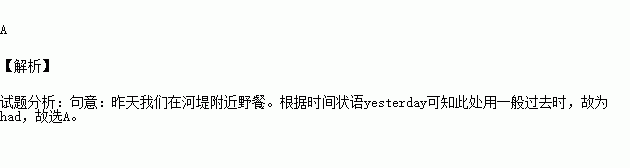
We ________ a picnic near the bank yesterday.
A. had B.has C. have D.having
People use their mouths for many things. They eat, talk, shout and sing. They smile and they kiss. In the English language, there are many expressions using the word mouth. But some of them are not so nice. For example, if you say bad things about a person, the person might protest(抗议; 反对) and say "Do not bad mouth me."
Sometimes, people say something to a friend or family member that they later regret (后悔)because hurts that person's feelings. Or they tell the person something they were not supposed to tell. The speaker might say: "I really put my foot in my mouth this time." If this should happen, the speaker might feel "down in the mouth." In other words, he might feel sad for saying the wrong thing.
Sometimes when one person is speaking, he says the same thing that his friend was going to say. When this happens, the friend might say: "You took the words right out of my mouth!"
Some people have lots of money because they were born into a very rich family. There is an expression for this, too. You might say such a person "was born with a silver(银子,银色的) spoon in his mouth."This rich person is the opposite of a person who lives "from hand to mouth." This person is very poor and only has enough money for the most important things in life, like food.
1.People can’t use their mouths to ______.
A. smell B. shout C. sing
2.You can say “______!” if you don’t want some people say bad things about you.
A. Down in the mouth
B. Don’t bad mouth me
C. Put foot in mouth
3.“I really put my foot in my mouth this time” means _______.
A. I have never done this thing
B. I want to do this thing
C. I regretted I had done the thing
4.When your friend took the words right out of your mouth, you can say “_______”.
A. I am very lucky
B. We have the same idea
C. I am very angry
5.If a person lives from hand to mouth, he must be very ______.
A. poor B. rich C. happy
-- What does your best friend look like, Lily?
-- She has long hair, but my hair is much than __________.
A. long; she
B. longer; hers
C. longer; her
The temperature in Beijing is ________ from Shanghai.
A. different B. same
C. far D. coming
Bill is _______ kind boy. He always helps others.
A. such a B. a such
C. So a D. a so
______ a cold,snowy day it is!
A. What B.How C. Which D.Where
句型转换 按括号内的要求转换下列句型,每空填一词。
1.Both of the twins like mooncakes with eggs in it. (改为否定句)
____ of the twins ____ mooncakes with eggs in it.
2.He set the alarm clock for seven. (改为一般疑问句)
____ he ____ the alarm clock for seven?
3.“Do they want fried chicken?”He asked the boys. (连成一个含宾语从句的句子)
He asked the boys ____ they ____ fried chicken.
4.You have done hard work. (变感叹句) __________ hard you have done!
5.We can finish the job in half an hour (改为被动语态)
The job can _____ ______ in half an hour.
People must_____ down too many trees.
A. stop to cut B. stop from cutting
C. be stopped from cutting D. be stopped to cut
They are talking ________ my parents _______ my study.
A. with to B. to with
C. with about D. about with

 天天练口算系列答案天天练口算系列答案