题目内容
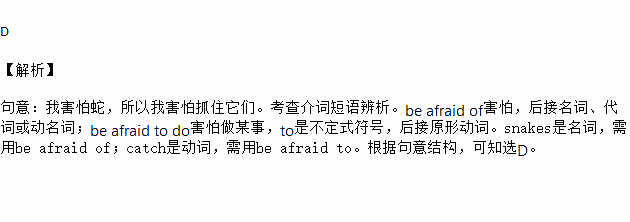
I am afraid_______ snakes so I’m afraid _____ catch them.
A. to; to B. to; of C. of; of D. of; to
Yesterday Li Ming went to the village ________ he visited five years ago.
A. where B. who C. that D. whom
Never forget to visit_______ when you go to the USA, Lin Tao.
A. the Statue of Liberty B. the Leaning Tower of Pisa
C. the Little Mermaid D. the Tower Bridge
-_______?
-Yes. This is Kitty speaking.
A. What's your name B. May I speak to Kitty '
C. Who are you D. Who calls you, Kitty
Which of the following words has the stress on the second syllable(音节)?
A. expensive B. palace C. Halloween D. capital
We may know that there are four basic periods for human beings to pass through when you enter and live in another country. This process (变化过程) helps you deal with culture shock (文化冲击).
Culture shock begins with the “honeymoon period”: This is the time when you first arrive in a place where everything about the new cu1ture is strange and exciting. You see new things, hear new sounds and language, eat new kinds of food. This period can last for quite a long time because you feel very happy.
Unluckily, the second period can be more difficu1t. After you have got used to your new life, you can become very uncomfortable and begin to miss your motherland, your family, your friends, your pets and so on. Al1 the little prob1ems in life seem to be much bigger and more worrying when you face them in a foreign country. This period can be very difficult and lead to moving backwards quickly.
The third period is called the “adjustment period”. This is when you begin to realize that things are not so bad in the new country. Your sense of humor usually becomes stronger and you realize you are becoming stronger by 1earning to take care of yourself in the new place. Things are still difficult, but you are now a survivor.
The fourth period can be cal1ed “at ease at last”. Now you feel quite comfortable in your new place. You can deal with most problems that you have. You may still have prob1ems with language, but you know you are strong enough to deal with them. At this time, you may feel a little uncomfortable if you go back to your motherland.
1.According to the passage, culture shock usually happens when you ______.
A. get married to a foreigner B. live in a big city
C. go to live in a foreign country D. meet foreigners in your motherland
2.During the first period of the process, you feel ______.
A. sad and lonely B. happy and excited
C. angry but strong D. easy but uncomfortable
3.According to the passage, the meaning of adjustment in the fourth paragraph is______.
A. 攻击 B. 调整 C. 重视 D. 扩大
4.If you organize a party without difficulties and enjoyed the good time with your buddies in the USA, you are probably in ______.
A. the lst period B. the 2nd period
C. the 3rd period D. the 4th period
5.We can conclude from the passage that ______.
A. living in another country is fun
B. it’s boring to live in another country
C. knowing about culture shock is hard
D. it’s not easy to dea1 with culture shock
—I spent the whole night preparing for my exam.
—Don't stay up too late, or you will be tired out. Remember, .
A. it never rains but it pours
B. you can't burn the candle at both ends
C. you can't put all your eggs in one basket
D. the grass is always greener on the other side
Tom and his cousin took a boat trip. When they got on the boat, every passenger(乘客) should answer the keeper a question. If the passenger answered “yes”, he or she got one gift; if the passenger answered “no”, he or she got two gifts. Tom and his cousin saw all about this. Now it was their turn. The keeper came up to them and asked, “Are you______?” Tom wanted to get two gifts, so he answered “no” loudly, at the same time he said, “I have never been a sailor, how could I be a good sailor.” The keeper gave him two gifts. His cousin gave the same answer, so, he got two gifts too.
The boat started off. The passengers began to open their gifts. Tom and his cousin did the same. They found that one of the two gifts was a small bottle of drinking water, the other was a seasick tablet (晕船药). Tom had a look at a “yes”-passenger’s gift. His was a nice chocolate. Tom shouted at the keeper, “We are never seasick. Why do you give us seasick tablets?”
1.Tom and his cousin ________.
A. went to eat chocolate
B. went on a trip by boat
C. worked for the keeper
D. needed a bottle of drinking water
2.When did the keeper ask the passengers questions?
A. Before the trip. B. After the trip.
C. During the trip. D. Never.
3.Why did Tom and his cousin answer “no”?
A. Because they felt sick on the boat.
B. Because they were good sailors.
C. Because they both wanted to get two gifts.
D. Because they wanted to have chocolate.
4.The underlined(下划线) part “a good sailor” means ________.
A. 晕船 B. 不晕船
C. 好销售员 D. 好水手
5.Which of the following statements is true?
A. The keeper cheated (欺骗) Tom and his cousin.
B. Tom and his cousin didn’t understand the question.
C. All the other passengers answered “yes”.
D. The keeper didn’t want to give Tom and his cousin chocolate
The man ______in 1988. He _______ for 30 years.
A. died, was dead B. died, has been dead
C. was dead, has died D. was dead, has been dead