题目内容

阅读理解

Mr.Whitcomb Judson was a really clever man.He invented a special train that was pushed along by air and in 1893 he invented something like a zip(拉链)that could be used to open and close clothes.It could be used on men’s trousers and on ladies’ dresses.He did not call his invention a ‘zip’ but everybody says that he was the ‘Father of the Zip’.Mr.Judson tried to sell his invention but no one wanted it because it did not work very well.A Canadian changed Mr.Judson’s invention and made it better.He made a zip that worked very well in 1913.This is the same zip we use today.

(1)

Mr.Whitcomb Judson was a _________ man.

[  ]

A.

kind

B.

lazy

C.

clever

D.

foolish

(2)

Mr.Whitcomb Judson invented _________ in 1893.

[  ]

A.

a special train

B.

something like a zip

C.

a washing machine

D.

a special car

(3)

A zip can be used to _________.

[  ]

A.

open clothes

B.

close clothes

C.

open and close clothes

D.

make clothes

(4)

A _________ man changed Mr.Judson’s invention and made it better.

[  ]

A.

Chinese

B.

Canadian

C.

German

D.

Japanese

(5)

_________ was called “Father of Zip”.

[  ]

A.

Mr.Whitcomb Judson

B.

The Canadian

C.

Whitcomb’s father

D.

Whitcomb’s son

答案:1.C;2.B;3.C;4.B;5.A;
解析:

(1)

细节理解题 根据第一句“Mr.Whitcomb Judson was a really clever man.”。可知。

(2)

细节理解题 根据第二句“In 1893 he invented something like a zip that could be used to open and close clothes.”。可知。

(3)

细节理解题 根据第二句“In 1893 he invented something like a zip that could be used to open and close clothes.”。可知。

(4)

细节理解题 根据倒数第三句“A Canadian changed Mr Judson' s invention and made it belter.”可知。

(5)

细节理解题 根据第四句“He did not call his invention a 'rip' but everybody says that he was the 'Father of the Zip'.”可知。


练习册系列答案
相关题目

阅读理解

  Ben Jones was walking home from school one day when he saw a black cat.It was walking across the srteet in front of him.Ben stopped, turned around, and walked down a different srteet to go home.Why did he do that?

  “It's unluchy when a black cat crosses the street in front of you, ”says Ben, “I did not want to walk down that street!”

  Many people think that some things bring bad luch of good luck.For example, some people think that 13 is an unlucky number.They never invite 13 people to a party.

  “I never walk under a ladder(梯子), ”says Ben.“And I never open an umbrella inside the house.They both bring bad luck.”

  And what brings good luck?“We have a horseshoe over the front door of our house for good luck, ”says Ben.

  “And when I find a peney on the ground, I always pick it up.That brings me good luck all day!”

(1)

Why did Ben turn aroundd when he saw the black cat crossing the street?

[  ]

A.

Because he thought it was unlucky.

B.

Because he disliked a black cat.

C.

Because he was afraid of the cat.

(2)

In western countries, which number do some people think is unlucky?

[  ]

A.

4.

B.

10.

C.

13.

(3)

Which of the following things can bring people good luck?

[  ]

A.

Opening an umbrella inside the house.

B.

Walking under a ladder.

C.

Picking up a penny on the ground.

(4)

Where does Ben's family have a horseshoe?

[  ]

A.

Over the front door.

B.

Inside the house.

C.

Under a ladder.

(5)

Which is the best title of the passage?

[  ]

A.

A black cat.

B.

Good luck and bad luck.

C.

Good things can bring good luck.

请阅读下面短文,根据短文内容从每小题所给的A、B、C、D四个选项中选出最佳选项

  A young girl called Ida in Sweden decided to travel to a place she hadn't seen for 22 years.She had a happy life until some kids asked, "Why don't you look like your room?" Ida was sent to her adopted(收养)family in Sweden right after she was born.She really didn't know anything about her birthplace, Korea, except for some information she recently heard about her birthparents.

  During her schooldays, she was often questioned about her looks.Ida considered herself a normal Swedish person.She tried to be part of the group in her school, but she found it hard.She was still seen as an outsider.

  As she grew older, she accepted(接受)who she was.Still, she wanted to find the missing piece of the puzzle(困惑).After finding out the place of her birthparents, Ida went to Korea in 2008.When she first arrived, she was surprised to see so many people who looked like her.However, apart from her looks, not much could be shared(分享)with others.She knew little about the culture, food, especially the language.Being in Korea wasn't always easy for her.

  Perhaps Ida can never truly fit in either culture, but it's worth visiting her birthplace because she finally realized how special and different she is.She has two loving families, and most of all a better understanding of who she is.This helps her to have a positive view of her life.

(1)

Where was Ida born?

[  ]

A.

In Japan.

B.

In Sweden.

C.

In England.

D.

In Korea.

(2)

Why was she seen as an outsider in Sweden?

[  ]

A.

Because of the culture.

B.

Because of her looks.

C.

Because of the food.

D.

Because of the language.

(3)

What does the phrase "apart from" in Paragraph 3 mean?

[  ]

A.

except

B.

as for

C.

as well as

D.

besides

(4)

What can we learn from the passage?

[  ]

A.

Ida hadn't seen her birthparents for at least 22 years.

B.

Ida found it easy for her to get used to living in Korea.

C.

Ida still couldn't accept who she was after she went back to Sweden.

D.

Ida realized she can't live a happy life either in Sweden or in Korea.

阅读理解

  A man came home from work late, tired, to find his 5-year-old son waiting for him at the door.

  “Daddy, how much money do you make each hour?”

  “If you must know, I make $20 each hour.”

  “Oh,” the little boy answered, with his head down.He thought for a moment, looked up and said, “Daddy, could you lend me $10?”

  The father was furious, “If you asked for the money to buy a toy or some other rubbish, the go straight to your room and think about why are you so selfish(自私)!”

  The little boy went to his room no words and shut the door.After a short while, the father calmed(平静)down, and started to think, “Maybe he really needs to buy something and he didn’t really ask for money very often.” So he went to the little boy’s room.

  “Sorry!Maybe I was too hard on your just now.” said the man, “Here’s $10.”

  “Oh, thank you Daddy!” he said happily.Then the boy took out some coins.When the father found that the boy already had money, he got angry again.

  “Why do you want more money since you already have some?” the father shouted angrily.

  “Because I didn't have enough, but now I do.” The little boy replied, “Daddy, I have $20 now.Can I buy one hour of your time? Please come home early tomorrow.I would like to have dinner with you.”

(1)

How much does the boy’s father make one hour?

[  ]

A.

$10

B.

$20

C.

$30

D.

$40

(2)

In this passage, the underlined word “furious” means ________.

[  ]

A.

very angry

B.

quite happy

C.

too excited

D.

a little nerous

(3)

At first, the father refused to lend the money because ________.

[  ]

A.

he thought the boy wanted to keep the money for himself.

B.

he did not have enough money at that moment

C.

the thought the boy would buy something of no use

D.

the boy always borrowed the money from him

(4)

The boy wanted to buy ________ with twenty dollars.

[  ]

A.

a new novel for himself

B.

a nice present for his father

C.

a toy for his own birthday

D.

one hour of his father’s time

(5)

From the passage, we can infer that the boy’s father ________.

[  ]

A.

often played with his son

B.

spent little time with his son

C.

didn’t love his son at all

D.

often came home early

阅读理解

  Here are two stories from different parts of the world.They seem strange but, believe it or not, they re all true!

  John Lee was an Englishman who refused to be hanged! In 1884 the police said Lee had killed an old woman who he used to work with.There was nothing to show that Lee had killed the woman.Lee told the police he hadn't done it, but no one believed him and he was going to be hanged.On the day of the hanging, however, the door in the floor, through which Lee's body would fall, did not open.They tried three times but each time the door stayed closed, even though it had worked well the day before.In the end they sent Lee back to prison, where he lived for the next twenty-two years.At all times, John Lee said he hadn't killed the woman, and he believed it was the "hand of God" that had saved him from death by hanging.

  The police in Venezuela(委内瑞拉)in South America followed a man home one night.He was the thief they wanted to catch.However, half of his house was standing in Venezuela and the other half was standing in Colombia(哥伦比亚).Venezuela's neighbor.When the police entered the house, the man ran upstairs to his bedroom, which was in Colombia, and called his lawyer(律师).The Venezuelan police were not allowed to enter Colombia so they could not enter the bedroom.They asked the police in Colombia to help.The Colombian police refused to help because the man's crime(罪行)was not a crime in Colombia.In the end, the Venezuelan police gave up and went back to the police station.

(1)

The underlined(下划线)word "hanged" in this passage probably means _________.

[  ]

A.

shut in a room

B.

questioned by the police

C.

killed by putting a rope around the neck

D.

kept in a place

(2)

What do we1 know about the door in the floor?

[  ]

A.

It had opened the day before the hanging.

B.

It had been broken a long time.

C.

After three times, it opened.

D.

John Lee's dead body fell through it.

(3)

From the story we know that the thief's bedroom was _________.

[  ]

A.

in Venezuela

B.

in Colombia

C.

in neither Venezuela nor Colombia

D.

in both Venezuela and Colombia

(4)

Why didn't the Venezuelan police go into the man's bedroom?

[  ]

A.

They didn't know where it was.

B.

The Venezuelan police were not allowed to enter Colombia.

C.

The police in Colombia told them that(hey would help.

D.

The police in Colombia told them not to go inside.

(5)

The police in Colombia didn't help the police in Venezuela to catch the thief because _______

[  ]

A.

they didn't know where he was

B.

the police in Venezuela didn’t ask for help

C.

the man's lawyer told them not to help

D.

the man's crime was not a crime in Colombia

阅读理解

  Children arc children after all, and most of them speak their mind.When they are just toddlers(幼儿), they are all lovely and lively.And it's so interesting to watch them speak like a grown-up.But as they grow, these same kids seem annoying and ill-mannered if they try to be a grown-up.

  Conflicts(矛盾)go between parents and children.It's hard to tell who are right and who are wrong.A child of 7-8 always finds some reasons to have a conflict with it's parents.Whether it is about some toy, studies, a party or a company, there is always a difference between them.And it becomes worse when they answer you back.Scientists tell us that children should be treated with care.Yes, sure they should respect their elders.

  We are partly responsible(有责任的)for this.At an early age we encourage children to behave like adults, just because we find it funny.The kids on the other hand consider this same behavior as normal and get used to it.And when it is not funny for us any more, we expect them to stop it, but by then it is already too late.Only when they reach a certain maturity will the children realize that answering back and being rude are not acceptable(可接受的).Until then, most of the time their behavior is difficult to change, unless by force(暴力).And use of force is against the every good idea, as it weakens the child's confidence.

  So it is one thing to bring a child into this world but quite another to make them into well mannered citizens.The best way is to be a good example ourselves, as our children are the mirrors of us adults.

(1)

________ are all lovely and lively.

[  ]

A.

Children

B.

Toddlers

C.

Kids

D.

Grown-ups

(2)

There are many conflicts between ________.

[  ]

A.

fathers and mothers

B.

parents and children

C.

parents and toddlers

D.

parents and parents

(3)

The underlined word "maturity" means ________.

[  ]

A.

学期

B.

阶梯

C.

知识

D.

成熟

(4)

Which is acceptable according to the passage?

[  ]

A.

Answering back.

B.

Being rude.

C.

Using force.

D.

Respecting elders.

(5)

Which of the following is true?

[  ]

A.

Children often copy what their parents do.

B.

Children can not change their behavior.

C.

Children's behavior develops in their own way.

D.

Children's behavior is not acceptable.

(6)

The writer wrote the passage ________.

[  ]

A.

to show the importance of good examples

B.

to give examples on educating children

C.

to show the growth of children

D.

to show the behavior of children

阅读理解

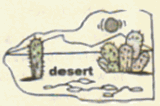
  A desert is a very dry land where there is hardly any rain.In the day, it can be so hot that you could fry an egg on the ground.But during the night it is sometimes so could that water would turn into ice.

  Many desserts are covered in sand.But some have mountains, rocks, or lakes that have dried up in the heat.The Great American Dessert has cliffs(悬崖)that have been made into amazing and beautiful shapes by the wind.The Sahara Desert in Africa is mostly sand.The Australian Desert has red sand.

  Sometimes it does not rain for a whole year in the desert.But there is water deep under the ground and some plants have roots that go very deep to find it.Other plants have roots that spread out(延伸)a long way so they can suck up the rain as soon as it falls.

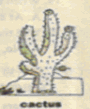
  One desert plant is the cactus, which has long, spreading roots.The cactus stores water inside its hard skin.This skin protects it from heat and cold.

  Camels are a bit like cactus plants! They store water too-inside their bodies.They have special fur which protects them from the sun during the day and keeps them warm at night.

  Some other animals live in deserts, too.They have to be very good at seeing and hearing because most of them only come out at night.This is why many desert animals have extra big eyes or ears.

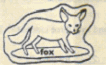
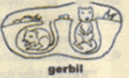
  A desert fox has bigger ears than a normal for.A gerbil has huge eye, so that it can see at night.It stays cool in the day by staying underground, like most desert animals.

  Some people live in the desert but they always make their homes near an oasis.An oasis is where water comes from an underground river.Near an oasis, people can grow lots of plants and keep animals.

  Life is hard in the desert, for people, animals and plants.But desert people like to live there.

(1)

A desert is very dry because __________.

[  ]

A.

it is sandy

B.

there is so little rain

C.

the wind is strong

D.

there is no water deep under the ground

(2)

What does the underlined phrase"suck up"in paragraph 3 mean __________?

[  ]

A.

围堵

B.

讨好

C.

释放

D.

吸收

(3)

Some desert animals have extra big eyes or ears because __________.

[  ]

A.

the sunlight is too strong in the day

B.

they need to see and hear well at night

C.

it is very cold at nigh

D.

they store water in them.

(4)

Most desert animals stay cool in the day by __________.

[  ]

A.

storing water in side their bodies

B.

drinking water as much as they can

C.

staying underground

D.

growing lots of plants

(5)

Which of the following is true?

[  ]

A.

Desert people like to live in the desert though life is hard.

B.

People in the desert usually fry eggs on the ground.

C.

Camels have special fur to store water.

D.

All the deserts are covered in sand.

阅读理解

  At a nation’s saddest moment, its greatest heroes are born.

  On September 11th, 2001, many police officers and government officials in America worked day and night to save lives from the big fire at the World Trade Centre.And in Japan, after the serious earthquake, a group of workers showed their courage.

  The earthquake on March 11th made Fukushima Nuclear Power Plant(福岛核电站)turn off and stop its protective cooling systems.And later, a fire broke out.Workers were told that the plant’s radiation(辐射)could be harmful to human health.Hundreds of workers left the plant quickly.However, a group of workers decided to fight against the fire and the damage, though they knew it could cause very serious health problems.There were 50 workers in all, so they were also named the "Fukushima 50".The workers worked in shifts(轮班).

  People knew little about the workers, who were mainly experts(专家)with the skills to control the situation.One woman said that her father had volunteered to stay there.“I heard that he volunteered even though he would retire(退休)in just half a year and my eyes were filled with tears.I am really proud of him.And I pray for his safe return.”

(1)

The passage mainly tells us _________

[  ]

A.

what happened in America on September 1lth, 2001

B.

"Fukushima 50" stayed in the nuclear power plant bravely

C.

who saved many lives from the big fire at the World Trade Centre

D.

what Japanese government did after the nuclear power plant was turned off

(2)

Fukushima Nuclear Power Plant was turned off because ________

[  ]

A.

there were no heroes there

B.

many workers left the plant

C.

it was destroyed by a big fire

D.

the earthquake damaged it heavily

(3)

workers stayed in Fukushima Nuclear Power Plant after the earthquake.

[  ]

A.

11

B.

50

C.

100

D.

150

(4)

Which of the following is TRUE?

[  ]

A.

The woman was happy to know his father was there.

B.

A woman’s father who had retired from work still stayed there.

C.

Little was known about the workers when the passage was written.

D.

The workers didn’t know staying in the nuclear plant was harmful to their health.

(5)

The writer thinks _________

[  ]

A.

American police officers were very strong

B.

the nuclear radiation would do no damage to humans

C.

all the workers who stayed in the plant should return quickly

D.

all the workers who stayed in the plant are great heroes

违法和不良信息举报电话:027-86699610 举报邮箱:58377363@163.com

精英家教网