【题目】阅读短文,根据短文内容回答问题

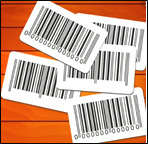
We see them everywhere — on boxes of food, on packages and on CDs. They, of course, are bar codes. The invention of bar codes has changed the way we shop and how companies learn where their products are.

It was two university students from America, Bernard Silver and Norman Woodland, who first got theidea of bar codes. In 1948, they heard that the president of a food company was looking for a way to easily get information about what was being sold to customers. They tried to help by using a code system. They invented a large electronic reader to read the codes. However, computers couldn’t easily record the data that was read.

Then, in the 1960s, David Collins made important developments in bar codes. He developed a system for recognizing train carriages. In order to develop the recognition system for other kinds of businesses, Collins started his own company. In 1969, Collins’s company put a bar code reading system in a car factory, showing that bar codes could be useful.

Shortly after Collins started his company, an American electronic company called RCA also saw the potential (潜力) of bar codes to help businesses. RCA’s

system, which recorded how much of a product was sold, was not perfect. Since bar codes were not common, not all products had them and different companies used different codes. Then, Woodland helped develop the Universal Product Code (UPC), which gave every product a code that included information about the manufacturer and the kind of product being sold. This made bar codes much more practical.

In addition to shops, hospitals use bar codes to recognize patients by giving them cards with bar codes on them. Libraries use bar codes to record which books have been lent, and airports use them to find out where bags are going. Bar codes have made life much easier and simpler.

1What changed the way we shop?

2Who first got the idea of bar codes?

3Why did Collins start his own company?

4What do hospitals use bar codes to do?

5What is the passage mainly about?

【题目】根据短文肉容.判断下列句子的正误。正确的用“T”.错误的用“F”(每小题1分.共5)

A long time ago. there was an emperor. He had a beautiful garden. In the garden, there was a little nightingale(夜莺) singing very beautifully.

One day the emperor heard about this little bird's beautiful voice. He asked his guards to bring her to him. As soon as the emperor heard the nightingale's voice, he said, "Put her in a golden cage, so she can stay and sing for me whenever I want to hear her. "

The little bird was so unhappy about being kept in the cage that she stopped singing one day. The emperor was very angry. He ordered the scientists in his palace to make a robot bird for him. The bird could sing very beautifully, too. The emperor was pleased.

Soon the robot bird became old. It no longer sang beautiful songs. Just at that time, the emperor became very weak. One morning, while lying in bed, the emperor wanted it to sing once again. But the robot bird couldn't sing any more. Suddenly the nightingale landed on the window. She began to sing her most beautiful song. The emperor was very happy! He became better and better each day.

After the emperor was wellhe changed a lot and became kind to his people. From then on, all his people cherished(爱戴) him for his love and kindness.

1Both the nightingale and the robot bird had a beautiful voice.

2The emperor kept the nightingale in a golden cage in order to hear her sing at any time.

3The nightingale was very happy after she was kept in the golden cage.

4The emperor was not satisfied with the robot bird at first.

5The emperor learnt from the nightingale what love and kindness was.

【题目】The Chinese used the abacus as early as the 2nd century BC, but now are welcoming“machine brains”to educate the young in this modern age.

For the young, e-learning seems so ________. Zhu Xufei, 12, uses her parents’ mobile phone to study English every day on her way to school and back home. Through an app, she can listen to and repeat back words and sentences in English. The app even tells the difference between her speech and proper pronunciation, and then ________ provides the score.

The mother of 12-year-old Zhu said,“The apps have enabled her to learn and practice spoken English anytime, anywhere,”she says.“The apps also have been designed to use games to encourage learning.”

It’s very popular nowadays, especially with parents. WeChat accounts of parents post progress reports every day on ________ their children are doing. For example,“Day 30: My son Thomas has learned 99 English words on Talking Pets.”

It’s not only children using mobile devices(设备)to learn new things. Many Metro or bus passengers can be seen with earplugs turned into app courses, like business management or the driving test.“I don’t have to ________ books around and turn pages on crowded buses,”an office lady says.“With just a touch of the screen on my smartphone, I can do practice tests whenever I have time. It also records my ________ and makes it easier for me to review them.”

E-learning has been welcomed among education services. Zheng Lili, owner of an English training school, says the learning apps help ________ better monitor the performances of students.

We believe that education should be‘whole-person’development and such devices are just support tools.

1A. strange B. difficult C. natural D. horrible

2A. immediately B. gently C. nearly D. secretly

3A. whether B. where C. why D. how

4A. borrow B. carry C. return D. deliver

5A. mistakes B. jobs C. photos D. interest

6A. bosses B. neighbours C. friends D. teachers

违法和不良信息举报电话:027-86699610 举报邮箱:58377363@163.com

精英家教网