
Decision-making can be extremely difficult. Decision-making styles are significantly different in different cultures.
In any approach to a problem and in any negotiations, the Western world turns to the“I to you” approach while Japan,the “you to you” approach. The former means both sides present their arguments openly from their own point of view. Naturally, often comes a confrontation(冲突) situation, which Westerners are very skillful in dealing with.The latter is based on each side trying to understand the other person’s point of view. Thus, the direction of the meeting is a mutual(相互的) attempt to reduce confrontation and achieve harmony.
Besides, Western decision-making goes mostly from top management(管理人员) and often does not consult middle management or the worker. However, in Japan great consideration is given to the thoughts and opinions of everyone at all levels. Based on “bottom-up direction”, ideas can be created at the lowest levels, travel upward through an organization and have an effect on the final decision.
Difference in decision-making also comes from different communication styles. The Japanese business person works to achieve harmony, even if the deal fallsthrough, and will spend whatever time is necessary to determine a “you to you” approach, communicating personal views only indirectly. They put a thorough job above the Western deadline approach. So the Japanese are thorough in their meetings. Thus Americans are often annoyed by the many meetings in many Japanese businesses. But where the American is pressingfor a specific decision, the Japanese is trying to think up a rather broad direction.
On the other hand, once a given agreement is made, it is the Japanese who sometimes wonderat the slow pace in which Westerners carry out the decision. The Japanese are eager to move forward and Westerners, perhaps, lag(落后)behind as they take the time for in-depth planning.
【小题1】 The text mainly tells us that Japan and the Western world .
【小题2】Which of the following is TRUE of the Westerners?
【小题3】The author’s attitude towards Japanese decision-making is .
In any approach to a problem and in any negotiations, the Western world turns to the“I to you” approach while Japan,the “you to you” approach. The former means both sides present their arguments openly from their own point of view. Naturally, often comes a confrontation(冲突) situation, which Westerners are very skillful in dealing with.The latter is based on each side trying to understand the other person’s point of view. Thus, the direction of the meeting is a mutual(相互的) attempt to reduce confrontation and achieve harmony.
Besides, Western decision-making goes mostly from top management(管理人员) and often does not consult middle management or the worker. However, in Japan great consideration is given to the thoughts and opinions of everyone at all levels. Based on “bottom-up direction”, ideas can be created at the lowest levels, travel upward through an organization and have an effect on the final decision.
Difference in decision-making also comes from different communication styles. The Japanese business person works to achieve harmony, even if the deal fallsthrough, and will spend whatever time is necessary to determine a “you to you” approach, communicating personal views only indirectly. They put a thorough job above the Western deadline approach. So the Japanese are thorough in their meetings. Thus Americans are often annoyed by the many meetings in many Japanese businesses. But where the American is pressingfor a specific decision, the Japanese is trying to think up a rather broad direction.
On the other hand, once a given agreement is made, it is the Japanese who sometimes wonderat the slow pace in which Westerners carry out the decision. The Japanese are eager to move forward and Westerners, perhaps, lag(落后)behind as they take the time for in-depth planning.
【小题1】 The text mainly tells us that Japan and the Western world .
| A.face great difficulty in making decisions |
| B.are different in decision-making styles |
| C.have all members contribute to a decision |
| D.have two approaches: “I to you” and “you to I” |
| A.They carry out the decision once it is made. |
| B.There are many meetings in their businesses. |
| C.They work to achieve harmony in doing business. |
| D.They are good at handling confrontation situation. |
| A.positive | B.critical | C.negative | D.casual(无所谓的) |
Decision-making can be extremely difficult. Decision-making styles are significantly different in different cultures.
In any approach to a problem and in any negotiations, the Western world turns to the“I to you” approach while Japan,the “you to you” approach. The former means both sides present their arguments openly from their own point of view. Naturally, often comes a confrontation(冲突) situation, which Westerners are very skillful in dealing with.The latter is based on each side trying to understand the other person’s point of view. Thus, the direction of the meeting is a mutual(相互的) attempt to reduce confrontation and achieve harmony.
Besides, Western decision-making goes mostly from top management(管理人员) and often does not consult middle management or the worker. However, in Japan great consideration is given to the thoughts and opinions of everyone at all levels. Based on “bottom-up direction”, ideas can be created at the lowest levels, travel upward through an organization and have an effect on the final decision.
Difference in decision-making also comes from different communication styles. The Japanese business person works to achieve harmony, even if the deal fallsthrough, and will spend whatever time is necessary to determine a “you to you” approach, communicating personal views only indirectly. They put a thorough job above the Western deadline approach. So the Japanese are thorough in their meetings. Thus Americans are often annoyed by the many meetings in many Japanese businesses. But where the American is pressingfor a specific decision, the Japanese is trying to think up a rather broad direction.
On the other hand, once a given agreement is made, it is the Japanese who sometimes wonderat the slow pace in which Westerners carry out the decision. The Japanese are eager to move forward and Westerners, perhaps, lag(落后)behind as they take the time for in-depth planning.
【小题1】 The text mainly tells us that Japan and the Western world .
【小题2】Which of the following is TRUE of the Westerners?
【小题3】The author’s attitude towards Japanese decision-making is .
In any approach to a problem and in any negotiations, the Western world turns to the“I to you” approach while Japan,the “you to you” approach. The former means both sides present their arguments openly from their own point of view. Naturally, often comes a confrontation(冲突) situation, which Westerners are very skillful in dealing with.The latter is based on each side trying to understand the other person’s point of view. Thus, the direction of the meeting is a mutual(相互的) attempt to reduce confrontation and achieve harmony.
Besides, Western decision-making goes mostly from top management(管理人员) and often does not consult middle management or the worker. However, in Japan great consideration is given to the thoughts and opinions of everyone at all levels. Based on “bottom-up direction”, ideas can be created at the lowest levels, travel upward through an organization and have an effect on the final decision.
Difference in decision-making also comes from different communication styles. The Japanese business person works to achieve harmony, even if the deal fallsthrough, and will spend whatever time is necessary to determine a “you to you” approach, communicating personal views only indirectly. They put a thorough job above the Western deadline approach. So the Japanese are thorough in their meetings. Thus Americans are often annoyed by the many meetings in many Japanese businesses. But where the American is pressingfor a specific decision, the Japanese is trying to think up a rather broad direction.
On the other hand, once a given agreement is made, it is the Japanese who sometimes wonderat the slow pace in which Westerners carry out the decision. The Japanese are eager to move forward and Westerners, perhaps, lag(落后)behind as they take the time for in-depth planning.
【小题1】 The text mainly tells us that Japan and the Western world .
| A.face great difficulty in making decisions |
| B.are different in decision-making styles |
| C.have all members contribute to a decision |
| D.have two approaches: “I to you” and “you to I” |
| A.They carry out the decision once it is made. |
| B.There are many meetings in their businesses. |
| C.They work to achieve harmony in doing business. |
| D.They are good at handling confrontation situation. |
| A.positive | B.critical | C.negative | D.casual(无所谓的) |
读图分析我国古代商业城市变化的主要原因有
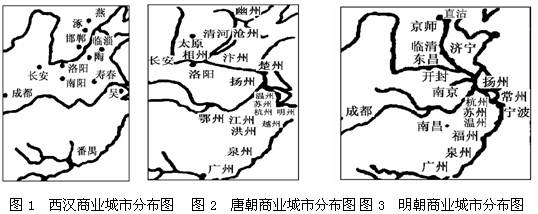
①经济重心南移,政治中心东移的推动
②人口南迁的影响
③南方自然条件优越、农业、手工业的发展商品经济的繁荣等
④封建统治者对南方商品经济采取宽松政策
①经济重心南移,政治中心东移的推动
②人口南迁的影响
③南方自然条件优越、农业、手工业的发展商品经济的繁荣等
④封建统治者对南方商品经济采取宽松政策
| A.①②③④ | B.①③④ | C.①②③ | D.②③④ |
读图分析我国古代商业城市变化的主要原因有
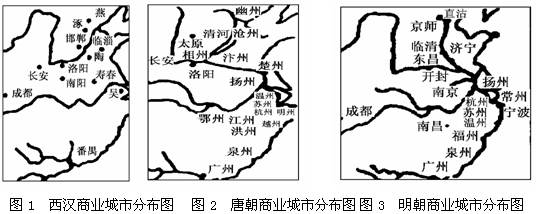
①经济重心南移,政治中心东移的推动
②人口南迁的影响
③南方自然条件优越、农业、手工业的发展商品经济的繁荣等
④封建统治者对南方商品经济采取宽松政策
①经济重心南移,政治中心东移的推动
②人口南迁的影响
③南方自然条件优越、农业、手工业的发展商品经济的繁荣等
④封建统治者对南方商品经济采取宽松政策
| A.①②③④ | B.①③④ | C.①②③ | D.②③④ |
完形填空 (共20小题;每小题1分,满分20分)
请认真阅读下面短文,从短文后各题所给的A、B、C、D四个选项中,选出最佳选项,并在答题卡上将该项涂黑。
Certainly dustmen prefer to be known as "Reuse Collection and Disposal Officers". You may think that this is rather 36 , and it is better to call a spade a spade. But dustmen can be as 37 as people of any other occupation, though we must 38 that their job is not a 39 one in the world. We often take dustmen for granted. Perhaps because they usually come very early in the morning, before most people are 40 .We are likely to forget their 41 .Our dustbins are 42 regularly, but we 43 stop to think about the men who do this. However, it is one of the most important jobs in the world, and when there are no dustmen to 44 the rubbish, the general 45 soon becomes aware that something is wrong. Recently, the dustmen of England went on strike for higher wages.
During the first few days it was regarded as a 46 .But when the first two weeks had passed, and the dustbins were overflowing in nearly every backyard in the country, the joke did not seem so 47 any more. 48 the strike continued, people could not 49 the hills of rubbish around their dustbins, and they looked for other places in which to 50 it. Even Leicester Square, in the heart of West End of London, was 51 high with plastic bags full of smelly rubbish. This was a(n) 52 attraction that the people of London were not at all 53 to see. Even when the strike was over, it took several weeks for the country to get cleaned up completely. Perhaps now the English people appreciate the work of 54 dustmen rather more 55 and won't take them for granted any more.
【小题6】.
【小题18】.
请认真阅读下面短文,从短文后各题所给的A、B、C、D四个选项中,选出最佳选项,并在答题卡上将该项涂黑。
Certainly dustmen prefer to be known as "Reuse Collection and Disposal Officers". You may think that this is rather 36 , and it is better to call a spade a spade. But dustmen can be as 37 as people of any other occupation, though we must 38 that their job is not a 39 one in the world. We often take dustmen for granted. Perhaps because they usually come very early in the morning, before most people are 40 .We are likely to forget their 41 .Our dustbins are 42 regularly, but we 43 stop to think about the men who do this. However, it is one of the most important jobs in the world, and when there are no dustmen to 44 the rubbish, the general 45 soon becomes aware that something is wrong. Recently, the dustmen of England went on strike for higher wages.
During the first few days it was regarded as a 46 .But when the first two weeks had passed, and the dustbins were overflowing in nearly every backyard in the country, the joke did not seem so 47 any more. 48 the strike continued, people could not 49 the hills of rubbish around their dustbins, and they looked for other places in which to 50 it. Even Leicester Square, in the heart of West End of London, was 51 high with plastic bags full of smelly rubbish. This was a(n) 52 attraction that the people of London were not at all 53 to see. Even when the strike was over, it took several weeks for the country to get cleaned up completely. Perhaps now the English people appreciate the work of 54 dustmen rather more 55 and won't take them for granted any more.
| 【小题1】 |
|
| 【小题2】 |
|
| 【小题3】 |
|
| 【小题4】 |
|
| 【小题5】 |
|
| A.existence | B.presence | C.absence | D.performance |
| 【小题7】 |
|
| 【小题8】 |
|
| 【小题9】 |
|
| 【小题10】 |
|
| 【小题11】 |
|
| 【小题12】 |
|
| 【小题13】 |
|
| 【小题14】 |
|
| 【小题15】 |
|
| 【小题16】 |
|
| 【小题17】 |
|
| A.disappointed | B.serious | C.nervous | D.happy |
| 【小题19】 |
|
| 【小题20】 |
|
Dr. Glenn Tisman, a cancer specialist, knew his young neighbor, Ray Bateman, had an unusual mind. But he had no idea at the time that 12 - year – old Ray had the ability to become his partner in cancer research.
Ray’s parents remembered that at age four, Ray surprised them by fixing a broken vacuum cleaner(吸尘器). When he was ten, he speedily constructed the family color television from a kit. Later, he succeeded in assembling(组装) a complex stereo system after two experts had failed to do the job.
When Ray was ten, he convinced his parents to buy him a computer. In a short time, Ray was able to do amazing things with the computer. Ray shared his enthusiasm for computers with Dr. Tisman, who used a computer for his research. The two discussed computers and medicine frequently. Amazingly, Ray understood the biology and chemistry related to Dr. Tisman’s medical research without any previous instruction.
Ray then worked with Dr. Tisman after school. He helped conduct research with the equipment and kept it in working order. The purpose of the research was to test the effectiveness of mixing an old cancer drug with certain vitamins. Ray analyzed patient test results by computer, while Dr. Tisman handled all patient contact. Together, they came up with solid research that helped advance cancer treatment.
In 1988, 14 - year - old Ray went with Dr. Tisman to a meeting of the American Federation for Clinical Research(AFCR), where Ray presented their initial research findings. Using terminology(术语) beyond the grasp of most kids his age, Ray told the scientists how the new drug mixture caused fewer and milder side effects for cancer patients.
A year later, Ray returned to the meeting to update the findings of his and Dr. Tisman’s research. By then, he had become well - known for his devotion to finding cures for sick patients. Stories about him appeared in hundred of newspapers around the world. He appeared on television newscasts and talk shows.
Ray continued to spend most free hours working with Dr. Tisman. The two began studying the effects of vitamins on babies inside the womb(子宫). However, Ray’s main interest remained cancer treatment, and he continues his research today.
【小题1】According to the passage, Ray______.
【小题2】What do we know about Dr. Tisman?
【小题3】What made Ray first known to the medical world?
【小题4】Dr. Tisman’s research is aimed at ______.
Ray’s parents remembered that at age four, Ray surprised them by fixing a broken vacuum cleaner(吸尘器). When he was ten, he speedily constructed the family color television from a kit. Later, he succeeded in assembling(组装) a complex stereo system after two experts had failed to do the job.
When Ray was ten, he convinced his parents to buy him a computer. In a short time, Ray was able to do amazing things with the computer. Ray shared his enthusiasm for computers with Dr. Tisman, who used a computer for his research. The two discussed computers and medicine frequently. Amazingly, Ray understood the biology and chemistry related to Dr. Tisman’s medical research without any previous instruction.
Ray then worked with Dr. Tisman after school. He helped conduct research with the equipment and kept it in working order. The purpose of the research was to test the effectiveness of mixing an old cancer drug with certain vitamins. Ray analyzed patient test results by computer, while Dr. Tisman handled all patient contact. Together, they came up with solid research that helped advance cancer treatment.
In 1988, 14 - year - old Ray went with Dr. Tisman to a meeting of the American Federation for Clinical Research(AFCR), where Ray presented their initial research findings. Using terminology(术语) beyond the grasp of most kids his age, Ray told the scientists how the new drug mixture caused fewer and milder side effects for cancer patients.
A year later, Ray returned to the meeting to update the findings of his and Dr. Tisman’s research. By then, he had become well - known for his devotion to finding cures for sick patients. Stories about him appeared in hundred of newspapers around the world. He appeared on television newscasts and talk shows.
Ray continued to spend most free hours working with Dr. Tisman. The two began studying the effects of vitamins on babies inside the womb(子宫). However, Ray’s main interest remained cancer treatment, and he continues his research today.
【小题1】According to the passage, Ray______.
| A.is a boy of many gifts |
| B.is very helpful to his parents |
| C.learned fast under Dr. Tisman’s instruction |
| D.stopped working with Dr. Tisman after his success |
| A.He succeeded in finding cures for cancer. |
| B.He made a new discovery in cancer treatment. |
| C.He convinced Ray to become a partner of him. |
| D.He taught Ray knowledge related to his research. |
| A.His presentation at AFCR. | B.His great skills in computer. |
| C.His devotion to cancer research. | D.His appearance on television newscasts. |
| A.providing different cancer treatments |
| B.proving the effects of vitamins on babies |
| C.finding the side effects of a cancer drug |
| D.testing the effectiveness of a new drug mixture |
Dr. Glenn Tisman, a cancer specialist, knew his young neighbor, Ray Bateman, had an unusual mind. But he had no idea at the time that 12 - year – old Ray had the ability to become his partner in cancer research.
Ray’s parents remembered that at age four, Ray surprised them by fixing a broken vacuum cleaner(吸尘器). When he was ten, he speedily constructed the family color television from a kit. Later, he succeeded in assembling(组装) a complex stereo system after two experts had failed to do the job.
When Ray was ten, he convinced his parents to buy him a computer. In a short time, Ray was able to do amazing things with the computer. Ray shared his enthusiasm for computers with Dr. Tisman, who used a computer for his research. The two discussed computers and medicine frequently. Amazingly, Ray understood the biology and chemistry related to Dr. Tisman’s medical research without any previous instruction.
Ray then worked with Dr. Tisman after school. He helped conduct research with the equipment and kept it in working order. The purpose of the research was to test the effectiveness of mixing an old cancer drug with certain vitamins. Ray analyzed patient test results by computer, while Dr. Tisman handled all patient contact. Together, they came up with solid research that helped advance cancer treatment.
In 1988, 14 - year - old Ray went with Dr. Tisman to a meeting of the American Federation for Clinical Research(AFCR), where Ray presented their initial research findings. Using terminology(术语) beyond the grasp of most kids his age, Ray told the scientists how the new drug mixture caused fewer and milder side effects for cancer patients.
A year later, Ray returned to the meeting to update the findings of his and Dr. Tisman’s research. By then, he had become well - known for his devotion to finding cures for sick patients. Stories about him appeared in hundred of newspapers around the world. He appeared on television newscasts and talk shows.
Ray continued to spend most free hours working with Dr. Tisman. The two began studying the effects of vitamins on babies inside the womb(子宫). However, Ray’s main interest remained cancer treatment, and he continues his research today.
【小题1】According to the passage, Ray______.
【小题2】What do we know about Dr. Tisman?
【小题3】What made Ray first known to the medical world?
【小题4】Dr. Tisman’s research is aimed at ______.
0 65665 65673 65679 65683 65689 65691 65695 65701 65703 65709 65715 65719 65721 65725 65731 65733 65739 65743 65745 65749 65751 65755 65757 65759 65760 65761 65763 65764 65765 65767 65769 65773 65775 65779 65781 65785 65791 65793 65799 65803 65805 65809 65815 65821 65823 65829 65833 65835 65841 65845 65851 65859 235360
Ray’s parents remembered that at age four, Ray surprised them by fixing a broken vacuum cleaner(吸尘器). When he was ten, he speedily constructed the family color television from a kit. Later, he succeeded in assembling(组装) a complex stereo system after two experts had failed to do the job.
When Ray was ten, he convinced his parents to buy him a computer. In a short time, Ray was able to do amazing things with the computer. Ray shared his enthusiasm for computers with Dr. Tisman, who used a computer for his research. The two discussed computers and medicine frequently. Amazingly, Ray understood the biology and chemistry related to Dr. Tisman’s medical research without any previous instruction.
Ray then worked with Dr. Tisman after school. He helped conduct research with the equipment and kept it in working order. The purpose of the research was to test the effectiveness of mixing an old cancer drug with certain vitamins. Ray analyzed patient test results by computer, while Dr. Tisman handled all patient contact. Together, they came up with solid research that helped advance cancer treatment.
In 1988, 14 - year - old Ray went with Dr. Tisman to a meeting of the American Federation for Clinical Research(AFCR), where Ray presented their initial research findings. Using terminology(术语) beyond the grasp of most kids his age, Ray told the scientists how the new drug mixture caused fewer and milder side effects for cancer patients.
A year later, Ray returned to the meeting to update the findings of his and Dr. Tisman’s research. By then, he had become well - known for his devotion to finding cures for sick patients. Stories about him appeared in hundred of newspapers around the world. He appeared on television newscasts and talk shows.
Ray continued to spend most free hours working with Dr. Tisman. The two began studying the effects of vitamins on babies inside the womb(子宫). However, Ray’s main interest remained cancer treatment, and he continues his research today.
【小题1】According to the passage, Ray______.
| A.is a boy of many gifts |
| B.is very helpful to his parents |
| C.learned fast under Dr. Tisman’s instruction |
| D.stopped working with Dr. Tisman after his success |
| A.He succeeded in finding cures for cancer. |
| B.He made a new discovery in cancer treatment. |
| C.He convinced Ray to become a partner of him. |
| D.He taught Ray knowledge related to his research. |
| A.His presentation at AFCR. | B.His great skills in computer. |
| C.His devotion to cancer research. | D.His appearance on television newscasts. |
| A.providing different cancer treatments |
| B.proving the effects of vitamins on babies |
| C.finding the side effects of a cancer drug |
| D.testing the effectiveness of a new drug mixture |