网址:http://m.1010jiajiao.com/timu3_id_3074721[举报]
A. Eco-tourism Creates a False Impression
B. Merits and Demerits of Eco-tourism
C. Doubts about Benefits of Eco-tourism
D. Eco-tourism Leads to Romantic Destruction
E. Eco-tourism Is Environmentally Risky
F. No Local Benefits from Eco-tourism
【小题1】_____________________________________
The trend towards eco-tourism holidays, presented as sustainable, nature-based and environmentally friendly, is now subject to considerable controversy. Governments as well as the tourism industry promote eco-tourism, resulting in an estimated world-wide annual growth of 10-15%, with its claims of economic and social sensitivity. But there are well-founded concerns that it lacks adequate scientific foundations, and is not practicable as a solution to the world’s social and environmental problems.
【小题2】_____________________________________
Many eco-tourism claims concerning its benefits are exaggerated, or owe more to labelling and marketing than genuine sustainability. Not only are such projects repeatedly planned and carried out without local approval and support, but they often threaten local cultures, economies, and natural resource bases. Critics regard eco-tourism as an “eco-façade”---a strategy concealing the mainstream tourism industry’s consumptive and exploitative practices by “greening” it.
【小题3】_____________________________________
Eco-tourism may have some advantages, but one of its most serious impacts is the expropriation(征用) of` “virgin” territories---national parks, wildlife parks and other wilderness areas---which are packaged for eco-tourists as the green option. Eco-tourism is highly consumer-centered, catering mostly to urbanised societies and the new middle-class “alternative lifestyles”. Searching for untouched places “off the beaten track” of mass tourism, travellers have already opened up many new destinations.
Mega-resorts, including luxury hotels, condominiums(公寓), shopping centres and golf course, are increasingly established in nature reserves in the name of eco-tourism. Such projects build completely artificial landscapes, tending to irretrievably(不可换回的) wipe out plant and wildlife species---even entire eco-systems.
【小题4】_____________________________________
Diverse local social and economic activities are replaced by an eco-tourism monoculture. Contrary to claims, local people do not necessarily benefit from eco-tourism. Tourism-related employment is greatly overrated: locals are usually left with low-paying service jobs such as tour guides, porters, and food and souvenir vendors. In addition, they are not assured of year-round employment: workers may be laid off during the off-season. Most money, as with conventional tourism, is made by foreign airlines, tourism operators, and developers who repatriate profit to their own economically more advanced countries.
【小题5】_____________________________________
Eco-tourism’s claim that it preserves and enhances local cultures is highly insincere. Ethnic groups are viewed as a major asset(优点) in attracting visitors; an “exotic” backdrop to natural scenery and wildlife. The simultaneous romanticism and destruction of indigenous cultures(本土文化) is one of eco- tourism’s ironies. Given a lack of success stories, and sufficient evidence of serious adverse effects, the current huge investments in eco-tourism are misplaced and irresponsible. Research, education, and information for tourists are needed, as well as the countering of eco-tourism’s demeaning of local cultures.
A. Eco-tourism Creates a False Impression
B. Merits and Demerits of Eco-tourism
C. Doubts about Benefits of Eco-tourism
D. Eco-tourism Leads to Romantic Destruction
E. Eco-tourism Is Environmentally Risky
F. No Local Benefits from Eco-tourism
1._____________________________________
The trend towards eco-tourism holidays, presented as sustainable, nature-based and environmentally friendly, is now subject to considerable controversy. Governments as well as the tourism industry promote eco-tourism, resulting in an estimated world-wide annual growth of 10-15%, with its claims of economic and social sensitivity. But there are well-founded concerns that it lacks adequate scientific foundations, and is not practicable as a solution to the world’s social and environmental problems.
2._____________________________________
Many eco-tourism claims concerning its benefits are exaggerated, or owe more to labelling and marketing than genuine sustainability. Not only are such projects repeatedly planned and carried out without local approval and support, but they often threaten local cultures, economies, and natural resource bases. Critics regard eco-tourism as an “eco-façade”---a strategy concealing the mainstream tourism industry’s consumptive and exploitative practices by “greening” it.
3._____________________________________
Eco-tourism may have some advantages, but one of its most serious impacts is the expropriation(征用) of` “virgin” territories---national parks, wildlife parks and other wilderness areas---which are packaged for eco-tourists as the green option. Eco-tourism is highly consumer-centered, catering mostly to urbanised societies and the new middle-class “alternative lifestyles”. Searching for untouched places “off the beaten track” of mass tourism, travellers have already opened up many new destinations.
Mega-resorts, including luxury hotels, condominiums(公寓), shopping centres and golf course, are increasingly established in nature reserves in the name of eco-tourism. Such projects build completely artificial landscapes, tending to irretrievably(不可换回的) wipe out plant and wildlife species---even entire eco-systems.
4._____________________________________
Diverse local social and economic activities are replaced by an eco-tourism monoculture. Contrary to claims, local people do not necessarily benefit from eco-tourism. Tourism-related employment is greatly overrated: locals are usually left with low-paying service jobs such as tour guides, porters, and food and souvenir vendors. In addition, they are not assured of year-round employment: workers may be laid off during the off-season. Most money, as with conventional tourism, is made by foreign airlines, tourism operators, and developers who repatriate profit to their own economically more advanced countries.
5._____________________________________
Eco-tourism’s claim that it preserves and enhances local cultures is highly insincere. Ethnic groups are viewed as a major asset(优点) in attracting visitors; an “exotic” backdrop to natural scenery and wildlife. The simultaneous romanticism and destruction of indigenous cultures(本土文化) is one of eco- tourism’s ironies. Given a lack of success stories, and sufficient evidence of serious adverse effects, the current huge investments in eco-tourism are misplaced and irresponsible. Research, education, and information for tourists are needed, as well as the countering of eco-tourism’s demeaning of local cultures.
查看习题详情和答案>>
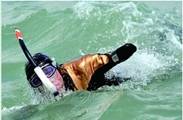 A French father-of-two who swam across the Channel 16 years after losing all his limbs(四肢) in an electrical accident said Sunday that he was “the happiest man alive.”
Philippe Croizon, a 42-year-old former metalworker, said he had performed his feat(壮举)to inspire all those “who think life is nothing but suffering.”
He set off from Folkestone in southern England just before 8:00 am on Saturday, and arrived on the French coast near Wissant just before 9:30 pm, aided by his specially designed flipper-shaped prosthetic(假肢的)legs.
Steadying himself with his prosthetic arms, Croizon kept up a constant speed in good weather and was accompanied by wild dolphins for part of the 33-kilometre (20-mile) crossing. “For a while, I didn’t realize what I’d done. It was only that night, when I went to bed, that suddenly I burst out laughing, and told myself, ‘You did it!’,” he told AFP by telephone from his home in northern France.
In 1994 Croizon was hit by a 20,000-volt charge as he attempted to remove a television aerial from a house roof. “I was on my hospital bed; they’d just finished cutting off my last leg. You can imagine how that felt. And then I saw a television documentary on a female swimmer who crossed the Channel,” he explained.
“There and then, I asked myself: ‘Why not me one day?’” he said.
Croizon trained for two years and last month completed a 12-hour swim between the ports of Noirmoutier and Pornic on France’s Atlantic coast, but his final Channel crossing was much faster than he had expected. “I wanted to slow down, but I couldn’t. The motor was running,” he said, adding that he had expected to be at sea for 24 hours.
“It was huge. I was in the zone. I was inside my head. I didn’t want to disappoint anyone,” he said, declaring that his next long-distance challenge will be to swim between Europe and Africa.
60. What led to Philippe’s decision to swim across the English Channel?
A. The aim to inspire all those suffering from disabilities.
B. His strong will and determination.
C. The female swimmer who crossed the Channel.
D. His unfortunate experience.
61. We can infer from the passage that ______.
A. Philippe’s success in crossing the Channel was incredible
B. the wild dolphins kept him company all the way
C. it took him 24 hours to cross the Channel
D. Philippe planned to travel to Africa
62. What does the underlined sentence mean in the last paragraph?
A. Philippe was swimming in his head.
B. Philippe filled his mind with determination to succeed.
C. Philippe was imagining his success.
D. Philippe was dreaming about his swimming across the Channel.
63. What can be the best title of the passage?
A. Limbless Man Crosses The English Channel
B. Crossing The Channel with Prosthetic Flippers.
C. Philippe’s Purpose of Crossing the Channel.
D. How Philippe Became Limbless.
查看习题详情和答案>>