网址:http://m.1010jiajiao.com/timu3_id_3003800[举报]
I grew up with my best friend, who was just like a sister to me. She was a little older than me. I 36 to her. If ever I had a problem, she was always 37 enough to help me out.
It wasn’t until the spring of“87” that I noticed a 38 in her. She was quick to anger, and her attitude was 39 . I asked her many times what was wrong. Her response each time was “I’m fine. ”
As time went on, she became more 40 , and became a person I did not 41 anymore. All I wanted was to help her. Every time I tried, she would get 42 , and say she was fine.
The summer of“88”, I finally got my 43 . My sister had changed due to the effects of 44 . My mother 45 put her arms around me, and told me my best friend had 46 due to an over-dose (过度剂量). Well, for a minute my world stood still, along with my heart. There was nothing to say or do, just tears in the 47 . Thinking over and over again, if only I had spent the time to notice the 48 , maybe I could have saved her.
My mother, seeing my distress, sat me down and told me this.
Some things are not in our 49 . Sometimes “signs” aren’t enough. You can’t 50 yourself for the path your friend chose. What you can do is to learn from her mistake, 51 at school for 52 , let other children know what happened to your friend, and how it made you 53 .
Since then I’ve never once blamed myself for her death. 54 I volunteer my time to SADD and DARE. Each year, at an assembly I tell new students what happened and the 55 of drugs.
36. A. came up B. looked up
C. looked forward D. went over
37. A. quick B. old C. clever D. close
38. A. change B. disease C. decline D. habit
39. A. polite B. acceptable C. poor D. rude
40. A. bitter B. weak C. proud D. cold
41. A. respect B. stand C. care D. know
42. A. polite B. defensive C. vague D. impatient
43. A. surprise B. chance C. answer D. turn
44. A. drugs B. loneliness C. illness D. sadness
45. A. tightly B. tearfully C. angrily D. finally
46. A. passed B. left C. died D. recovered
47. A. disaster B. trouble C. disturbance D. silence
48. A. signs B. effects C. causes D. results
49. A. way B. favor C. control D. side
50. A. help B. enjoy C. destroy D. blame
51. A. attend B. volunteer C. engage D. settle
52. A. health-awareness B. self-improvement C. self-protection D. drug-prevention
53. A. feel B. think C. act D. learn
54. A. Still B. Instead C. Therefore D. Anyhow
55. A. use B. consequence C. danger D. influence
查看习题详情和答案>>
阅读理解
EARTH WEEK-A DIARY OF THE PLANETEnduring Storms
Several more rounds of severe storms, tornadoes and flash flooding struck many parts of the American Midwest and Northeast as bad weather continued across the US for a second month.
Monsoon Storms
A south-west monsoon has caused havoc in parts of SriLanka. Government meteorologists said that unexpected monsoonal winds blew directly across the country from the Southern Hemisphere at about 100 km/h, producing several rounds of stormy weather. Nearly 250 houses in the capital Colombo were damaged.
For the week ending 3 July 1998
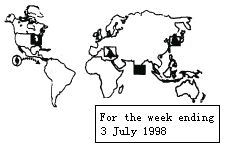
Mt. Etna Erupts
Sicily’s Mount Etna volcano erupted shortly after midnight on July 1, shooting“bombs”of lava nearly 1.5 metres in diameter on the eastern side of the mountain. The 30-minute eruption could be seen for several miles, but did not threaten any nearby villages.
Hurricane
Hurricane Blas lost strength as it moved over cooler waters in the Pacific Ocean to the west of Mexico. Blasformed off southwest Mexico during the previous week, but squalls on the outer fringes of the storm lashed western Michoacan State, killing four people when their wood and cardboard home collapsed.
Monkey Repellent
After years of unsuccessful attempts to keep crop-eating monkeys out of Japanese fields, a Tokyo research team believes that it may have finally found a way to prevent the damage caused by the monkeys. Animal raids on crops were successfully prevented by shooting chilli powder into the air, irritating the eyes and noses of monkeys that passed in front of carefully-placed warning sensors.“We’ve tried…all kinds of preventive measures, but the monkeys are smart enough to outwit the tricks,”said Toshiaki Wada, Director of the Tokyo Forestry Experiment Station in western Tokyo.
1.The monsoon is Sri Lanka ________.
[ ]
A.was of average strength
B.destroyed more property than previous monsoons
C.was not typical for that time of the year
D.affected only the outer areas of the nation
2.What aspect of Hurricane Blas does the map show?
[ ]
3.According to the information, which of the following statements is TRUE?
[ ]
A.The eruption of Mt. Etna lasted thirty days.
B.Hurricane Blas was formed off the coast of Italy.
C.The American Midwest had fine weather throughout July 1998.
D.The eruption of Mt. Etna did not destroy local villages.
4.According to the information, the monkeys in the Japanese fields ________.
[ ]
A.destroy crops
B.kill unsuspecting humans
C.spread eye diseases to humans
D.stop farmers from working
5.Toshiaki Wada, Director of the Tokyo Forestry Experiment Station, would describe the monkeys as ________.
[ ]
D
Build the highway and watch the town grow.At first a few shops appear and maybe a restaurant.Then a hotel opens. Eventually new house are built. A village is born.
This is also how the virtual world has developed. Think of the Internet as the road carrying information between two computers.Think of the World Wide Web as the village. At first it is just a place on the virtual road where travelers meet. More travelers come bringing new kinds of information. New travelers come bringing new kinds of information.New villages are started.
Every willage has a founder.Tim Berners-Lee is the man who wrote the software programme that led to the foundation of the Word Wide Web.How did he get the idea? He tells us on his own web site. "One of the things computers were not able to do was store in formation from different sources. The dream behind the Web is of a common space in which we communicate by sharing information."
In 1991 his programmmes were placed on to the Internet.Everyone was welcome to use them.
Tim Berners-Lee could have followed the Microsoft route by forming a company to sell the programmes he invented. Or he could have joined another company. But in his view the Web is a language,not a pproduct. Charging a gee for using his programmes would have slowed the growth of the Web.And other companies would make similar products to compete. Instead of one World Wide Web there would be several smaller Webs. Each would use incompatible (不相容的) software. They Web is valuable because it uses a common computer language to reach people and share information. Competing webs would lose this value.Imagine if somebody sent you a bill every time you spoke a world of English.
In 1994 Tim Berners-Lee formed the World Wide Web Consortium,or W3C.More than 200 leading companies and laboratories are represented by W3C. Together they make sure that everyone, no matter what their equipment or solftware,can work equally on the Web.
"The Web can help people to understand the way that others live and love. It helps us understand the humanity of people," he says.
68.The writer's purpose in writing the first two paragraphs is to ______.
A.give us some idea of the Internet
B.give us some idea of the Web
C.tell us how the idea of Web started
D.tell us the idea of the Web is wonderful
69.Tim Berners-Lee invented the World Wide Web in order to _____
A.place his programmers on the Internet
B.stop smaller webs appearing
C.help people to form a web site
D.let people share all kinds of information
70.According to the text,the disadvantage of competing webs is that they would ______.
A.slow the development of the Web
B.destroy the whole web system
C.lose the value of information
D.waste a lot of money
查看习题详情和答案>>
The Great Fire of London started in the very early hours of 2 September, 1666. In four days it destroyed more than three-quarters of the old city, where most of the houses were wooden and close together. Over one hundred people became homeless, but only a few lost their lives.
The fire started on Sunday morning in the house of the King’s baker (面包师) in Pudding Lane. The baker, with his wife and family, was able to get out through a window into the roof. A strong wind blew the fire from the bakery (面包房) into a small hotel next door. Then it spread quickly into Thames Street. That was the beginning.
By eight o’clock three hundred houses were on fire. On Monday nearly a kilometer of the city was burning along the River Thames. Tuesday was the worst day. The fire destroyed many well-known buildings, old St Paul’s and the Guildhall among them.
Samuel Pepys, the famous writer, wrote about the fire, “People threw their things into the river. Many poor people stayed in their houses until the last moment. Birds fell out of the air because of the heat .”
The fire stopped only when the King finally ordered people to destroy hundreds of buildings in the path of the fire. With nothing left to burn, the fire became weak and finally died out.
After the fire, Christopher Wren, the architect (建筑师), wanted a city with wider streets and fine new houses of stone. In fact, the streets are still narrow, but he did build more than fifty churches, among them the mew St Paul’s
The fire caused great pain and loss, but after it London was a better place: a city for the future and not just of the past.
From the passage, we can learn that the fire began in ________.
A. a hotel B. the palace C. Pudding Lane D. Thames Street
The underlined word “family” in the second paragraph means ________.
A. wife and husband B. wife and children C. home D. children
It seems that the writer of the text was most sorry for the fact that ________.
A. many famous buildings were destroyed
B. some people lost their lives
C. the birds in the sky were killed by the fire
D. the King’s bakery was burned down
Why did the writer cite (引用) Samuel Pepys?
A. Because Pepys was among those putting out the fire.
B. Because Pepys also wrote about the fire.
C. Because he wanted to give the reader a clearer picture of the fire.
D. Because he wanted to show that poor people suffered most.
How was the fire put out according to the text?
A. The King and his soldiers came to help.
B. Houses standing in the direction of the fire were pulled down.
C. All the wooden houses in the city were destroyed.
D. People managed to get enough water from the river.
查看习题详情和答案>>The Great Fire of London started in the very early hours of 2 September 1666. In four days it destroyed more than three-quarters of the old city, where most of the houses were wooden and close together. Over one hundred people became homeless, but only a few lost their lives.
The fire started on Sunday morning in the house of the King’s baker(面包师)in Pudding Lane. The baker, with his wife and family, was able to get out through a window into the roof. A strong wind blew the fire from the bakery(面包房)into a small hotel next door. Then it spread quickly into Thames Street. That was the beginning.
By eight o’ clock three hundred houses were on fire. On Monday nearly a kilometer of the city was burning along the River Thames. Tuesday was the worst day. The fire destroyed many well-known buildings, old St Pauls and the Guildhall among them.
Samuel Pepys, the famous writer, write about the fire, “People threw their things into the river. Many poor people stayed in their houses until the last moment. Birds fell out of the air because of the heat .”
The fire stopped only when the King finally ordered people to destroy hundreds of buildings in the path of the fire. With nothing left to burn, the fire became weak and finally died out.
After the fire, Christopher Wren, the architect(建筑师), wanted a city with wider streets and fine new houses of stone. In fact, the streets are still narrow, but he did build more than fifty churches, among them the mew St Pauls.
The fire caused great pain and loss, but after it London was a better place: a city for the future and not just of the past.
1.The fire began in_________ .
A. a hotel B. the palace C. Pudding Lane D. Thames Street
2.The underlined word “family” in the second paragraph means_________ .
A. home B. children C. wife and husband D. wife and children
3.Why did the writer cite(引用)Samuel Pepys?
A. Because Pepys was among those putting out the fire.
B. Because Pepys also wrote about the fire.
C. To show that poor people suffered most.
D. To give the reader a clearer picture of the fire.
4.How was the fire put out according to the text?
A. The soldiers came to help.
B. All the wooden houses in the city were destroyed.
C. People managed to get enough water from the river.
D. Houses standing in the path of the fire were destroyed according to the King’s order.
查看习题详情和答案>>