网址:http://m.1010jiajiao.com/timu_id_809792[举报]
Torch relay back on track today
By Wang Shanshan (China Daily)
Updated: 2008-05-22 07:26
NINGBO, Zhejiang - The Olympic torch relay resumes today in this ancient port city after a three-day pause out of respect for victims of the earthquake.
Since the nationwide mourning began on Monday, the Olympic flame has been kept at Daxie Island off the coast of Ningbo.
The relay will begin this morning and will go on to Jiaxing in the afternoon. A total of 208 torchbearers will take part in the two events.
The relay will then cross the 36-km-long Hangzhou Bay Bridge, the longest sea bridge in the world.
A total of 56 torchbearers will take part, each covering a distance of 5.6 km.
At the end of the bridge lies the 1,800-year-old city of Jiaxing.
The relay will pass along the Grand Canal linking Beijing and Hangzhou, which was built in 604 AD, and the Nanhu Lake where the Communist Party of China had its first national congress in July 1921.
根据短文内容,简要回答下面的问题。
1. When did the relay stop? _______________________
2. Which place will the torch be passed to in the afternoon? _______________________
3. Is Hangzhou Bay Bridge the longest sea bridge in the world? _______________________
4. What does “Grand Canal” mean in Chinese? _______________________
5. Where did the Communist Party of China had its first national congress? _______________________
查看习题详情和答案>>Torch relay back on track today
By Wang Shanshan (China Daily)
Updated: 2008-05-22 07:26
NINGBO, Zhejiang - The Olympic torch relay resumes today in this ancient port city after a three-day pause out of respect for victims of the earthquake.
Since the nationwide mourning began on Monday, the Olympic flame has been kept at Daxie Island off the coast of Ningbo.
The relay will begin this morning and will go on to Jiaxing in the afternoon. A total of 208 torchbearers will take part in the two events.
The relay will then cross the 36-km-long Hangzhou Bay Bridge, the longest sea bridge in the world.
A total of 56 torchbearers will take part, each covering a distance of 5.6 km.
At the end of the bridge lies the 1,800-year-old city of Jiaxing.
The relay will pass along the Grand Canal linking Beijing and Hangzhou, which was built in 604 AD, and the Nanhu Lake where the Communist Party of China had its first national congress in July 1921.
根据短文内容,简要回答下面的问题。
1. When did the relay stop? _______________________
2. Which place will the torch be passed to in the afternoon? _______________________
3. Is Hangzhou Bay Bridge the longest sea bridge in the world? _______________________
4. What does “Grand Canal” mean in Chinese? _______________________
5. Where did the Communist Party of China had its first national congress? _______________________
查看习题详情和答案>>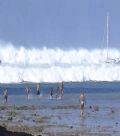
On Sunday morning, a strong earthquake hit Indonesia and then big tsunamis(海啸) followed. They soon went on to other countries in the south and southeast Asia as well as East Africa.
Tsunamis are especially dangerous for children. By Wednesday, nearly 60 000 people died because of the tsunamis. 30% of them were children, and most of them were 5 to 12 years old.
In open seas tsunamis are only one or two metres high. When they are near land, they are as high as 10 metres, Houses and cars near the sea can be taken away by these big waves. Because tsunamis move fast and can travel to another side of the sea within one day, they may affect(影响)a lot of places.
The Pacific Ocean(太平洋)has a lot of strong tsunamis because of the size of the ocean and large earthquakes there. China doesn\'t see tsunamis often because its sea floor is quite flat(平的). Islands around China also help the country avoid from them.
What should you do when there\'s a tsunamis? Move to a safe place. If you are near the sea and you feel the earth shake, move to higher ground. Stay away from rivers and streams(溪流).
Reported by "China Daily" on Friday, December 31st, 2004.
1. The big Asian tsunamis first happened________.
A. on Friday morning B. on the morning of December 26th
C. on December 31st, 2004 D. three days ago
2. Which places did the big tsunamis hit?
A. All the coastal(海岸的) countries.
B. Only in Indonesia and Sri Lanka.
C. South and southeast Asia as well as East Africa.
D. Vietnam(越南)and India.
3. Why does the Pacific Ocean have a lot of strong tsunamis?
A, Because there are few islands in the ocean.
B, Because of the strong wind on the sea.
C, Because there are many Asian countries around the Pacific Ocean.
D. Because of the large earthquakes and the size of ocean.
4. Which of the following is wrong?
A. In open seas tsunamis are one or two metres high.
B. Tsunamis can\'t travel to another side of the sea within 24 hours.
C. Most of the children who died in tsunamis were under 5-12 years old.
D. China\'s sea floor is quite flat and tsunamis seldom happen.
5. You should________ when there\'s a tsunamis according to the passage.
A. listen to a weather report
B. try to find out what will happen
C. run to the policeman for help
D. get to a higher and safer place as soon as possible
1.Which is Millie's favourite subject?
A. History
B. Maths
C. Chinese
D. English
2. Which place will the boy visit in Beijing this summer holiday?
A. The Palace Museum
B. The Great Wall
C. Wangfujing Street
D. Tian'anmen Square
3. What did Simon do yesterday afternoon?
A. Skiing
B. Swimming
C. Skating
D. Diving
4. How will they go to the pa
 rk?
rk?A. By bike
B. By car
C. By bus.
D. By taxi
5. Which Club does Kate join?
A. The Singing Club
B. The Reading Club
C. The Swimming Club
D. The Diving Club
6. Which subject is Helen's favourite?
A. Maths
B. English
C. Computer Studies
D. Geography
7. Who is the tallest boy in Mike's class?
A. Simon
B. Jim
C. Mike
D. Daniel
8. Who has the most flowers of the three?
A. Tom
B. Simon
C. Ann
D. Kate
9. What time did the boy get to school this morning?
A. At 7 a.m.
B. At 6 a.m.
C. At 7:10 a.m.
D. At 6:50 a.m.
10. How was Mary's birthday party?
A. It was good and the talk was interesting.
B. It was good and she received many presents.
C. It was good and she had a long talk with her classmates.
D. It was good and she got many toys .
They soon went on to other countries in the South and Southeast Asia as well as East Africa.
Tsunamis are especially dangerous for children. By Wednesday, nearly 60, 000 people died
because of the tsunamis. One third of them were children, and most of them were 5 to 12 years old.
In may Asian countries near the sea, poor kids helped their parents fish. So they were in harm's way
when the tsunamis came. In Sri Lanka, when the first waves hit, thousands of children came to the
seaside. The waves brought in fish. The old and the young collected them. Many waited for more.
Then tsunamis six metres high hit the island of 19 million people.
''They got caught and could not run to safety. This is the reason why so many children have died,"
said a police spokesman in Sri Lanka.
In open seas tsunamis are only one or two metres high. When they are near land, they are as high
as 10 metres. Houses and cars near the sea can be taken away by these big waves. Because tsunamis
move fast and can travel to another side of the sea within on day, they may affect a lot of places.
The Pacific Ocean(太平洋)has a lot of strong tsunamis because of the size of the ocean and large
earthquakes there. China doesn't
 see tsunamis often because its sea floor is quite flat. Islands around
 China also help the country avoid them.
What should you do when there's a tsunami? Move to a safe place. If you are near the sea and you
feel the earthquake, move to higher ground. Stay away from rivers and streams.
B. South and Southeast Asia as well as East Africa.
C. Only Indonesia and Sri Lanka.
B. Sri Lanka has a population of 19, 000, 000 children.
C. Most of the children who died in tsunamis were 5 to 12 years old.
B. sharks appeared and ate the children
C. they helped their parents fish near the sea and could not run to safety
B. Because of large earthquakes.
C. Because its sea floor is quiet flat.
B. Run to your parents for help.
C. Get to a safe place as soon as possible.