网址:http://m.1010jiajiao.com/timu_id_1710025[举报]
D
It was Sunday morning. All the summer world was bright and fresh, and full of life. There was cheer on every face and a spring in every step.
Tom appeared on the sidewalk with a bucket of whitewash and a long-handled brush. He stopped by the fence in front of the house where he lived with his aunt Polly. He looked at it, and all joy left him. The fence was long and high. He put the brush into the whitewash and moved it along the top of the fence. He repeated the operation. He felt he could not continue and sat down.
He knew that his friends would arrive soon with all kinds of interesting plans for the day. They would walk past him and laugh. They would make jokes about his having to work on a beautiful summer Saturday. The thought burned him like fire.
He put his hand into his pockets and took out all that he owned. Perhaps he could find some way to pay someone to do the whitewashing for him. But there was nothing of value in his pockets—nothing that could buy even half an hour of freedom. So he put the bits of toys back into his pockets and gave up the idea.
At this dark and hopeless moment, a wonderful idea came to him. It filled his mind with a great, bright light. Calmly he picked up the brush and started again to whitewash.
While Tom was working, Ben Rogers appeared. Ben was eating an apple as he walked along the street. As he walked along, he was making noises like the sound of a riverboat. First he shouted loudly, like a boat captain. Then he said “Ding-Dong-Dong”, “Ding-Dong-Dong” again and again, like the bell of a riverboat. And he made other strange noises. When he came close to Tom, he stopped.
Tom went on whitewashing. He did not look at Ben. Ben stared a moment and then said: "Hello! I’m going swimming, but you can’t go, can you?”
No answer. Tom moved his brush carefully along the fence and looked at the result with the eye of an artist. Ben came nearer. Tom's mouth watered for the apple, but he kept on working.
Ben said, "Hello, old fellow, you’ve got to work, hey?"
Tom turned suddenly and said, "Why, it's you, Ben! I wasn't noticing."
"Say — I'm going swimming. Don't you wish you could? But of course you’d rather work — wouldn't you? Of course you would."
Tom looked at the boy a bit, and said "What do you call work?"
"Why, isn't that work?"
Tom went back to his whitewashing, and answered casually,
"Well, maybe it is, and maybe it isn't. All I know is, it suits Tom Sawyer."
"Oh come, now, you don't mean to say that you like it?"
The brush continued to move.
"Like it? Well, I don't see why I shouldn’t like it. Does a boy get a chance to whitewash a fence every day?" Ben stopped eating his apple. Tom moved his brush back and forth, stepped back to look at the result, added a touch here and there, and stepped back again. Ben watched every move and got more and more interested. Soon he said,
"Say, Tom, let me whitewash a little."
Tom thought for a moment, was about to agree; but he changed his mind:
"No — no — it won’t do, Ben. You see, Aunt Polly wants this fence to be perfect. It has got to be done very carefully. I don’t think there is one boy in a thousand, maybe two thousand, that can do it well enough."
"No — is that so? Oh come, now —let me just try. Only just a little."
"Ben, I'd like to, but if it isn’t done right, I’m afraid Aunt Polly— "
"Oh, I'll be careful. Now let me try. Say -- I'll give you the core(核心)of my apple."
"Well, here — No, Ben, now don't. I'm afraid —"
"I'll give you all of it."
Tom gave up the brush with unwillingness on his face, but joy in his heart. And while Ben worked at the fence in the hot sun, Tom sat under a tree, eating the apple, and planning how to get more help. There were enough boys. Each one came to laugh, but remained to whitewash. By the time Ben was tired, Tom sold the next chance to Billy for a kite; and when Billy was tired, Johnny bought in for a dead rat — and so on, hour after hour. And when the middle of the afternoon came, Tom had won many treasures
And he had not worked. He had had a nice idle time all the time, with plenty of company -- and the fence had been whitewashed three times. If he hadn't run out of whitewash, Tom would have owned everything belonging to his friends.
He had discovered a great law of human action, namely, that in order to make a man or a boy want a thing, it is only necessary to make the thing difficult to get.
68.Tom was about to agree to let Ben whitewash when he changed his mind because ______ .
A. Tom wanted to do the whitewashing by himself
B. Tom was unwilling to let Ben do the whitewashing
C. Tom was afraid Ben would do the whitewashing better
D. Tom didn’t want to let Ben do the whitewashing before he made him give up his apple first
69.The underlined word “casually” is most similar to “______” in meaning.
A. carelessly B. delightedly C. seriously D. angrily
70.We can learn from the passage that ______ .
A. Tom was interested in whitewashing the fence.
B. Tom had a lot of friends who are ready to help others.
C. Tom was unwilling to whitewash the fence, but he managed to let other boys do it for him
D. Tom was good at whitewashing the fence, so he looked at the result of his work with the eye of an artist.
查看习题详情和答案>>Would you believe that the first outstanding deaf teacher in America was a Frenchman? His name was Laurent Clerc. He became a friend of Thomas Hopkins Gallaudet and together they founded America's first school for the deaf.
Laurent Clerc was born in a small village near Lyons, France, on December 26, 1785. When he was one year old, he fell into a fire, losing both his hearing and his sense of smell.
At 12, Laurent entered the Royal Institution for the Deaf in Paris where he did well in his studies. After he graduated, the school asked him to stay on as an assistant teacher.
Meanwhile, in America, Thomas Hopkins Gallaudet was studying to be a minister. He was very concerned about the lack of educational opportunities for the deaf. Therefore, in 1815, Gallaudet sailed to London, England to seek ideas on how to teach deaf people. While he was there, he met a French educator of the deaf who invited him to go to Paris to spend three months learning at the Royal Institution for the Deaf, the school where Laurent Clerc was teaching. Gallaudet accepted the offer. The two worked and studied well together. When the time came for Gallaudet to return, he asked Clerc to come with him. Clerc accepted on one condition: that he would stay in America only a short time.
The two men set sail on June 18, 1816. The voyage across the Atlantic Ocean took 52 days; however, Clerc and Gallaudet put the time to good use. Clerc studied English, and Gallaudet studied sign language. They discussed the school for the deaf which they planned to open. On the long trip, they had many conversations about education and deafness. The year after they arrived, they founded a school for the deaf in Harford, Connecticut.
At the school, Clerc led a busy life. He taught signs to Principal Gallaudet; he taught the pupils; and he taught hearing men who came to the school to study deaf education.
In 1819, Clerc married Eliza Crocker Boardman, one of his pupils. They had six children. He retired from teaching in 1858. Although he had intended to return to France, he never did. He died on July 18, 1869 in the United States.
1.Why did Thomas Hopkins Gallaudet sail to London?
A. He needed to finish his studies to become a minister.
B. It was the easiest way to get to France.
C. He wanted to study their system of deaf education.
D. He wanted to marry Alice Cogswell.
2.On their trip from Paris to America, Clerc and Gallaudet ___________.
A. played cards and socialized
B. studied and discussed their plans for a deaf school
C. founded a school for the deaf
D. Gallaudet studied English and Clerc studied Sign Language
3.Which is the right order of the things Clerc did?
A. met Gallaudet, moved to America, got married, went to school in Paris.
B. met Gallaudet, went to school in Paris, moved to America, got married.
C. went to school in Paris, met Gallaudet, moved to America, got married.
D. got married, went to school in Paris, met Gallaudet, moved to America.
4.The main idea of this passage could best be stated as_________.
A. Clerc managed his time well, and was able to teach a lot of information in a short period of time
B. Thomas Gallaudet was grateful to Clerc for all that he taught him
C. Clerc preferred teaching deaf students to hearing students
D. Clerc, an educated Frenchman, had a great impact on American Deaf Education
查看习题详情和答案>>Natural ways of keeping time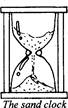
In ancient times, people had to use the sun and the moon to tell time. They got up when the sun came up and worked in the fields until the sun went down.
Man-made things
The sand clock is made of two glass balls joined by a narrow neck. The top ball was filled with sand. The sand slowly moved through the neck into the bottom ball. People knew how much time had passed when all the sand had fallen to the bottom ball.
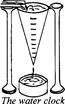
People also made the water clock. They made a small hole near the bottom of a pot. Then they filled the pot with water. Markings inside the pot showed how much time passed as the water dripped (滴) out of the hole.
Nature’s Clocks in Living Things
◆Animals’ Body Clock
Animals do not need clocks to know time. They have a way of telling time by their bodies. Birds know when to fly to warmer places before winter. Some animals know when to keep more food for the cold winter months. Some fish know when it is time to move up the river and lay eggs.
◆Plants have their own clocks
Plants also have their own clocks to keep time. Plants know when to open flowers or when to drop their leaves.
◆The Body Clock in Human Beings
People also have their own body clocks. When we get used to our lives, our body clocks can be very accurate (准确的). It can tell us when it is time to wake up. It can also tell us when to eat or to go to sleep.
【小题1】How could an ancient farmer know when to go back home in the daytime?
| A.By looking at the moon. | B.By looking at the stars. |
| C.By looking at the sun. | D.By feeling whether tired or not. |
| A.2. | B.3. | C.5 | D.6. |
| A.both of them have a hole. | B.both of them are designed with glass balls. |
| C.both of them can be used only once. | D.both of them tell time in the same way |
How did Ancient People Tell Time?
Natural ways of keeping time.
In ancient time, people had to use the sun and the moon to tell time. They got up when the sun came up and worked in the fields until the sun went down.
Man-made things
The sand c1ock is made of two glass balls joined by a narrow neck.The

 top ball was filled with sand.The sand slowly moved through the neck into the bottom ball.People knew how much time had passed when all the sand had fallen to the bottom ball.
People also made the water clock.They made a small hole near the bottom of a pot.Then they filled the pot with water.Markings inside the pot showed how much time passed as the water dripped(滴)out of the hole.
Nature’s C1ocks in Living Things
Animals’ Body Clock
Animals do not need clocks to know time.They have a way of telling time by their bodies.Birds know when to fly to warmer places before winter.some animals know when to keep more food for the cold winter months.Some fish know when it is time to move up the river and lay eggs.
Plants have their own clocks
Plants also have their own clocks to keep time.Plants know when to open flowers or when to drop their leaves.
The Body Clock in Human Beings
People also have their own body clocks.When we get used to our lives,our body clocks can be very accurate.It can tell us when it is time to wake up.It can also tell us when to eat or to go to sleep.
68.How could an ancient farmer know when to go back home from the field in the daytime?
A.By looking at the stars. B.By looking at the moon.
C.By looking at the sun. D.By feeling whether tired or not.
69.In what way is the sand clock the same as the water clock in telling time?
A.Both of them have a neck. B.Both of them have two glass balls.
C.Both of them can be used only once. D.Both of them give the time by quantity.
70.What is the best title for the whole passage?
A.Man—made clocks B.Nature’s clocks C.Time and clock D.How people keep time
查看习题详情和答案>>How did Ancient People Tell Time?
Natural ways of keeping time.
In ancient time.people had to use the sun and the moon to tell time.They got up when the sun came up and worked in the fields until the sun went down.
Man-made things
 The sand c1ock is made of two glass balls joined by a narrow neck.The
  top ball was filled with sand.The sand slowly moved through the neck into the bottom ball.People knew how much time had passed when all the sand had fallen to the bottom ball.
People also made the water clock.They made a small hole near山e bottom of a pot.Then they filled the pot with water.Markings inside the pot showed how much time passed as the water dripped(滴)out of the hole.
Nature’s C1ocks in Living Things
Animals’ Body Clock
Animals do not need clocks to know time.They have a way of telling time by their bodies.Birds know when to fly to warmer places before winter.some animals know when to keep more f00d for the cold winter months.Some fish know when it is time to move up the river and lay eggs.
Plants have their own clocks
Plants als0 have their own clocks to keep time.Plants know when to open flowers or when to drop their leaves.
The Body Clock in Human Beings
People also h8ve their own body clocks.When we get used to our lives,our body clocks can be very accurate.It can tell us when it is time to wake up.It can also tell us when to eat or to go to sleep.
64.How could an ancient farmer know when t0 go back home from the field in the daytime?
A.By looking at the stars. B.By looking at the moon.
C.By looking at the sun. D.By feeling whether tired or not.
65.According to the passage,how can animals know time?
A.They use body clocks. B.They ask other animals.
C.They use the sun and the moon.D.They make something to tell time.
66.In what way is the sand clock the same as the water clock in telling time?
A.Both of them have a neck.
B.Both of them have two glass balls.
C.Both of them can be used only once.
D.Both of them give the time by quantity.
67.What is the best title for the whole passage?
A.Man―made clocks B.Nature’s clocks
C.Time and clock D.How people keep time
查看习题详情和答案>>