网址:http://m.1010jiajiao.com/timu_id_1706970[举报]
When an official at the U. S. Open Pocket Pool(台球)Championship saw a 9-year-old girl playing at one of the tournament tables, he told her that spectators(观众)were not allowed to play. But much to his surprise, the girl was actually a competitor. That was nine years ago, and today, with five U. S. Open Women’s titles behind her and a recently won world championship, no one is likely to mistake Jean Balukas for a spectator again.
It doesn’t seem too surprising that Jean became caught up in pool——her father owns a pool hall within walking distance of the family’s home in Brooklyn. When she was just tall enough to see over the table, she fell in love with the game soon. Five years later Jean was ready to enter her first U. S. Open. She still remembers the letter the officials sent her reminding her that she wouldn’t be allowed to stand on a box to play.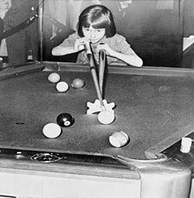
As Jean improved, she found it increasingly difficult to play games at her father’s pool hall. “If I’d beat one of the guys, his friends would laugh at them about losing to me,” she says. Now Jean comes to the hall only weeks before a tournament when she plays Johnny Goon, her father’s pool manager.
That Johnny can beat her shows the gap that now exists in pool — as in other sports — between the top men and women competitors. “I’m supposedly the top woman player, but I’d have a hard time beating the number 50 man,” says Jean. “If I was a boy and played pool, I’d be a nobody.”
Jean thinks that women pool players still have a long way to go because pool has been a man’s game for so long. “When they think of pool players, people have this picture in their head of gambling(赌博) and smoke,” she says.
Jean won four of the seven games in these two years. She was as surprised as anyone else at her performance, even though she was a New York City tennis champion and center for her high-school basketball team. Jean does not take full credit for her achievements, saying, “I think what I have in sports is a gift from God, and that’s why I can get out there and do so well.”
【小题1】We can learn from the first passage that Jean Balukas_____.
| A.had become well-known at the age of 9 |
| B.had achieved great fame at the age of 18 |
| C.was often asked to play with men players |
| D.was refused to play in the U. S. Open for her young age |
| A.told her to arrive in time for the game |
| B.showed people’s doubt about her ability |
| C.told her about the basic rules of the game |
| D.invited her to compete in the U. S. Open |
| A.fall far behind men players |
| B.aren’t suitable for a man’s game |
| C.are impossible to beat any man player |
| D.have a bad reputation(名声) for gambling and smoking |
| A.women players had a long way to go |
| B.she wouldn’t stop before her great achievement |
| C.she had much confidence in the game |
| D.she achieved her success because of her born gift |
| |||||||||||||||||||||||||||||||||||||||||||||||||||||||||||
More than three years after moving from Australia to this remote part of England, we are still learning how things are done here.
Not too long after we arrived and unpacked, we were invited for “a drink on Sunday morning” by a retired couple nearby. We got there about noon, to find the living-room crowded — lots of chat and discussions, and in all a very jolly occasion.
Trouble was, there was no food — no self-respecting Australian would regard a tray of crisps as food. In Sydney, when you are invited for a drink any time after midday on a Sunday, you know you will be fed as well as watered and you plan accordingly. Meaning the hardworked little woman makes no plans to cook lunch because you are eating out.
By one-fifteen my stomach was sending up “please explain” to me. Even the crisps had gone. There was nothing we could do except wait, and wonder if the hostess was going to perform some magic and feed us fashionably late. Then, as quickly as if word had spread that there was free beer at the local pub, the room emptied. By one-forty-five there were only a few guests left, so we decided to go home. Tinned soup for lunch that day because the little woman was not really interested in real cooking for us.
A few weeks ago we were invited out for “supper” and the hostess suggested 8:15. Ah, we thought greedily, “this is going to be the real thing.”
We dressed with some care — I putting on a dark suit — and arrived on time. My wife looked pretty good, I thought — a little black dress and so on. But when we walked in I had a terrible feeling we had got the night wrong because the hostess was dressed in a daytime kind of way and the husband was in jeans and an open-neck shirt. But no, we were greeted and shown into the sitting-room.
After a drink I looked around and saw that this was indeed a superior cottage because it had a (more or less) separate dining-room. But there were no signs of a table-setting. Not again! I thought. Were we meant to eat before we came? I decided that in future my wife and I would always carry a chocolate bar. About 9:28 our hostess went out of the room, saying something about food. Ten minutes later she returned and asked us to follow. We were led out to the kitchen. There on the table were country style plates and a huge bowl of soup, rough bread and all the makings of a simple meal. And that is what it was. In other words we had not read the signals right when we were invited for “supper”. If they want you to come to dinner, they say so, and you know that means dark suits and so on. If they mean supper, they say it, and you get fed in the kitchen.
1.When the author and his wife were invited out for “a drink on Sunday morning”, they thought _________.
A. they would be the only people there
B. they would be given lunch as well
C. they would be taken to a restaurant for lunch
D. they would be asked to take some food with them
2.The “party” had been going on for about an hour and three quarters when _________.
A. the hostess decided to feed her guests
B. everyone had tinned soup for lunch
C. most of the guests went to lunch at the pub
D. the author realized he would go home hungry
3.When invited out for “supper” a few weeks later, the writer _________.
A. expected to be served a proper dinner
B. arrived on the wrong evening
C. interpreted the invitation correctly this time
D. realized there was no dining-room in the cottage
4.As the evening wore on, the writer became aware that _________.
A. no one used their dining-rooms in the countryside
B. he should have had a meal before going out
C. “supper” meant a simple, informal meal
D. he should, in future, eat only chocolate in the evening
More than three years after moving from Australia to this remote part of England, we are still learning how things are done here.
Not too long after we arrived and unpacked, we were invited for “a drink on Sunday morning” by a retired couple nearby. We got there about noon, to find the living-room crowded — lots of chat and discussions, and in all a very jolly occasion.
Trouble was, there was no food — no self-respecting Australian would regard a tray of crisps as food. In Sydney, when you are invited for a drink any time after midday on a Sunday, you know you will be fed as well as watered and you plan accordingly. Meaning the hardworked little woman makes no plans to cook lunch because you are eating out.
By one-fifteen my stomach was sending up “please explain” to me. Even the crisps had gone. There was nothing we could do except wait, and wonder if the hostess was going to perform some magic and feed us fashionably late. Then, as quickly as if word had spread that there was free beer at the local pub, the room emptied. By one-forty-five there were only a few guests left, so we decided to go home. Tinned soup for lunch that day because the little woman was not really interested in real cooking for us.
A few weeks ago we were invited out for “supper” and the hostess suggested 8:15. Ah, we thought greedily, “this is going to be the real thing.”
We dressed with some care — I putting on a dark suit — and arrived on time. My wife looked pretty good, I thought — a little black dress and so on. But when we walked in I had a terrible feeling we had got the night wrong because the hostess was dressed in a daytime kind of way and the husband was in jeans and an open-neck shirt. But no, we were greeted and shown into the sitting-room.
After a drink I looked around and saw that this was indeed a superior cottage because it had a (more or less) separate dining-room. But there were no signs of a table-setting. Not again! I thought. Were we meant to eat before we came? I decided that in future my wife and I would always carry a chocolate bar. About 9:28 our hostess went out of the room, saying something about food. Ten minutes later she returned and asked us to follow. We were led out to the kitchen. There on the table were country style plates and a huge bowl of soup, rough bread and all the makings of a simple meal. And that is what it was. In other words we had not read the signals right when we were invited for “supper”. If they want you to come to dinner, they say so, and you know that means dark suits and so on. If they mean supper, they say it, and you get fed in the kitchen.
1.When the author and his wife were invited out for “a drink on Sunday morning”, they thought _________.
A. they would be the only people there
B. they would be given lunch as well
C. they would be taken to a restaurant for lunch
D. they would be asked to take some food with them
2.The “party” had been going on for about an hour and three quarters when _________.
A. the hostess decided to feed her guests
B. everyone had tinned soup for lunch
C. most of the guests went to lunch at the pub
D. the author realized he would go home hungry
3.When invited out for “supper” a few weeks later, the writer _________.
A. expected to be served a proper dinner
B. arrived on the wrong evening
C. interpreted the invitation correctly this time
D. realized there was no dining-room in the cottage
4.As the evening wore on, the writer became aware that _________.
A. no one used their dining-rooms in the countryside
B. he should have had a meal before going out
C. “supper” meant a simple, informal meal
D. he should, in future, eat only chocolate in the evening
查看习题详情和答案>>