网址:http://m.1010jiajiao.com/timu_id_1689373[举报]
Look! The pond ________, and no fish in it can survive.
A. dries up???????? B. has dried up????? C. had dried up???? D. dried up
查看习题详情和答案>>
One day, Grandpa and Grandson came to a pond where many children were driving their remote - controlled boats. Watching the children racing boats happily, the boy felt 36 . He knew his parents couldn’t afford such a boat. And Grandpa had no chance of giving him such a gift __37 his pension was small. Grandpa felt the boy’s 38 . He looked around until his eyes __39 on a bench next to a big pine tree.
Then, Grandpa led the boy to the bench and sat down. “Grandpa, I want a 40 like that,” the boy said. “I know,” grandpa patted the boy on the shoulder.
Some time later, Grandpa 41 a big piece of pine bark fallen from the tree, some sticks and grass. Grandson looked 42 at what he was doing . To the boy’s surprise, Grandpa made him a big bark ship with a beautiful white 43 made of a handkerchief.
“Now, let’s see how it 44 !” Grandpa gave the ship to the boy. The boy 45 the boat carefully into the water. A remote - controlled boat went by, _ 46 waves and splashing their boat wet. “Oh, no !” the boy cried.
Out of nowhere came a breeze and the sail 47 the wind. First slowly, then faster the boat
braved the water. The wind 48 the boat around the pond. And finally it drove the boat back to
them. The boy took the boat out of the water with eyes full of 49 .
“Look at the 50 boats,” Grandpa said. “They are great, but you saw 51 two of them ran out of batteries. Our boat is remote - controlled by a source that will never be 52 .”
“By what?” The boy asked.
“It is controlled by 53 Humans run out of energies when trying to control everything. But when we 54 our need to control and let nature 55 our boat, it’s a journey and a wonder to look at.” The boy nodded, leaving the pond with grandpa, with the bark ship carefully in his arms.
36. A. worried B. disappointed C. puzzled D. strange
37. A. because B. when C. if D. though
38. A. excitement B. surprise C. anger D. envy
39. A. got B. put C. fell D. came
40. A. boat B. control C. childhood D. race
41. A. found out B. made out C. picked up D. put up
42. A. painfully B. nervously C. amusingly D. curiously
43. A. sail B. oar C. bow D. shell
44. A. swims B. floats C. slides D. dips
45. A. lowered B. turned C. threw D. rolled
46. A. collecting B. drawing C. becoming D. raising
47. A. caught B. borrowed C. kept D. stopped
48. A. showed B. ran C. carried D. walked
49. A. joy B. tears C. achievement D. questions
50. A. artificial B. real C. perfect D. expensive
51. A. when B. why C. how D. where
52. A. given out B. used up C. sold out D. burned up
53. A. nature B. heart C. water D. energy
54. A. lack B. understand C. abandon D. meet
55. A. serve B. order C. assist D. guide
查看习题详情和答案>>Chuck,unlike other frogs,didn't like catching flies himself. But he did love eating them.
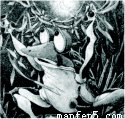
Some frogs thought Chuck was lazy. Some believed he must think he was too good for them. Some thought Chuck was the strangest frog ever.
That didn't matter to Chuck. Each morning,Chuck jumped over and sat under the spider's web. Then when Lady Eightlegs went off to dip (浸) her feet in the pond,Chuck ate flies from her web.
One morning while Chuck was enjoying his fly breakfast,Lady Eightlegs returned and caught him.
“You're the one who keeps eating my flies!”she cried.
Chuck jumped away and into the pond. Now there was an idea!Why not spin (结) his own web?
He collected some vines (葡萄藤) from a nearby farm. Then he began to spin his web. He worked on his web for hours,until very late at night. And then he fell asleep.
When he woke up the next morning,he found that he got caught by the vines.
“Help!”he shouted.
Lady Eightlegs looked up from the edge of the pond. She hurried up to help Chuck out of the vine web.
“No matter how hard I try,I can't spin a spider's web,”Chuck said.
“Of course not,”Lady Eightlegs said. “You're a frog. Frogs can't spin spider's webs any better than spiders can swim,I guess.”
“But I always see you in the water,”Chuck said.
“I only wade in (蹚水) up to my knees,”Lady Eightlegs sighed. “How wonderful it would be to swim in the middle of the pond and float (漂浮) peacefully under the sun.”
Chuck smiled,“I have an idea.”
From that day forward,Chuck carried Lady Eightlegs out to the middle of the pond,where they floated and played together. When they returned to land,they shared a breakfast of flies from her spider's web.
It wasn't exactly an ordinary friendship. But Chuck was not an ordinary frog.
1.The second paragraph is written to show that Chuck ______.
A.was different from other frogs B.didn't get along well with other frogs
C.led a lonely life D.was a proud frog
2.What do we know about Chuck's web?
A.Lady Eightlegs helped Chuck spin it. B.It was successfully spun by Chuck.
C.It was spun far from the pond. D.Chuck failed to spin it himself.
3.It can be inferred from the text that ______.
A.Chuck had tried to catch Lady Eightlegs B.Chuck had difficulty collecting vines
C.Lady Eightlegs was very wise D.Lady Eightlegs swam well
4.What was Lady Eightlegs' attitude towards Chuck in the end?
A.Worried. B.Friendly. C.Doubtful. D.Cold.
查看习题详情和答案>>
Once upon a time a king, in the company of his ministers, went to the imperial garden for a walk. When he was walking around a pond, a strange idea 26 upon him and he asked, “How many buckets(桶) of water are there in the pond?” The ministers looked at each other, 27 to give an answer.
Rather 28 , the king ordered, “You have three days’ grace. Any one who offers an answer will be handsomely awarded. Those who fail will be 29 .”
The time limit was due in the twinkling(闪烁)of an eye, yet the ministers were still at their wit’s end. At this time a child appeared who declared that he knew the answer. The king told his 30 ministers to go with the child for the measurement. To their 31 , the child refused the suggestion with a smile, “It is very easy. No 32 to go to the pond.” This made the king laugh 33 , “Alright, let us know what it is.” The child winked (眨眼) and said, “That 34 on the size of the bucket. If it is as big as the pond, there is one bucket of water; if it is half as big, two buckets; if one third as big, three buckets; if...” “Stop! That’s it. You’ve got the 35 .” The king was satisfied and the child was duly rewarded.
Why did the ministers feel it so different to settle the problem? Because they fell in a pitfall (陷阱), following a wrong way of thinking. People’s thinking often goes a habitual way — the beaten track of straightforwardness. 36 is a static (静态的) way presupposing every object definite and certain, i.e. the size of the pond and the bucket should be clearly 37 . If one of them is unknown, it will be difficult to do the measurement, let alone 38 . Why not change your mode of thought — from static to dynamic(动态的), from concrete to 39 ? If you adopt an indirect way and try to find out the proportional relation between the pond and the bucket, you’ll get an answer — flexible yet 40 to solve the problem.
Sometimes to get out of the difficulty one must change one’s way of thinking, or simply change one’s approach towards a problem.
1. A. fixed B. focused C. came D. looked
2.A. struggling B. thinking C. falling D. failing
3.A. disappointed B. excited C. pleased D. contented
4.A. killed B. punished C. blamed D. scolded
5.A. exciting B. amazing C. surprising D. trembling
6.A. doubt B. surprise C. envy D. delight
7.A. good B. use C. need D. wonder
8.A. wonderfully B. joyfully C. cheerfully D. doubtfully
9. A. decides B. depends C. calls D. looks
10.A. award B. reward C. answer D. number
11.A. This B. That C. It D. Such
12.A. marked B. measured C. signed D. known
13.A. another B. other C. one D. both
14.A. detailed B. easy C. simple D. abstract
15.A. acceptable B. available C. adequate D. proper
查看习题详情和答案>>
There are two types of twins; identical and non-identical twins. Identical twins are formed from a single egg in mother’s body which divides to from two separate babies. Identical twins look the same, and are often dressed by their parents in clothes of the same colors. It is often difficult to tell identical twins from each other, even when they are standing side by side. Non-identical twins come into being when the mother produces two separated eggs a the same time, both of which grow to form babies. In this case the twins look like normal brothers and sisters and are easy to tell one from the other.
In the 1970s and 1980s a scientist did some research into twins. He invited many pairs of identical twins to university and asked them to take part in a week of tests. He was particularly interested in adopted (收养) twins who had been separated at birth. He would give the twins different kinds of tests to study their speed of thinking, their speech, their memory, the ways they saw and heard different things, and so on. Time and time again he found separated twins who preferred clothes of the same color, used the same kind of shaving soap, wore the same shaped square glasses and the same colored socks.
There is a third type of twins, but it is a very unusual one. Twins which are joined together at birth are known in western countries as Siamese twins.
【小题1】It is difficult to tell identical twins apart because _______.
| A.they are dressed in the same clothes | B.they are dressed in the same color |
| C.they are very alike | D.they are standing side by side |
| A.very probably non-identical twins | B.surely identical twins |
| C.surely identical twins | D.always a brother and a sister |
| A.In the 1970s and 1980s a scientist did some research into the two main types of twins. |
| B.In the week of tests, he tested their speed of thinking, their speech, their memory and some other things. |
| C.There were twins who had been separated from each other as soon as they were born. |
| D.Very often, separated twins were found to choose things of the same kind, the same shape and the same color. |
| A.the main types of twins | B.what has been found out about twins |
| C.how twins are formed | D.how a scientist studied twins |