网址:http://m.1010jiajiao.com/timu_id_1676747[举报]
Some youngsters know what to _______ at the university; they have made up their minds about future.
A. take in B. take up C. take over D. take off
查看习题详情和答案>>
根据短文内容,从短文后的选项中选出能够填入空白处的最佳选项,
选项有两个为多余项。
In China some radio broadcasting station use hotline to encourage the listeners to take part in the talk shows.
__71__Yes,the fact is some people do nothing but break the whole programme
.__72__Sometimes they do not even know what the host is talking about. So the host has to tell the caller what the show is about. Usually the caller will ask questions which express his hope and show his ignorance. The host has to answer and explain ---how silly this is.! __73 ___
It seems that some people phone the hotlines in fun. __74__ They don’t care what the topic is, whether they themselves are interested in the topic or how silly they appear to be.
__75___ In my opinion, if a caller does not know what is going on ,the operator should not let the caller take part in it.
|
A.Radio broadcasting stations use hotlines in a wrong way |
|
B.That is a good idea |
|
C.It waste a lot of time |
|
D.Some people do not know what the show is about |
E. Some people know little about the topic under discussion
F. They just want to let the listeners hear them
G. It is necessary for radio broadcasting to improve the hotline programmes
查看习题详情和答案>>
Natural ways of keeping time
In ancient times, people had to use the sun and the moon to tell time. They got up when the sun came up and worked in the fields until the sun went down.
Man-made things
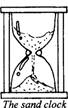
The sand clock is made of two glass balls joined by a narrow neck. The top ball was filled with sand. The sand slowly moved through the neck into the bottom ball. People knew how much time had passed when all the sand had fallen to the bottom ball.
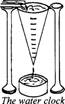
People also made the water clock. They made a small hole near the bottom of a pot. Then they filled the pot with water. Markings inside the pot showed how much time passed as the water dripped (滴) out of the hole.
Nature’s Clocks in Living Things
◆Animals’ Body Clock
Animals do not need clocks to know time. They have a way of telling time by their bodies. Birds know when to fly to warmer places before winter. Some animals know when to keep more food for the cold winter months. Some fish know when it is time to move up the river and lay eggs.
◆Plants have their own clocks
Plants also have their own clocks to keep time. Plants know when to open flowers or when to drop their leaves.
◆The Body Clock in Human Beings
People also have their own body clocks. When we get used to our lives, our body clocks can be very accurate (准确的). It can tell us when it is time to wake up. It can also tell us when to eat or to go to sleep.
1.How could an ancient farmer know when to go back home in the daytime?
A. By looking at the moon. B. By looking at the stars.
C. By looking at the sun. D. By feeling whether tired or not.
2. How many kinds of living things with nature’s clocks are mentioned here?
A. 2. B. 3. C. 5 D. 6.
3.From the passage, we know what man-made things have in common is that_______.
A. both of them have a hole. B. both of them are designed with glass balls.
C. both of them can be used only once. D. both of them tell time in the same way
查看习题详情和答案>>
Throughout history, people have been interested in knowing how languages first began, but no one knows exactly where or how this happened. However, we do know a lot about languages, the languages of today and also the languages of earlier times. There are probably about 3,000 languages in the world today. Chinese is the language with the most speakers. English, Russian and Spanish are also spoken by many millions of people. On the other hand, some languages in the world have less than one hundred speakers.
There are several important families of languages in the world. For example, most of the languages of Europe are in one large family called Indo-European. The original (最初的) language of this family was spoken about 4,500 years ago. Many of the present day languages of Europe and India are modern forms of the language of 4,500 yeas ago.
Languages are always changing. The English of today is very different from the English of 500 years ago. In time some even died out completely. About 1,000 years ago, English was a little-known relative of German spoken on one of the borders of Europe.
If a language has a large number of speakers or if it is very old, there may be differences in the way it is spoken in different areas. That is, the language may have several dialects. Chinese is a good example of dialect differences. Chinese has been spoken for thousands of years by many millions of speakers. The differences between the dialects of Chinese are so great that speakers of Chinese from some parts of China can’t understand speakers from other parts.
The first paragraph mainly tells us that ____ .
A. most people in the world speak Chinese
B. there are thousands of languages in the world today
C. man has much knowledge about languages
D. some people know several languages
According to the passage, most European and Indian languages ____ .
A. will soon die out completely B. were once a relative of English
C. are no longer spoken D. come from the same family
According to the passage, ____ has the most speakers.
A. Chinese B. English C. Spanish D. German
According to the passage, ____ seems to have changed a lot.
A. German B. English C. Spanish D. Chinese
The underlined word dialect in the last paragraph probably means ____ .
A. a special language spoken by Chinese
B. the sign used by the Chinese people in a special area
C. the difference between the old and today’s Chinese
D. the form of a language used in one part of the country
查看习题详情和答案>>Throughout history, people have been interested in knowing how languages first began, but no one knows exactly where or how this happened. However, we do know a lot about languages, the languages of today and also the languages of earlier times. There are probably about 3,000 languages in the world today. Chinese is the language with the most speakers. English, Russian and Spanish are also spoken by many millions of people. On the other hand, some languages in the world have less than one hundred speakers.
There are several important families of languages in the world. For example, most of the languages of Europe are in one large family called Indo-European. The original (最初的) language of this family was spoken about 4,500 years ago. Many of the present day languages of Europe and India are modern forms of the language of 4,500 yeas ago.
Languages are always changing. The English of today is very different from the English of 500 years ago. In time some even died out completely. About 1,000 years ago, English was a little-known relative of German spoken on one of the borders of Europe.
If a language has a large number of speakers or if it is very old, there may be differences in the way it is spoken in different areas. That is, the language may have several dialects. Chinese is a good example of dialect differences. Chinese has been spoken for thousands of years by many millions of speakers. The differences between the dialects of Chinese are so great that speakers of Chinese from some parts of China can’t understand speakers from other parts.
【小题1】The first paragraph mainly tells us that ____ .
| A.most people in the world speak Chinese |
| B.there are thousands of languages in the world today |
| C.man has much knowledge about languages |
| D.some people know several languages |
| A.will soon die out completely | B.were once a relative of English |
| C.are no longer spoken | D.come from the same family |
| A.Chinese | B.English | C.Spanish | D.German |
| A.German | B.English | C.Spanish | D.Chinese |
| A.a special language spoken by Chinese |
| B.the sign used by the Chinese people in a special area |
| C.the difference between the old and today’s Chinese |
| D.the form of a language used in one part of the country |