Travel can be fun, but it can be dangerous at the same time.The following tips can protect you from being hurt.
(1)If you are in the area where crime(犯罪)is high, you may want to hire(雇佣)security guards.(安全向导).
(2)Do not show off your money in public.
(3)Watch out for children following you.Some of them may be thieves.
(4)Keep your passport in the safe place.It is not wise to show it to strangers.Do not tell strangers your personal information, or travel plan.If you must talk about your personal information in public, you must keep your voice down.
(5)Know bus and train schedules before traveling.You do not want to miss the last bus.You should always study the map before traveling.
(6)Take a first-aid kit(急救箱)with you.You do not know what will happen on your trip.It is wise to carry medicine and necessary things with you.
(7)Tell your family about your travel plan.If you run into an event of emergency(紧急), they should know where you are, so they can help you.
(8)If you have children, you should bring their photographs.If they are separated from you, it will come in handy.
(9)Travel with one credit card.You do not want to lose all credit cards on foreign land.It is wise to keep some credit cards at home.
(1)
If you are in the area where crime is high, you ________.
[ ]
A.
mustn't go there without a partner
B.
should hire those who can protect you
C.
must bring a knife with you
D.
can ask the police for help at any time
(2)
According to the author, some children following you ________.
[ ]
A.
may steal your money
B.
may beg food from you
C.
are keeping watch on you
D.
may get you into trouble
(3)
When you visit a foreign country you had better take ________.
[ ]
A.
a lot of money with you
B.
some credit cards with you
C.
a first-aid kit with you
D.
more clothes with you
(4)
Which of the following would be the best title of this passage?
[ ]
A.
How to travel
B.
Good travel plans
C.
Safety travel tips
D.
Be careful in travel
阅读理解
When Ray was about seven, he had a very close friend Mike.They lived near each other, traveled to and from school together, played together, were together in school, and spent time in each other's homes.
Once, in school, Ray got bad marks(分数)and was very down.He just walked round and round the school playground.Mike followed Ray.Far enough not to stifle him, but near enough never to let Ray out of his sight.Ray was very angry at that time.He just wanted to be alone.At one point, he got so angry that he even shouted out,“Just leave me alone!”But Mike just silently walked on behind Ray, still never saying a word.
It was only after many years, almost twenty years later, that Ray truly began to understand the lesson on friendship which had been shown to him that day, Ray and Mike had already separated by then, only seeing each other a couple of times every year.But Ray still remembered that thing with gratitude(感激), a warm feeling in his heart and sometimes tears in his eyes.
Mike had taught him that true friendship does not only show up when one wants or needs it.A true friend will be around when he thinks you need him, regardless of(不管)whether you want it or not or whether you would admit it or not.He will be there even when you drive(赶走)him away, as long as he feels his presence will help you.But he will not speak if you do not want him to, and he will give you the peace that you expect.
The true friend will do what Mike did, following a distance behind, giving you space and peace, but always nearby, casting(投)a silent eye on you to make sure that you do not do anything silly, making sure he is around if you need him, and being ready to pick you if you fall anytime, to wipe your tears if they flow.
Appreciate your true friends.And be a true friend to others.
(1)
The underlined word“stifle”in the second paragraph can be replaced by“________”.
[ ]
A.
upset
B.
follow
C.
pick
D.
surprise
(2)
When Ray got angry with him, Mike ________.
[ ]
A.
walked away angrily
B.
said some words of comfort to him
C.
just came along with him silently
D.
turned away and wept
(3)
Twenty years later, each time Ray remembered that thing, he felt ________.
[ ]
A.
sad
B.
angry
C.
grateful
D.
funny
(4)
Ray learned from that thing that ________.
[ ]
A.
a true friend will be there whether you need him or not
B.
a friend in need is a friend indeed
C.
a true friend will do what you ask him to do
D.
a true friend always shows up when you need him
阅读理解
Every day we experience one of the wonders of the world around us without even realizing it.It is not the amazing complexity of television, nor the impressive technology of transport.The universal wonder we share and experience is our ability to make noises with our mouths, and so transmit ideas and thoughts to each other's minds.This ability comes so naturally that we tend to forget what a miracle(奇迹)it is.
Obviously, the ability to talk is something that marks humans off from animals.Of course, some animals have powers just as amazing.Birds can fly thousands of miles by observing positions of the stars in the sky in relation to the time of day and year.In Nature's talent show, humans are a species of animal that have developed their own special act.If we reduce it to basic terms, it's an ability for communicating information to others, by varying sounds we make as we breathe out.
Not that we don't have other powers of communication.Our facial expressions convey our emotions, such as anger, or joy, or disappointment.The way we hold our heads can indicate to others whether we are happy or sad.This is so-called“body language”.Bristling(直立的)fur is an unmistakable warning of attack among many animals.Similarly, the bowed head or drooping tail shows a readiness to take second place in any animal gathering.
Such a means of communication is a basic mechanism that animals, including human beings, instinctively acquire and display.Is the ability to speak just another sort of instinct?If so, how did human beings acquire this amazing skill?Biologists can readily indicate that particular area of our brain where speech mechanisms function, but this doesn't tell us how that part of our bodies originated in our biological history.
(1)
According to the passage, the wonder we take for granted is ________.
[ ]
A.
our ability to use language
B.
the miracle of technology
C.
our ability to make noises with mouth
D.
the amazing power of nature
(2)
What feature of“body language”mentioned in the passage is common to both humans and animals?
[ ]
A.
Lifting heads when sad.
B.
Keeping long faces when angry.
C.
Bowing heads when willing to obey.
D.
Bristling hair when ready to attack.
(3)
What can be inferred from Paragraph 3?
[ ]
A.
Body language is unique to humans.
B.
Animals express emotions just as humans do.
C.
Humans are no different from animals to some degree.
D.
Humans have other powers of communication.
(4)
This passage is mainly about ________.
[ ]
A.
the development of body language
B.
the special role humans play in nature
C.
the difference between humans and animals in language use
D.
the power to convey information to others
阅读理解
Modern inventions have speeded up people's lives amazingly.Motor-cars cover a hundred miles in little more than an hour, aircraft cross the world inside a day, while computers operate at lightning speed.Indeed, this love of speed seems never-ending.Every year motor-cars are produced which go even faster and each new computer boasts(吹嘘)of saving precious seconds in handling tasks.
All this saves time, but at a price.When we lose or gain half a day in speeding across the world in an airplane, our bodies tell us so.We get the uncomfortable feeling known as jet-lag; our bodies feel that they have been left behind in another time zone.Again, spending too long at computers results in painful wrists and fingers.Mobile phones also have their dangers, according to some scientists; too much use may transmit harmful radiation into our brains, a consequence we do not like to think about.
However, what do we do with the time we have saved?Certainly not relax, or so it seems.We are so accustomed to constant activity that we find it difficult to sit and do nothing, or even just one thing at a time.Perhaps the days are long gone when we might listen quietly to a story on the radio, letting imagination take us into another world.
There was a time when some people's lives were devoted simply to the cultivation of the land or the care of cattle.No multi-tasking there; their lives went on at a much gentler pace, and in a familiar pattern.There is much that we might envy about a way of life like this.Yet before we do so, we must think of the hard tasks our ancestors faced:they farmed with bare hands, often lived close to hunger, and had to fashion tools from wood and stone.Modern machinery has freed people from that primitive existence.
(1)
The new products become more and more time-saving because ________.
[ ]
A.
time is limited
B.
our love of speed seems never-ending
C.
the prices are increasingly high
D.
the manufacturers boast a lot
(2)
What does“the days”in Paragraph 3 refer to?
[ ]
A.
Simple life in the past.
B.
Imaginary life.
C.
Times of inventions.
D.
Time for constant activity.
(3)
What is the author's attitude towards the modern technology?
[ ]
A.
Objective.
B.
Critical.
C.
Optimistic.
D.
Negative.
(4)
What does the passage mainly discuss?
[ ]
A.
Machinery and human beings.
B.
The present and past times.
C.
Imaginations and inventions.
D.
Modern technology and its influence.
阅读理解
Kong Zi, also called Confucius(551-479 B.C.), and Socrates(469-399 B.C.)lived only a hundred years apart, and during their lifetimes there was no contact between China and Greece, but it is interesting to look at how the world that each of these great philosophers came from shaped their ideas, and how these ideas in turn, shaped their societies.
Neither philosopher lived in times of peace, though there were more wars in Greece than in China.The Chinese states were very large and feudal, while the Greek city-states were small and urban.The urban environment in which Socrates lived allowed him to be more radical(激进的)than Confucius.Unlike Confucius, Socrates was not asked by rulers how to govern effectively.Thus, Socrates was able to be more idealistic, focusing on issues like freedom, and knowledge for its own sake.Confucius, on the other hand, advised those in government service, and many of his students went on to government service.
Confucius suggested the Golden Rule as a principle for the conduct of life:“Do not do to others what you would not want others to do to you.”He assumed that all men were equal at birth, though some had more potential than others, and that it was knowledge that set men apart.Socrates focused on the individual, and thought that the greatest purpose of man was to seek wisdom.He believed that some had more potential to develop their reason than others did.Like Confucius, he believed that the superior class should rule the inferior(下层的)classes.
For Socrates, the family was of no importance, and the community of little concern.For Confucius, however, the family was the centre of society, with family relations considered much more important than political relations.
Both men are respected much more today than they were in their lifetimes.
(1)
Which of the following is TRUE according to the first paragraph?
[ ]
A.
Socrates and Confucius had much in common.
B.
The societies were influenced by the philosophers' ideas.
C.
Confucius had much influence on Socrates' ideas.
D.
There were cultural exchanges between China and Greece.
(2)
Socrates shared with Confucius the idea that ________.
[ ]
A.
all men were equal when they were born
B.
the purpose of man was to seek freedom and wisdom
C.
the lower classes should be ruled by the upper class
D.
people should not ask others to do what they did not want to
(3)
What made some people different from others according to Confucius?
[ ]
A.
Family.
B.
Knowledge.
C.
Potential.
D.
Community.
(4)
This passage is organized in the pattern of ________.
[ ]
A.
time and events
B.
cause and effect
C.
comparison and contrast
D.
definition and classification
阅读理解
(1)
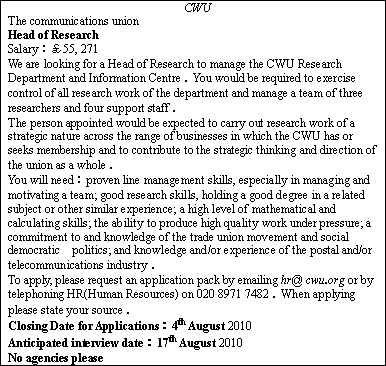
In which column of a newspaper could we find this advertisement?
[ ]
A.
Arts.
B.
News.
C.
Jobs.
D.
Sales.
(2)
One of the duties of the person to be appointed is ________.
[ ]
A.
taking charge of research work
B.
running a telecommunications company
C.
managing a team of three or four members
D.
seeking membership for the trade union
(3)
If you want to apply for this position, you can do all EXCEPT ________.
[ ]
A.
ask an agency for an application form
B.
send in your application before 4th August 2010
C.
email hr@ cwu.org for an application pack
D.
dial 020 8971 7482 for more information
(4)
Which of the following applicants is most likely to be employed?
[ ]
A.
A school teacher with a master's degree.
B.
A clerk from a telecommunications company
C.
A director from a research centre with a master's degree.
D.
A university graduate majoring in computer science.
阅读理解
Andy rode slowly on his way to school, day-dreaming about the fishing trip that his father had promised him.He was so busy dreaming about all the fish he would catch that he was unaware of everything else around him.
He rode along until a strange sound drew him to the present.He came to a stop and looked curiously up to the heavens.What he saw shocked and terrified him.A huge swarm of bees filled the sky like a black cloud and the buzzing mass seemed to be heading angrily towards him.
With no time to waste, Andy sped off in the opposite direction, riding furiously-but without knowing how to escape the swarm.With a rapidly beating heart and his legs pumping furiously, he sped down the rough road.As the bees came closer, his panic increased.Andy knew that he was sensitive to bee stings(蜇).The last sting had landed him in hospital-and that was only one bee sting!He had been forced to stay in bed for two whole days.Suddenly, his father's words came to him.“When you are in a tight situation, don't panic.Use your brain and think your way out of it.”
On a nearby hill, he could see smoke waving slowly skywards from the chimney of the Nelson family home.“Bees don't like smoke,”he thought.“They couldn't get into the house.”Andy raced towards the Nelson house, but the bees were gaining ground.Andy knew he could not reach the house in time.He estimated that the bees would catch up with him soon.
Suddenly, out of the corner of his eyes, he spotted a small dam used by Mr.Nelson to irrigate his vegetable garden.Off his bike and into the cool water he dived, disappearing below the surface and away from the savage insects.After holding his breath for as long as he could, Andy came up for air and noticed the bees had gone.Dragging himself out of the dam, he struggled up the hilly slope and rang the doorbell.Mrs.Nelson took him inside and rang his mother.
“You'll really need that fishing break to help you recover,”laughed his mother with relief.“Thank goodness you didn't panic!”But Andy did not hear her.He was dreaming once again of the fish he would catch tomorrow.”
(1)
Why did Andy fail to notice the swarm of bees earlier?
[ ]
A.
He was lost in the thought of the fishing trip.
B.
He was listening to a strange sound.
C.
He was going fishing with his father.
D.
He was riding to school.
(2)
Which of the following is NOT mentioned about the swarm of bees in the passage?
[ ]
A.
They made Andy stay in hospital for two days.
B.
They shocked and terrified Andy.
C.
They tried to attack Andy in a mass.
D.
They crowded like a black cloud.
(3)
How did Andy avoid the bees in the end?
[ ]
A.
He rode off in the opposite direction.
B.
He hid himself under the water.
C.
He rushed into the Nelson house.
D.
He asked Mr.Nelson for help.
(4)
Which of the following can best describe Andy's escape from the bees?
[ ]
A.
In time of danger, one's mind works fast.
B.
Once bitten, twice shy.
C.
Where there is a will, there is a way.
D.
No pains, no gains.
阅读理解
What is time?Is it a thing to be saved or spent or wasted, like money?Or is it something we have no control over, like the weather?Is it the same all over the world?That's an easy question, you say.Wherever you go, a minute is 60 seconds, an hour is 60 minutes, a day is 24 hours, and so forth.Well, maybe.But in America, time is more than that.Americans see time as a valuable resource.Maybe that's why they are fond of the expression,“Time is money.”
Because Americans believe time is a limited resource, they try to keep and manage it.People in the US often attend conferences or read books on time management.It seems they all want to organize their time better.Professionals carry around pocket planners(计划书)-some in electronic form-to keep track of appointments and deadlines.People do all they can to press more life out of their time.
To Americans, punctuality is a way of showing respect for other people's time.Being more than 10 minutes late to an appointment usually calls for an apology, and maybe an explanation.People who are running late often call ahead to let others know of the delay.Of course, the less formal the situation, the less important it is to be exactly on time.At informal get-togethers, for example, people often arrive as much as 30 minutes past the appointed time.But they usually don't try that at work.
American lifestyles show how much people respect the time of others.When people plan an event, they often set time days or weeks in advance.Once the time is fixed, it takes almost an emergency to change it.If people want to come to your house for a friendly visit, they will usually call first to make sure it is convenient.Only very close friends will just“drop by”unannounced.Also, people hesitate to call others late at night for fear they might be in bed.The time may vary, but most folks think twice about calling after 10∶00 pm.
Even Americans would admit that no one can master time.Time, like money, slips all too easily through our finger.And time, like the weather, is very hard to predict.However, time is one of life's most precious gifts.
(1)
The main idea of the passage is ________.
[ ]
A.
time is money
B.
different attitude toward time in the world
C.
how to save time
D.
how Americans treat time
(2)
In the fourth paragraph, the writer mainly tells us that ________.
[ ]
A.
Americans respect others' time in daily life
B.
Americans seldom call after 10∶00
C.
Americans inform before paying a visit to their friends
D.
when planning an event, Americans usually fix time ahead of time
(3)
The underlined phrase“think twice”(in Paragraph 4)probably means“________”.
[ ]
A.
think for a second time
B.
be careful
C.
be afraid
D.
pay attention
(4)
It can be inferred from the passage that ________.
[ ]
A.
Americans like time better than anything else
B.
generally speaking, Americans respect their time
C.
on the whole, Americans treasure their time
D.
Americans consider their time is difficult to master and predict
阅读理解
Many Americans are turning to Japan, they think, a country of high academic achievement and economic success, for possible answers.However, the answers provided by Japanese preschools are not the ones Americans expected to find.In most Japanese preschools, surprisingly little emphasis is put on academic instruction.In one survey, 300 Japanese and 210 American preschool teachers, child development specialists, and parents were asked about various aspects of early childhood education.Only 2 percent of the Japanese respondents(答问卷者)listed“to give children a good start academically”as one of their top three reasons for a society to have preschools.In contrast, over half the American respondents chose this as one of their top three choices.To prepare children for successful careers in first grade and beyond, Japanese preschools do not teach reading, writing, and mathematics, but rather skills such as determination, concentration, and the ability to work as a member of a group.The huge majority of young Japanese children are taught to read at home by their parents.
Like in America, there is diversity(多样性)in Japanese early childhood education.Some Japanese kindergartens have specific aims, such as early musical training or potential development.In large cities, some kindergartens are attached to universities that have elementary and secondary schools.Some Japanese parents believe that if their young children attend a university-based program, it will increase the children's chances of eventually being admitted to top-rated(一流的)schools and universities.Several more progressive programs have introduced free play as a way out for the heavy intellectualizing(智能化)in some Japanese kindergartens.
(1)
We learn from the first paragraph that many Americans believe ________.
[ ]
A.
Japanese parents are more involved in preschool education than American parents
B.
Japan's economic success is a result of its scientific achievements
C.
Japanese preschool education emphasizes academic instruction
D.
Japan's higher education is superior to theirs
(2)
In Japan's preschool education, the focus is on ________.
[ ]
A.
preparing children academically
B.
developing children's artistic interests
C.
developing children's potential
D.
shaping children's character
(3)
Why do some Japanese parents send their children to university-based kindergartens?
[ ]
A.
They can do better in their future studies.
B.
They can make more group experience grow there.
C.
They can be self-centered when they grow up.
D.
They can have better chances of getting a first-rate education.
(4)
Free play has been introduced in some Japanese kindergartens in order to ________.
[ ]
A.
broaden children's knowledge
B.
train children's creativity
C.
lighten children's study load
D.
enrich children's experience
阅读理解
I had an experience some years ago, which taught me something about the ways in which people make a bad situation worse by blaming themselves.One January, I had to hold two funerals on successive days for two elderly women in my community.Both had died“full of years”, as the Bible would say.Their homes happened to be near each other, so I paid condolence(吊唁)calls on the two families on the same afternoon.
At the first home, the son of the deceased(已故的)woman said to me,“If only I had sent my mother to Florida and gotten her out of this cold and snow , she would be alive today.It's my fault that she died.”At the second home, the son of the other deceased woman said,“If only I hadn't insisted on my mother's going to Florida, she would be alive today.That long airplane ride, the sudden change of climate, was more than she could take.It's my fault that she's dead.”
You see that any time there is a death, the survivors will feel guilty.Because the course of action they took turned out badly, they believe that the opposite course-keeping Mother at home, putting off the operation-would have turned out better.After all, how could it have turned out any worse?
There seem to be two elements involved in our willingness to feel guilty.The first is our pressing need to believe that the world makes sense, that there is a cause for every effect and a reason for everything that happens.That leads us to find patterns and connections both where they really exist and where they exist only in our minds.
The second element is the view that we are the cause of what happens, especially the bad things that happen.It seems to be a short step from believing that every event has a cause to believing that every disaster is our fault.The roots of this feeling may lie in our childhood.
A baby comes to think that the world exists to meet his needs, and that he makes everything happen in it.He wakes up in the morning and summons the rest of the world to its tasks.He cries, and someone comes to attend to him.When he is hungry, people feed him, and when he is wet, people change him.Very often, we do not completely outgrow that childish view that our wishes cause things to happen.
(1)
The author had to hold the two women's funerals probably because ________.
[ ]
A.
he wanted to comfort the two families
B.
he was an official from the community
C.
he had great pity for the deceased
D.
he was priest of the local church
(2)
People feel guilty for the deaths of their loved ones because ________.
[ ]
A.
they couldn't find a better way to express their sorrow
B.
they believe that they were responsible
C.
they had neglected the natural course of events
D.
they didn't know things often turn out in the opposite direction
(3)
According to the passage, the underlined part in paragraph 4 probably means that ________.
[ ]
A.
everything in the world is predetermined
B.
the world can be interpreted in different ways
C.
there's an explanation for everything in the world
D.
we have to be sensible in order to understand the world
(4)
What's the main idea of the passage?
[ ]
A.
Life and death is an unsolved mystery.
B.
Every story should have a happy ending.
C.
Never feel guilty all the time because not every disaster is our fault.
D.
In general, the survivors will feel guilty about the people who passed away.