Charles Blackman: Alice in Wonderland

An Exhibition at the National Gallery of Victoria (NGV), Australia

10 June~12 August 2007

Venue (地点) : The Ian Potter Centre

Admission: Free entry

  Charles Blackman is famous for his beautiful paintings of dreams. In 1956, he heard for the first time Lewis Carroll's extraordinary tale of Alice in Wonderland---the story of a Victorian girl who falls down a rabbit hole, meets a lot of funny characters and experiences all kinds of things. At that time, Blackman's wife was suffering from progressive blindness. The story of Alice moving through the strange situations, often disheartened (使气馁) by various events, was similar to his wife's experiences. It also reflected so much of his own life. All this contributed to the completion of the Alice in Wonderland paintings.

Illustrator Workshop

  Go straight to the experts for an introductory course in book illustration (插图). The course includes an introduction to the process of illustration and its techniques, workshop exercises and group projects.

Dates: Sunday, 17 June & Sunday 5 Aug, 10 a. m. ~ 1 p. m.

Venue: Gas Works Arts Park

Wonderful World

  Celebrate the exhibition and Children's Book Week with special activities just for the day, including a special visit from Alice and the White Rabbit.

Date: Sunday, 24 June, 11 a. m. ~ 4 p. m.

Venue: Exhibition Space, Level 3

Topsy-Turvy

  Visit the exhibition or discover wonderful curiosities in artworks in the NGV Collection and make a magic world in a box Alice and the White Rabbit will be with you. Walt Disney's Alice in Wonderland will be screened.

Dates: Sunday 8, 15, 22, 29 July, and Tuesday 24 ~ Friday 27 July, 12 noon ~ 3 p. m.

Venue: Theatre, NGV Australia

Drawing Workshop

  Distortions of scale (比例失真) can make artworks strange but interesting. Find out how Charles Blackman distorted scale in his paintings to create a curious world, then experiment with scale in your own drawings. More information upon booking.

Date: Friday 27 July, 10:30 a. m. ~ 3 p. m.

Venue: Foyer, Level 3

(2007·天津)

(1) Charles Blackman's paintings come from ________.

[  ]

A.his admiration for Lewis Carroll

B.his dream of becoming a famous artist

C.his wish to express his own feelings

D.his eagerness to cure his wife's illness

(2) Which two activities can you participate in on the same day?

[  ]

A.Illustrator Workshop and Wonderful World.

B.Illustrator Workshop and Drawing Workshop.

C.Wonderful World and Topsy-Turvy.

D.Topsy-Turvy and Drawing Workshop.

(3) To understand the Alice in Wonderland paintings, you should go to ________.

[  ]

A.Exhibition Space, Level 3

B.Gas Works Arts Park

C.Theatre, NGV Australia

D.Foyer, Level 3

(4) Activities concerning children's books are to be held ________.

[  ]

A.on June 24,2007
B.on July 15,2007
C.on July 27,2007
D.on August 5,2007

  African-American talk show queen Oprah Winfrey is the world's most powerful celebrity (名人), according to Forbes (福布斯) magazine. It placed Winfrey at the top of its annual ranking of the 100 people with the biggest pull (影响力).

  Winfrey, 52, draws 30 million viewers weekly in the United States. Her talk show reaches 112 countries. She earned $ 225 million over the past 12 months to rank second in celebrity riches.

  The annual Forbes list gives most weight to annual earnings. But it also looks at the celebrity's presence on the Internet and in the media. "After 21 years, her exciting chat show still rules the airwaves," the magazine said.

  Winfrey is most popular with her popular talk show "The Oprah Winfrey Show". She can always attract the superstars and let them open up to her intimate interviewing style. Winfrey's approach appears to be simple. She is in a pursuit (追求) of self-empowerment. This has proved to be just what people, especially women, want.

  Winfrey often talks about her personal secrets on her show. That pulls in viewers. For example, she made it known that she had been sexually abused as a child, and has spoken freely of her struggle with her weight.

  Her success has not just been on the screen. Her media group includes a women's TV network and websites for women. Her work has extended to social change. In 1991, she did a lot of work for the National Child Protection Act. She testified before the US Senate to establish a national database (数据库) of dangerous child abusers. President Bill Clinton later signed the "Oprah Bill" into law.

(1) The annual Forbes list selects its celebrities according to ________.

[  ]

A.their names

B.their annual earnings

C.their presence on the Internet and in the media

D.their annual earnings and presence in the public

(2) Which of the following statements is NOT true?

[  ]

A.Oprah Winfrey was the first of the 100 celebrities according to Forbes magazine.

B.Oprah's success has been only on the screen.

C.Oprah can attract superstars and get them to open up to her interview.

D.Oprah ranked second in celebrity riches that year.

(3) The underlined phrase "rules the airwaves" in Paragraph 3 means ________.

[  ]

A.attracts many readers' attention

B.causes many people to take planes

C.has a large number of viewers

D.measures the airwaves

(4) What's the best title of the passage?

[  ]

A.Oprah Winfrey Conquering the Americans

B.Oprah Winfrey---the No. 1 Celebrity

C.Forbes Ranking List

D.The Oprah Winfrey Show

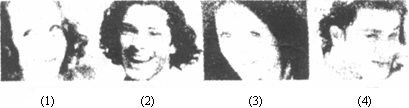
  Laura

  The smile is in the eyes. This is a sensitive person, and a loyal friend. This sort of person thinks before they speak and is a good listener. They don't like to be the center of attention of a crowd.

  Peter

  This type of person is very sure of themselves. They like a good argument. They usually win. They're hard-working and very ambitious. And they can be quite bossy (爱指挥人的).

  Lucy

  This is the smile of a joker. The raised eyebrows and dimples (酒窝) in the cheeks show a good sense of humor and a warm personality. This sort of person is often a bit of a rebel---they have little respect for authority.

  Bill

  The wide, toothy smile shows that this person is easy-going and friendly. They enjoy being in a crowd and are good fun to go out with. They are always looking for the next party. This is a smile that says, "I know it all."

(1) Which of the following matches the pictures and the descriptions correctly?

[  ]

A.Picture 1---Laura; Picture 2---Peter; Picture 3---Lucy; Picture 4---Bill

B.Picture 1---Lucy; Picture 2---Peter; Picture 3---Laura; Picture 4---Bill

C.Picture 1---Laura; Picture 2---Bill; Picture 3---Lucy; Picture 4---Peter

D.Picture 1---Lucy; Picture 2---Bill; Picture 3---Laura; Picture 4---Peter

(2) What does the underlined word "rebel" (in Paragraph 3) mean?

[  ]

A.Someone who tends to refuse to do what they are told to.

B.Someone who respects people in power.

C.Someone who always tells other people what to do.

D.Someone who always follows what other people do.

(3) Who are most likely to have a quarrel when living and working together?

[  ]

A.Lucy and Laura.
B.Bill and Peter.
C.Lucy and Peter.
D.Laura and Bill.

(4) If you often get nervous around people or fear public speaking, who can help you most probably?

[  ]

A.Laura.
B.Peter.
C.Lucy.
D.Bill.

(5) What is the best title for the passage?

[  ]

A.What's in a Smile?
B.What's in a Character?
C.Who's Who?
D.What's What?

  Two American scientists told the people in industrial nations that they would be much healthier if they ate more of the same kind of foods eaten by humans living more than 10 000 years ago.

  The scientists say that the human body has changed very little since human first appeared on earth, but the way we live has changed greatly. Our body has not been able to deal with these changes in life style and this has led to new kinds of sicknesses. These new sicknesses were not known in ancient times. So they are called "diseases of civilization". Many cancers and diseases of the blood system, including heart attacks and strokes (中风) are examples of such diseases.

  Scientists noted that early stone-age people used very little alcohol (酒精) or tobacco, probably none. Ancient people also got a great deal of physical exercise, but a change in food is one of the main differences between life in ancient times and life today. Stone-age people hunted wild animals for their meat, which had much less fat than farm animals. They also ate a lot of fresh wild vegetables and fruits. They did not use milk and other dairy products, and they made very little use of grains. But today, we eat a large amount of dairy products and grain foods. We eat six times more salt than stone-age people. We eat more sugar. We eat twice as much fat but only one third as much protein and much less vitamin C.

  People today probably do not want to live as people thousands of years ago did, but scientists say that we would be much healthier if we ate as those ancient people did, cutting the amount of fatty, salty and sweet foods.

(1) The people in industrial nations would be much healthier if they ate ________.

[  ]

A.more foods as humans living 10 000 years ago did

B.as humans living 10 000 years ago

C.more kinds of food eaten by people living over 10 000 years ago

D.more of the same kind of foods eaten by people over 10 000 years ago

(2) What is the main cause mentioned in the article why people suffer from a lot of new sicknesses?

[  ]

A.Ancient people did a great deal of physical exercise.

B.People today have a lot of alcohol.

C.People today have more tobacco.

D.Food is quite different between life today and life in ancient times.

(3) Stone-age people were much healthier than people today because they ate a lot of ________.

[  ]

A.milk and other dairy products

B.grain foods and farm animals

C.salt and sugar

D.wild animals, fresh wild vegetables and fruits

(4) From this article, we know that ________ are not good to our health.

[  ]

A.protein and vitamin C

B.milk and grain foods

C.wild animals, vegetables and fruits

D.a huge amount of fatty, salty and sweet foods

阅读下列短文,从每题所给的A、B、C和D项中,选出最佳选项。

  One night recently, I was driving down a two-lane highway at about 60 miles an hour. A car approached from the opposite direction at about the same speed. As we passed each other, I caught the other driver's eye for only a second I wondered whether he might be thinking, as I was, how dependent we were on each other at that moment. I was relying on him not to fall asleep, not to be put off by a phone conversation, not to cross over into my lane and bring my life to a sudden end. Though we had never spoken a word to each other, he relied on me in just the same way.

  Multiplied a million times over, I believe that is the way the world works. At some level, we all depend upon one another. Sometimes that dependence requires us simply not to do something like crossing over the double yellow line. And sometimes it requires us to act cooperatively, with friends or even with strangers.

  As technology shrinks our world, the need increases for cooperative action among nations. In 2003, doctors in five nations were quickly organized to identify the SARS virus, which saved thousands of lives. The threat of international terrorism has shown itself to be a similar problem, one requiring coordinated action by police and intelligence forces across the world We must recognize that our fates (命运) are not ours alone to control.

  In my own life, I've put great stock in personal responsibility. But, as the years have passed, I've also come to believe that there are moments when one must rely upon the good faith and judgment of others. So, while each of us faces the case of driving alone down a dark road, what we must learn is that the approaching light may not be a threat, but a shared moment of trust.

(1) The author considers ________ very important.

[  ]

A.driving alone on a dark road

B.independence of people

C.cooperation to identify SARS virus

D.shared trust and cooperation

(2) The author said that they depended on each other in the same way because ________.

[  ]

A.the approaching car was very dangerous

B.they both drove their car at a terrific speed

C.he might be killed out of the other's careless driving

D.it was dark and the road was not wide enough

(3) From the second paragraph, we know the author drew the important lesson form ________.

[  ]

A.only one experience

B.many similar experiences

C.a driver on a dark road

D.many friends and strangers

(4) The need for cooperation increases because ________.

[  ]

A.peoples' fates can't be controlled by themselves

B.the SARS virus spread quickly

C.terrorism can happen everywhere

D.the world has become smaller

(5) We can infer from the last paragraph that the author has ________.

[  ]

A.believed in one's own personal responsibility

B.counted upon himself alone in everything

C.had no trust in others' good faith and judgment

D.had a change on his viewpoint of life

  The English, as a race, are very different from all other nationalities, including their closest neighbors, the French, Belgians and Dutch. It is claimed (声称) that living on an island separated from the rest of Europe has much to do with it. Whatever the reasons, it may be fairly slated (预定,注定) that the Englishman has developed many attitudes and habits which distinguish him from other nationalities.

  Broadly speaking, the Englishman is a quiet, shy, reserved person who is fully relaxed only among people he knows well. In the presence of strangers or foreigners he often seems embarrassed. You have only to see a city train any morning or evening to see the truth of this. Serious-looking businessmen and women sit reading their newspapers or having a light sleep in a corner. No one speaks. In fact, to do so would seem most unusual. An Englishman, pretending to be giving advice to overseas visitors, once suggested, "On entering a railway carriage, shake hands with all the passengers." Needless to say, he was not being serious. There is an unwritten but clearly understood code of behavior which, if broken, makes the person immediately suspected (怀疑).

  In many parts of the world it is quite normal to show openly extremes of enthusiasm, emotion, excitement, etc. The Englishman is somewhat different. Of course, an Englishman feels no less deeply than any other nationality, but he tends to display his feelings far less. This is reflected in his use of language. Imagine a man commenting on the great beauty of a young girl. Whereas a more emotional man might describe her as "an excellent jewel", "extremely beautiful" or "precious", the Englishman will flatly state "Um, she is all right."

(1) From the passage people can infer that the English are different from other nationalities mainly in ________.

[  ]

A.manners

B.character

C.the principle of behavior

D.all aspects

(2) If one doesn't want to be suspected in public, he had better ________.

[  ]

A.behave relaxed

B.shake hands with all the people he meets

C.talk with others

D.keep quiet

(3) According to the passage, the Englishman ________.

[  ]

A.has fewer feelings than other nationalities

B.has emotions as deep as any other nationality

C.expresses emotions by using his language

D.likes to have a joke with foreign visitors

(4) An Englishman's saying "all right" usually has the sense of ________.

[  ]

A.not bad
B.quite right
C.so-so
D.very good

  Hong Kong action star and tourism ambassador Jackie Chan apologized for his disruption and insults (辱骂) to the audience at Jonathan Lee's concert in Hong Kong but refused to admit that he was drunk.

  Chan told the media backstage on Monday, "I was drunk and I feel ashamed." Alex Fong, Chan's son, also apologized for his father's behavior and promised the media there would he no such things next time.

  However, on Wednesday, Chan denied that he was drunk. "I would call it excitement on stage. I only made some jokes with Lee, not a big deal," he said.

  Lee also defended his friend Chan, saying there was no smell of alcohol in his breath. "He is a forthright (直率的) person. We always use dirty words with each other in daily life but it is not right to say them in public," Lee said.

  Actually, it was the second time that day that Chan disturbed an event. Guangzhou-based Information Times reported yesterday that at a TVB party, Chan criticized the Hong Kong public TV channel for keeping singers signed with the station from being interviewed by other media.

  Since Chan is Hong Kong's tourism ambassador, his gaffe on stage drew attention of the Hong Kong Tourism Hoard. A spokeswoman for the board said they had contacted Chan but he was on a business trip. She refused to comment on whether Chan's behavior had hurt Hong Kong's image. No complaints have received so far according to the Hong Kong Leisure and Cultural Service Department.

(1) What did Jackie Chan do at Lee's concert according to this passage?

[  ]

A.He refused to admit that he was drunk.

B.He was drunk and felt ashamed.

C.He made some jokes with Lee.

D.He said some dirty words.

(2) Which of the following can best describe Lee's attitude towards Chan?

[  ]

A.He understood Chan well.

B.He made some remarks in favour of Chan.

C.He didn't think highly of Chan's behavior.

D.He criticised Chan's behavior.

(3) What would be the best title for this passage?

[  ]

A.Dirty Words on Stage

B.Jackie Chan's Story

C.Excitement on Stage

D.Jonathan Lee's Concert

(4) The underlined word "gaffe" in the last paragraph means ________.

[  ]

A.an improper behavior

B.ill-treatment

C.an excellent performance

D.an exciting remark

(5) Where can we probably read this passage?

[  ]

A.In a science book.
B.In a biography.
C.In a newspaper.
D.In a history book.

阅读下列短文,从每题所给的A、B、C和D项中,选出最佳选项。

  During my travels through the mountains of Greece I was only ever scared once. It was dusk and as I walked alone I came across six large wolves that were feeding on the body of a dead animal. I had heard many stories about wolves as a child and it was this animal that I feared more than any other. The wolves before me were huge, at least 6 feet long and covered with thick grey fur.

  As I approached, the wolves left the blood-covered snow that surrounded the body and started walking towards me, one after another. They stopped about 20 metres from me and stared. The lead wolf raised his head into the air and took in a deep breath, as if he was smelling my presence. The animals looked both beautiful and terrifying, but I knew I could not show them my fear. As I drew nearer the lead wolf raised its head once more but this time let out a loud howl. The awful cry rang out across the silent valley. A more frightening sound I had never heard. I was almost certain it signalled death.

  Every moment I expected to see the pack dash at me. I knew my only hope was to pretend I had no fear. I walked past the line of wolves, like a general moving among his soldiers. They howled out again. But when they saw that their warcry did not cause me to change my direction or make me run they feared to come after me; so they let me pass and returned to the dead animal.

  Had I turned back or tried to run away when they marched out to meet me I am certain the whole pack would have attacked me in a moment. But my show of false courage intimidated them and kept them back.

(1) Why didn't the wolves attack the man?

[  ]

A.They were no longer hungry when they saw him.

B.The man was already known to the wolves.

C.They were too far away to catch the man.

D.The man showed no fear as he passed them by.

(2) The underlined word "intimidated" probably means "________".

[  ]

A.encouraged
B.scared
C.doubted
D.hurt

(3) In which order are the following events mentioned?

a.The wolves walked towards the man.

b.The man thought he was about to die.

c.The wolves returned to the dead animal.

d.The man had heard stories about wolves.

e.The man walked past the wolves.

f.The lead wolf took a deep breath.

[  ]

A.a,d,f,b,c,e
B.d,a,f,b,e,c
C.a,f,d,e,b,c
D.d,f,a,b,c,e

(4) What is the author's intention in writing this story?

[  ]

A.To show that mountains can be dangerous places.

B.To discuss the habits of mountain wolves.

C.To make people aware of the danger of wolves.

D.To stress the need for courage when in danger.

(5) Which is the best title for this story?

[  ]

A.In the Face of Fear
B.My Greek Adventure
C.My Mountain Travels
D.A Man Without Fear

阅读下列短文,从每题所给的A、B、C和D项中,选出最佳选项。

  Ideas about polite behavior are different from one culture to another. Some societies, such as America and Australia, for example, are mobile and very open. People here change jobs and move houses quite often As a result, they have a lot of relationships that often last only a short time, and they need to get to know people quickly. So it's normal to have friendly conversations with people that they have just met, and you can talk about things that other cultures would regard as personal.

  On the other hand there are more crowded and less mobile societies where long-term relationships are more important. A Malaysian or Mexican business person, for example, will want to get to know you very well before he or she feels happy to start business. But when you do get to know each other, the relationship becomes much deeper than it would in a mobile society.

  To Americans, both Europeans and Asians seem cool and formal at first. On the other hand, as a passenger from a less mobile society put it, it's no fun spending several hours next to a stranger who wants to tell you all about his or her life and asks you all sorts of questions that you don't want to answer.

  Cross-cultural differences aren't just a problem for travelers, but also for the flights that carry them All flights want to provide the best service, but ideas about good service are different from place to place. This can be seen most clearly in the way that problems are dealt with.

  Some societies have "universalist" cultures. These societies strongly respect rules, and they treat every person and situation in basically the same way.

  "Particularist" societies, on the other hand, also have rules, but they are less important than the society's unwritten ideas about what is right or wrong for a particular situation or a particular person So the normal rules are changed to fit the needs of the situation or the importance of the person.

  This difference can cause problems. A traveler from a particularist society, India, is checking in for a flight in Germany, a country which has a universalist culture. The Indian traveler has too much luggage, but he explains that he has been away from home for a long time and the suitcases are full of presents for his family. He expects that the check in official will understand his problem and will change the rules for him. The check-in official explains that if he was allowed to have too much luggage, it wouldn't be fair to the other passengers. But the traveler thinks this is unfair, because the other passengers don't have his problem.

(1) Often moving from one place to another makes people like Americans and Australians ________.

[  ]

A.like travelling better

B.easy to communicate with

C.difficult to make real friends

D.have a long-term relationship with their neighbors

(2) People like Malaysians prefer to associate with those ________.

[  ]

A.who will tell them everything of their own

B.who want to do business with them

C.they know quite well

D.who are good at talking

(3) A person from a less mobile society will feel it ________ when a stranger keeps talking to him or her, and asking him or her questions.

[  ]

A.boring
B.friendly
C.normal
D.rough

(4) In "particularist" societies, ________.

[  ]

A.they have no rules for people to obey

B.people obey the society's rules completely

C.no one obeys the society's rules though they have

D.the society's rules can be changed with different persons or situations

(5) The writer of the passage thinks that the Indian and the German have different ideas about rules because of different ________.

[  ]

A.interests
B.cultures
C.habits and customs
D.ways of life

  My husband and children think they are very lucky that they are living and that it's Christmas again. They can't see that we live on a dirty street in a dirty house among people who aren't much good. But Johnny and children can't see this. What a pity it is that our neighbors have to make happiness out of all this dirt. I decided that my children must get out of this. The money that we've saved isn't nearly enough.

  The Me Garitys have money but they are so proud. They look down upon the poor. The Me Garity girl just yesterday stood out there in the street eating from a bag of candy while a ring of hungry children watched her. I saw those children looking at her and crying in their hearts; and when she couldn't eat any more she threw the rest down the sewer (下水道). Why, is it only because they have money? There is more to happiness than money in the world, isn't there?

  Miss Jackson who teaches at the Settlement House isn't rich, but she knows things. She understands people. Her eyes look straight into yours when she talks with you. She can read your mind. I'd like to see the children be like Miss Jackson when they grow up.

(1) This passage mainly suggests that the writer ________.

[  ]

A.is easy to get along with

B.is unhappy with the life they are living

C.is good at observing and understanding

D.is never pleased with her neighbors

(2) What do you think of Me Garity girl?

[  ]

A.She is proud and hungry.

B.She is selfish and cruel.

C.She is lonely and friendless.

D.She is unhappy and misunderstood.

(3) In this text, the writer tries to tell us that ________.

[  ]

A.money is the key to everything

B.the more money you have, the less happy you'll be

C.there is something more important than money

D.when talking to people we should look into their eyes

(4) Pick out the one that does NOT describe the writer's view on money.

[  ]

A.Why, is it only because they have money?

B.There is more to happiness than money.

C.Miss Jackson isn't rich, but she knows things.

D.The money we saved isn't nearly enough.

 0  78436  78444  78450  78454  78460  78462  78466  78472  78474  78480  78486  78490  78492  78496  78502  78504  78510  78514  78516  78520  78522  78526  78528  78530  78531  78532  78534  78535  78536  78538  78540  78544  78546  78550  78552  78556  78562  78564  78570  78574  78576  78580  78586  78592  78594  78600  78604  78606  78612  78616  78622  78630  151629 
违法和不良信息举报电话:027-86699610 举报邮箱:58377363@163.com

精英家教网