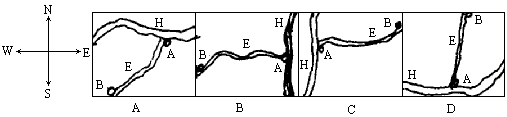
The Erie Canal was the first important national waterway built in the US. It crossed New York from Buffalo on Lake Erie Troy to Albany on the Hudson River. It joined the Great Lakes with the Atlantic Ocean. The canal served as a route over which industrial goods could flow into the west, and materials could pour into the east. The Erie Canal helped New York develop into the nation's largest city.

  The building of the canal was paid for entirely by the state of New York. It cost $ 7,143,789, but it soon gained its price many times over. Between 1825, when the canal was opened, and 1882, when toll charges were stopped, the state collected $ 121,461,891.

  For a hundred years before the Erie was built, people had been talking about a canal which could join the Great Lakes and the Atlantic Ocean. The man who planned the Erie Canal and carried the plan through was De Witt Clinton. Those who were against the canal laughingly called it “Clinton's Ditch”. Clinton talked and wrote about the canal and drew up plans for it. He and Governor Morris went to Washington in 1812 to ask for help for the canal, but they were unsuccessful.

  Clinton became governor of New York in 1817, and shortly afterwards, on July 4,1817, broke ground for the canal in Rome, N. Y. The first part of the canal was 40 feet wide and 4 feet deep. Between 1836 and 1862, the Erie Canal was enlarged to a depth of 7 feet. In 1903, a third canal was begun, known as the Barge Canal. Completed in 1918, it used a new route in many places. It is 12 to 14 feet deep, 120 to 200 feet wide, and 363 miles long, from Albany to Buffalo. The Erie Canal today is used largely by recreational boats.

1.Which of the following picture tells the right position of the Erie Canal?

(H=Hudson River; E=Erie Canal; A=Albany; B=Buffalo)

[  ]

2.It can be inferred that ________ into the Atlantic Ocean.

[  ]

A.the Great Lakes flow

B.The Hudson River flows

C.Lake Erie flows

D.the Erie Canal flows

3.Which of the following is TRUE according to the text?

[  ]

A.The Eric Canal is now used mainly for tourism rather than for transport.

B.It's 363 miles from the Great Lakes to the Atlantic Ocean.

C.The West was more advanced than the East when the canal was built.

D.The final canal is more than 4 times deeper than the original one.

4.Which of the following statements is NOT true about the canal?

[  ]

A.The Erie Canal brought profits(利润) of over 114,000,000.

B.The Erie Canal has a history of nearly 180 years.

C.New York city charged for the use of the canal for 57 years.

D.Construction of the original canal took 8 years.

  The orange towers of the Golden Gate Bridge-probably the most beautiful, certainly the most photographed bridge in the world-are visible from almost every point of elevation in San Francisco. The only cleft(穿过) in Northern California's 600-mile continental wall, for years this mile-wide strait was considered unbridgeable. As much an architectural as an engineering feat, the Golden Gate took only 52 months to design and build. Designed by Joseph Strauss, it was the first really massive suspension bridge, with a span of 4200ft, and until 1959 ranked as the world's longest. It connects the city at its northwesterly point on the peninsula to Marin County and Northern California, and was designed to withstand winds of up to a hundred miles an hour and to swing as much as 27ft. Handsome on a clear day, the bridge takes on an eerie(阴森森的) quality when the thick white fogs pour in and hide it almost completely.

  You can either drive or walk across. The drive is the more thrilling of the two options as you race under the bridge's towers, but the half-hour walk across it really gives you time to take in its enormous size and absorb the views of the city behind you and the headlands of Northern California straight ahead. Pause at the midway point and consider the seven or so suicides a month who choose this spot, 260ft up, as their jumping-off spot. Monitors of such events speculate that victims always face the city before they leap. In 1995, when the suicide toll from the bridge had reached almost 1000, police kept the figures quiet to avoid a rush of would-be suicides going for the dubious distinction of being the thousandth person to leap.

  Perhaps the best-loved symbol of San Francisco, in 1987 the Golden Gate proved an auspicious(幸运的) place for a sunrise party when crowds gathered to celebrate its fiftieth anniversary. Some quarter of a million people turned up (a third of the city's entire population); the winds were strong and the huge numbers caused the bridge to buckle, but fortunately not to break.

1.The underlined word “buckle” here means ________.

[  ]

A.collapse
B.crash
C.bend
D.shake

2.The Golden Gate Bridge was complete in ________.

[  ]

A.1922
B.1995
C.1937
D.1959

3.Which of the following is TRUE?

[  ]

A.The Golden Gate is the longest bridge in the world.

B.So far about 1000 people killed themselves form the Golden Gate.

C.It took the workers 52 months to build the Golden Gate.

D.San Francisco had a population of about 750, 000 in 1987.

4.If you want to enjoy the views of San Francisco from the bridge, you'd better cross the bridge ________.

[  ]

A.by train
B.on foot
C.by car
D.by ship

  The following are four forms about medicine. How to use the medicine is very important. Never take any by mistake.

  ·Take the medicine with water, followed by one tablet every eight hours, as required. For further nighttime and early morning, take two tablets at bedtime. Do not take more than six tablets in 24 hours. For children six or twelve years old, give half the adult dosage. For children under six years old, go to your doctor for advice. Reduce dosage if nervousness, restlessness or sleeplessness takes place.

  ·Each pill of the medicine is taken three times every day for those fourteen years old. As usual, a pill at 6:00 a. m before breakfast, one before 11:00 a, m and one before sleep. Not for children under six years old and old persons with heart trouble.

  ·The medicine is for a person with a fever. Once two pills a day before sleep. Half for children under 12 years old. Children with a high fever, go to see a doctor.

  ·The medicine is taken three times a day, once five pills for adult with a cold. Half of the pills for children 10 years old. Take the medicine before breakfast, lunch, supper or before sleep.

1.If one aged 22 with fever requires to get rid of the illness, he should take the ________ kind of medicine.

[  ]

A.first
B.second
C.third
D.fourth

2.________ should stop taking the second kind of medicine.

[  ]

A.Persons in a bad mood

B.Sleepless persons

C.Persons with heart trouble

D.Nervous persons

3.When a person has a cold, he had better ________.

[  ]

A.have about fifteen pills a day

B.have pills twice a day

C.have pills four times a day

D.have nine pills a day

4.How many kinds of medicine are used for the children six years old?

[  ]

A.All of them.

B.Three kinds of medicine.

C.Two kinds of medicine.

D.Almost not any medicine.

  I fell in love with England because it was quaint(古雅)-all those little houses, looking terribly old-fashioned but nice, like dolls' houses. I loved the countryside and the pubs, and I loved London. I've slightly changed my mind after seventeen years because I think it's an ugly town now.

  Things have changed. For everybody, England meant gentlemen, fair play, and good manners. The fair play is going, unfortunately, and so are the gentlemanly attitudes and good manners-people shut doors heavily in your face and politeness is disappearing.

  I regret that there are so few comfortable meeting places. You're forced to live indoors. In Paris I go out much more, to restaurants and nightclubs. To meet friends here it usually has to be in a pub, and it can be difficult to go there alone as a woman. The cafes are not terribly nice.

  As a woman, I feel unsafe here. I spend a bomb on taxis because I will not take public transport after 10 p. m. I used to use it, but now I'm afraid.

  The idea of family seems to be more of less non-existent in England. My family is well united and that's typically French. In Middlesex I had a neighbour who is 82 now. His family only lived two miles away, but I took him to France for Christmas once because he was always alone.

1.The writer doesn't like London because she ________.

[  ]

A.is not used to the life there now

B.has lived there for seventeen years

C.prefers to live in an old-fashioned house

D.has to be polite to everyone she meets there

2.Where do people usually meet their friends in England?

[  ]

A.In a cafe.
B.In a restaurant.
C.In a nightclub.
D.In a pub.

3.The underlined part “it” (in Para. 4) refers to ________.

[  ]

A.a taxi
B.the money
C.a bomb
D.public transport

4.The writer took her neighbour to France for Christmas because he ________.

[  ]

A.felt lonely in England

B.had never been to France

C.was from a typical French family

D.didn't like the British idea of family

  A rising moon seems larger because it appears farther away. Why does the moon seem so much larger when it's on the horizon than when it's overhead? The question has perplexed us for millennia(千年).

  Known as the “moon illusion,” the effect has produced some studies that show when the moon hangs low in the sky it appears twice as big as when it reaches its zenith (顶峰). Yet the moon remains constant, both in size and distance from the earth.

  Lloyd Kaufman, professor of psychology and neural science at New York University, has pondered the problem for more than 40 years, and he thought he knew the answer but couldn't prove it. “It became increasingly clear that there was no way we were going to convince the critics without date,” he said.

  So he teamed up with his son, James Kaufman, a physicist at IBM's Almaden Research Center in San Jose, Calif. Both thought that the illusion was caused by our perception(感觉) of how far away we thought the moon was-its apparent distance. “I asked, can't we just measure the perceived distance that the brain uses in calculating the size of the moon?” the younger Kaufman says. “An experiment was the logical thing to do.”

  Aided by a few wizards at IBM, he came up with just the tool, a computerized moon simulator that allows the scientists to determine what people think they're seeing when they look at the moon. The result is surprising, and like any good illusion, the answer itself is a bit baffling(困惑). We think the horizon moon is bigger, the study shows, because we think it's farther away. That seems to defy commonsense. When the moon rises over the snowcapped mountain outside my office window in Alaske, it looks close enough to be just the other side of the mountain. But the study shows that isn't what my brain perceives. But don't let the science take the romance out of moonlit walks.

1.In the third line of the first paragraph, the word “perplexed” probably means ________.

[  ]

A.surprised
B.shocked
C.feared
D.confused

2.The best title for this passage is ________.

[  ]

A.It's How You Look At It

B.Father and Son Collaborate

C.How Big Is The Rising Moon

D.The Moon Can't Be With A.Cue

3.Professor Llyod Kaufman cooperated with his son ________.

[  ]

A.to carry out an experiment on the “moon illusion”

B.to continue their research

C.to convince the critics

D.to make a further experiment on the moon

4.The result of the experiment on the topic turned out to be ________.

[  ]

A.surprising
B.excellent
C.sad
D.encouraging

5.The passage tells us when the moon rises over a high mountain, it looks ________.

[  ]

A.smaller than before
B.near to the mountain
C.the same as usual
D.bigger than before

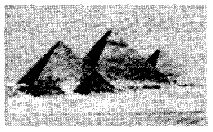
  The oldest stone buildings in the world are the pyramids. They have stood for nearly 5,000 years, and it seems likely that they will continue to stand for thousands of years yet. There are over eighty of them scattered along the banks of the Nile, some of which are different in shape from the true pyramids. The most famous of these are the “Step” pyramid and the “Bent” pyramid.

  Some of the pyramids still look as much alike as they must have been when they were built thousands of years ago. Most of the damage suffered by the others has been at the hands of men who were looking for treasure or. more often, for stone to use in modern buildings. The dry climate of Egypt has helped to keep the pyramid, in good condition, and their very shape has made them less likely to fall into ruin. These are good reasons why they can still be seen today, but perhaps the most important one is that they were planned to last forever.

  The “Step” pyramid had to be on the west side of the Nile, the side on which the sun set. This was for spiritual reasons. It also had to stand well above the level of the river to protect it against the regular floods. It could not be too far from the Nile, however, as the stones to build it needed to be carried in boats down the river to the nearest point. Water transport was, of course, much easier than land transport. The builders also had to find a rock base, which was not likely to crack under the great weight of the pyramid. Finally, it had to be near the capital, or better still, near the king's palace so that he could visit it easily to personally check the progress being made on the final resting place for his body.

1.Which of the following statements is TRUE about the “Step” pyramid?

[  ]

A.It is unlikely to fall into ruin in the near future.

B.It was built on the sands along the Nile.

C.It is the oldest building on earth.

D.It is the most famous of the true pyramids.

2.The most important reason why some pyramids remain in good condition is that ________.

[  ]

A.people have taken care of them

B.it doesn't rain often in Egypt

C.they were well designed

D.the government has protected them from damage

3.Most of the damage to the pyramids has been caused by ________.

[  ]

A.the regular floods

B.the dry climate of Egypt

C.people searching for gold

D.people in search of building materials

4.Why did the Egyptians build the pyramids along the banks of the Nile?

[  ]

A.Because they believed in their god.

B.Because it was difficult to find a large rock base far from the Nile.

C.Because the river helped a lot in the transport of building materials.

D.Because it was not easy to choose a suitable place for the pyramids.

  One night when my wife was preparing dinner, our little son took a piece of paper to her which read:

  For washing the car………………………………………$ 5, 00

  For making my own bed this week………………………$ 1.00

  Going to the provision shop………………………………$ 0.50

  Playing with little sister……………………………………$ 0.25

  Taking out the rubbish………………………………………$ 1.00

  Getting a good report card…………………………………$ 5.00

  And for sweeping the common corridor……………………$ 2.00

  Total…………………………………………………………$ 14.75

  His mother looked at him standing there expecting payment. I could see athousand memories flashed through her mind. So she picked up the pen and turning the paper over, this is what she wrote:

  For 9 months I carried you, growing inside me………………………………No Charge

  For the nights I sat up with you, doctored and prayed for you………………No Charge

  For the toys, food and clothes and wiping your nose………………………No Charge

  When you add it all up, the full cost of my love……………………………No Charge

  Well, when he finished reading, he had great big tears in his eyes. He looked at his mother and said, “Mummy, I love you.” Then he took the pen and in great big letters wrote on the “bill” “All paid.”

1.What's the best title for this passage?

[  ]

A.Part-time Job

B.Mother's Love, No Charge

C.Payment for Housework

D.Greedy Mother

2.The writer wrote the passage in order to ________.

[  ]

A.show that children should be paid for their housework

B.show that children should not be paid for their housework

C.show a clever way of teaching children

D.tell children how to spend their spare time

3.How do you think of the mother in the passage?

[  ]

A.Clever.
B.Greedy.
C.Cold-hearted
D.Selfish.

4.From the last passage we know that ________.

[  ]

A.the boy got all the money he wanted

B.the mother was unwilling to give the money to the boy

C.the boy realized that it was not right to ask for money for the housework

D.the mother was angry with what the boy said

  Samhhar is a 190-sq-km lake which lays some 60 km west of Jaipur. Jaipur is about 560 km southwest of New Delhi. Within a year, Sambhar is sweet or salty. Every year from October to the following May, it contains a high level of salt, and yet between June and September it gets saltless, and becomes a lake sweet enough to drink from. In the four rainy months, rain water from several rivers feeds the lake in large amounts, causing flood, Because of the rain, the salt is watered down and the water grows sweet. When the rainy season is gone, the lake gets salt back.

  Sambhar quite literally means salt and it's India's largest salt lake. Salt has been extracted from the area for over a thousand years. This vast body of salt is on average just 0.6 cm deep and never more than 3m even just after the rainy season. The lake has been divided into two sections by a 5-km-long stone dam The eastern section contains the reservoirs for salt extraction, canals and saltpans. Water from the western section is pumped to the other side when it reaches a degree of salt considered proper for extraction.

  What really draws one to Sambhar is the lure of flamingos and many other species. The birds are attracted here in thousands by the delicious algae. Birds, perhaps 20,000 to 30,000 strong, can be seen flying and singing over the glassy water and dark mud.

1.Which of the following maps gives the right position of Jaipur?

(ND=New Delhi; J=Jaipur; I=India)

[  ]

2.Which of the following statements is TRUE about the lake?

[  ]

A.It has a total area of 190 square miles.

B.Salt is extracted from the west part of the lake.

C.The salt in the lake is more than 3 m deep.

D.The rain removes the salt from Sambhar.

3.The underlined word “lure” is the nearest in meaning with ________.

[  ]

A.attraction
B.number
C.food
D.beauty

4.The writer is trying to tell us ________ in the text.

[  ]

A.how Sambhar came into being

B.Sambhar is an interesting place

C.Sambhar is a tasty lake

D.what “sweet of salty” really means

Princeton University

  Location

  The university is in Princeton, New Jersey. It is an hour's train ride south of New York City and an hour's train ride north of Philadelphia.

  Students

  There are 4,600 undergraduates(本科生). There are also 1,900 graduate students, but Princeton is unusual among universities in having a student body made up largely of undergraduates.

  Faculty

  Princeton has about 700 full-time faculty members(教员). There are another 300 or so part-time and visiting faculty. All faculty members at Princeton are expected to teach and research.

  Princeton offers two undergraduate degrees: the bachelor(学士) of arts (A. B. ) degree and the bachelor of science in engineering(B. S. E) degree.

  Academic Year

  All academic years runs from September to late May and lasts two terms(fall and spring). A.normal course load is four or five courses per term, although many students take extra courses.

  Residences

  Princeton provides housing for all undergraduate students. Freshmen and second-year students are required to spend their first two years in one of five colleges. Each college has its own dining hall, common rooms and computer centers. Fees and Expenses(Academic Year 2004-2005)

  Tuition(学费):$ 29,910

  Room and board:$ 8,387

  Other expenses(books, telephone, etc. ):$ 3,083

  Total:$ 41,380

1.How many kinds of faculty members are there in Princeton University?

[  ]

A.One.
B.Two.
C.Three.
D.Four.

2.In Princeton University, an undergraduate will pay at least ________ for the Academic Year 2004-2005 besides tuition.

[  ]

A.$ 41,380
B.$ 52,850
C.$ 11,470
D.$ 8.387

3.In what way is Princeton University different from other American universities according to the text?

[  ]

A.It has five-colleges.

B.Its students are mainly undergraduates.

C.It provides housing for all undergraduate students.

D.All the faculty members at Princeton are expected to teach and research.

4.Which of the following is NOT true?

[  ]

A.Princeton offers two undergraduate degrees.

B.An academic year lasts about nine months in Princeton University.

C.Undergraduates should spend their first two years in one of five colleges.

D.It's about an hour's train ride from Princeton University to the north of New York City.

  Between 1977 and 1981, three groups of American women, numbering 27 in all, between the ages of 35 and 65, were given month-long tests to determine how they would respond to conditions resembling those aboard the space shuttle.

  Though carefully selected from among many applicants, the women were volunteers and pay was barely above the minimum wage. They were not allowed to smoke or drink alcohol during the tests, and they were expected to tolerate each others' company at close quarters(住所) for the entire period. Among other things, they had to stand pressure three times the force of gravity and carry our both physical and mental tasks while exhausted from strenuous(紧张的) physical exercise. At the end of ten days, they had to spend a further twenty days absolutely confined(限于) to bed, during which time they suffered backaches and other discomforts, and when they were finally allowed up, the more physically active women were especially subject(遭受) to pains due to a slight calcium(钙) loss.

  Results of the tests suggest that women will have significant advantages over men in space. They need less food and less oxygen and they stand up to radiation better. Men's advantages in terms of strength and stamina(耐力), meanwhile, are virtually wiped out by the zero-gravity condition in space.

1.For how long was each woman tested?

[  ]

A.Four days.

B.Twenty days.

C.Twenty-seven months.

D.One month.

2.Which of the following can be inferred from the passage?

[  ]

A.The tests were not carried our aboard the space shuttle.

B.The women involved had bad previous physical fitness training.

C.The women were tested once a year from 1977 to 1981.

D.The tests were carried out on women of all ages.

3.What can be said about the women who applied?

[  ]

A.There were 27 in all.

B.They were anxious to give up either smoking or drinking.

C.They had previously earned the minimum wage.

D.They chose to participate in the tests.

4.According to the passage, physical and mental tasks were carried out by the women ________.

[  ]

A.prior to strenuous exercise.

B.after strenuous exercise.

C.before they were subjected to unusual pressure.

D.after they were subjected to unusual pressure.

5.The calcium loss particularly affected ________.

[  ]

A.all the women tested.

B.those who had been particularly active in the previous ten day.

C.those who were generally very active.

D.those who had suffered backaches.

 0  76732  76740  76746  76750  76756  76758  76762  76768  76770  76776  76782  76786  76788  76792  76798  76800  76806  76810  76812  76816  76818  76822  76824  76826  76827  76828  76830  76831  76832  76834  76836  76840  76842  76846  76848  76852  76858  76860  76866  76870  76872  76876  76882  76888  76890  76896  76900  76902  76908  76912  76918  76926  151629 
违法和不良信息举报电话:027-86699610 举报邮箱:58377363@163.com

精英家教网