The brown rat was once a native of the Middle East. But it has colonized the world. It reached Europe by ship. From Norway it went to Great Britain --- hence its other name, Norway rat. It crossed the Atlantic to invade the Americas.

  Some brown rats live with man all the time, others only some of the time. Still others never live with man at all. In summer many rats move from buildings to hedges, rabbit warrens, and riversides. Large numbers return inside in the autumn. Rats often move with the seasons between field and farm. Small parties of rats can often be seen at such times. Mass movements are less common, but have been observed after fires or floods.

1. The brown rat originally came from_________.

A. the Far West B. eastern Europe C. the Middle East D. Australia

2. Its other name must have been used first in _______.

A. Britain B. Norway C. France D. America

3. The brown rat colonized the world by_________.

A. air B. road C. railD. sea

4. Facts in the article show that rats live with man when they need_______.

A. company  B. rest C. shelter D. water

5. Rats seem to prefer to live outside in__________.

A. winter B. summer C. spring D. autumn

6.The brown rat makes its home in_________.

A. buildings B. rabbit holes C. hedges D. All of the above

7.Mass movements of rats can be seen_________.

A. between field and farm B. after fires or floods

C.in spring and autumn   D. in ports and harbors

  Atoms are building materials of all matter, because by putting together atoms in different ways, all elements and compounds can be formed.

  An element is a substance or a kind of thing that has only one type of atom. Pure oxygen has only oxygen atoms. Elements are substances which cannot be broken down chemically into any simpler substances.

  All the atoms of an element have the same atomic number. You will remember that the atomic number is the number of protons (= very very small pieces of matter that carry positive or Å electricity) in the nucleus or centre of an atom, and this number determines or decides the nature of the element. Each oxygen atom has eight protons in its nucleus, while each aluminum has thirteen. We call these substances elements because all their atoms are of the same type;they all have the same number of protons in the nucleus.

  The element is made up of chemical units which have two or more atoms held together by chemical bonds or connections. A chemical unit is the smallest unit of a substance which shows all the chemical nature of the substance. Chemical units of elements are called molecules. The number of atoms in a molecule depends on the element.

  At room temperature, some elements are gases (in a gas, there are larger spaces between the (molecules ). In the Noble Gases, each molecule has only one atom, because the atoms of these elements do not form chemical bonds with each other. In other gases, however, the molecules each have two atoms held together by chemical bonds. For example, nitrogen, chlorine, fluorine, oxygen, and hydrogen are all gases whose molecules have two atoms each.

  The chemical symbol or sign of an element stands for one atom of the element. The formula of the element, however, stands for one molecule of the element.

  Most elements are solid at room temperature. Some of these elements are made up of single atoms placed closely together within the solid, e.g. copper, iron, and nickel.

  Other solid elements are made up of molecules with two or more atoms each. Iodine is a solid whose molecules have two atoms each(I2 ), but phosphorus has molecules made up of four atoms (P4 ), while the molecules of sulphur may have up to eight atoms each ( S8 ). In each of these elements, the molecules are put so closely together that the result is a solid substance.

  Bromine and mercury are two elements which are liquids at room temperature. Bromine, like its neighbours chlorine and iodine in the periodic ( = of period ) table, has molecules made up of two atoms each. In these liquid elements, the molecules are close together, but not so crowded;they can pass lightly by one another.

1.All elements are made up of    

A.atoms B. matter C. building materials D. molecules

2Pure elements can ______.

A.never be broken away in any way

B.not be broken into smaller parts in any simpler way

C.seldom be made up of only one atom

D.have only oxygen atoms

3.Which of the following statements is TRUE?

A.The nature of atoms decides the nature of an element they are in.

B.The number of atoms decides the nature of an element they are in.

C.The nature of protons inside an atom decides the nature of the atom.

D.The number of protons inside an atom decides the number of the atom.

4. The symbol of aluminum is ______ and its atom number is ______

A.Al, 8 B.Alu, 9 C.Al, 13 D.Alu, 14

5. The molecule is ________of a substance.

A.a small chemical unit B.the smallest unit

C.the chemical bonds  D.a chemical unit

6. A noble gas molecule has ________.

A.something to do with room temperature

B.no chemical bonds with each other

C.only one atom

D.has no chemical bonds with other elements

7.The formula of fluoride , sulphur , iodine and phosphorus are __________.

A 2, 4, 6, 8 B.2, 2, 4, 8

C.2, 4, 2, 8 D.2, 8, 2, 4

8. Molecules in a solid are    those in a gas.

A.as closely placed as B.more closely put than

C.less closely placed than D.smaller in space than

9. It seems that elements in an ordinary lab are    solids.

A.mostly B.sometimes C.seldom D.never

10. Which of the following statements is TRUE?

A.Bromine and mercury are always solids.

B.Molecules of liquids are less closely put than those of gases.

C.Each bromine element has the same number of atoms as that of nitrogen.

D.Liquid molecules are always more closely put than those of solids.

  If we wish to write an equation for the chemical reaction between the elements phosphorus and oxygen, we begin with the formulae for the molecules of phosphorus and oxygen.

  P4 (s) + O2 (g)--->    [※s = solid , g = gas .]

  Again, we state the formulae of the molecules which react;by writing P4 and O2, we indicate or show that a molecule of phosphorus has four atoms, while a molecule of oxygen has two atoms .

  The product of this reaction is the compound phosphorus oxide:

  P4 (s) + O2 (g)--->    P4O10 (s)

  Again wesee that a chemical unit of the new compound has two types of atoms. Each chemical unit contains or has four phosphorus atoms and ten oxygen atoms. This equation correctly gives the formulae of the reactants and the products, but, as it is written, mass is not conserved or kept. Only two atoms of oxygen enter the reaction, but ten atoms of oxygen appear in the product. This equation cannot be correct. Ten atoms of oxygen must have come from five molecules of oxygen. So we must make the following correction:

  P4 (s) + 5O2 (g)---> P4O10 (s)

  Now the mass of oxygen is conserved;all the oxygen atoms in the product are present in the reactants.

  Now the equation is correct. Mass is conserved, and both the reactants and the products are shown by correct formulae. This process or step by which we explain all the atoms in a reaction, and so show that mass is conserved or kept throughout the reaction, is called balancing a chemical equation. A chemical equation is not correctly written until it shows that the reactants and products obey or keep to the Law of Conservation of Mass. This law of chemistry states or says that: In an ordinary chemical reaction, atoms are neither created (= newly made) nor destroyed.

  In many cases or very often, both the reactants and the products of chemical reactions are compounds. But, as always, the reaction results in a rearrangement or replacing of the atoms in the reactants to form new substances or things. For example, copper (II) oxide will react with hydrochloric acid to produce a salt, copper(II) chloride, and water.

  CuO(s) + HCl (2q)---Cucl2(aq) + H2O (1)

  [※aq = aqua/‘æ kw / =liquid solution溶液;l = liquid .]

  Since we know the reactants and the products, we begin our equation by writing correct formulae for these compounds. Then we check or examine to see whether the Law of Conservation of Mass has been observed. We can see immediately that it has not, for two atoms of chlorine appear in the products while only one atom of chlorine is shown in the reactants. So we balance the numbers of chlorine atoms and check again.

  CuO(s) + 2HCl (2q)---CuCl2(aq) + H2O (l)

  Now the equation is correct. It tells us that each compound has two different types of atoms. During the reaction, these atoms have “changed patterns”, so to speak, and new arrangements have been formed to produce different compounds.

  We have seen that elements may react with one another to form compounds, and since compounds may also react with one another to form new substances, the number and variety of chemical reactions which may occur are almost limitless. Chemical equations are a type of chemical shorthand which we use to show these reactions, but they do not tell us what will happen when elements or compounds react. We can write a correct equation only if we know both the reactants and the products. Suppose you knew that the element zinc reacts with hydrochloric acid to produce a salt, zinc chloride, and the element hydrogen. You would begin the chemical equation by writing correct formulae to show the chemical units of the reactants and the products:

  Zn(s) + HC1(aq) ® ZnCl2 (aq) +H2(g)

  Correct formulae for the chemical units of both elements and compounds are necessary. (All the common gases have two atoms per molecule, and you are fairly safe in supposing that most other elements have only one atom per molecule. However, you have seen a few exceptions to this rule earlier in the chemistry book you learned at school.) If you are satisfied that your formulae are correct, balance the equation to show that the Law of Conservation of Mass is observed during the reaction. In our example you can see that the two atoms of hydrogen and the two atoms of chlorine in the chemical units of the products must have come from two chemical units of the reactant, hydrochloric acid.

  We show this fact as follows:

  Zn(s) + 2HC1(aq) ® ZnCl2 (aq) +H2(g)

1.Which of the following is a correct equation?

A.P4B. P4O10 C. P4 + O2 ---> P4O10  D. P4 + 5O2 ---> P4O10

2.Which of the following is an element?

A.P B. P4O10  C. H2O D. CuO + 2HCl ---> Cucl2 + H2O

3.P4 shows that it     

A.has four atoms  B. is a new compound

C.is the formula of an element D. contains or has ten oxygen atoms

4.Whichof the following is a reactant in a chemical reaction?

A.P4O10 in P4 + 5O2 ---> P4O10  B. O2 in P4 + O2 --->

C.CuO in CuO + 2HCl---> CuCl2 + H2O

D.H2 in Zn + 2HC1 ---> ZnCl2 +H2

5.Which of the following is NOT correct?

A.ZnS + HCl ---> ZnCl2 +H2S  B. P4 + 5O2 ---> P4O10

C.CuO + 2HCl---> CuCl2 + H2O  D. Zn + 2HCl---> ZnCl2 +H2

6.Matter is made up of         

A.substances  B. reactants and products

C.elements and compounds  D. equations

7.Which of the following sayings is true?

A.Most elements have only one atom each.

B.Most gases have only one atom each.

C.Almost all elements have two atoms each.

D.Almost all gases or gas elements have two atoms each.

8.What quantities are the same on both sides of a chemical equation?

A.Molecule quantities  B. Atom quantities.

C.Reactant quantities and product quantities. D. Element quantities.

9.The difference between a compound and an element is that   

A.they have different number of atoms each

B.they have different quality of atoms each

C.the element has the same kind of atoms while the compound has not

D.the element is made up of atoms while the compound is not

10.How many molecules of sodium would be required to produce six molecules of hydrogen according to the following equation?

  2Na + 2H2O ---> 2NaOH + H2

A.6.  B.8.  C.10.   D.12.

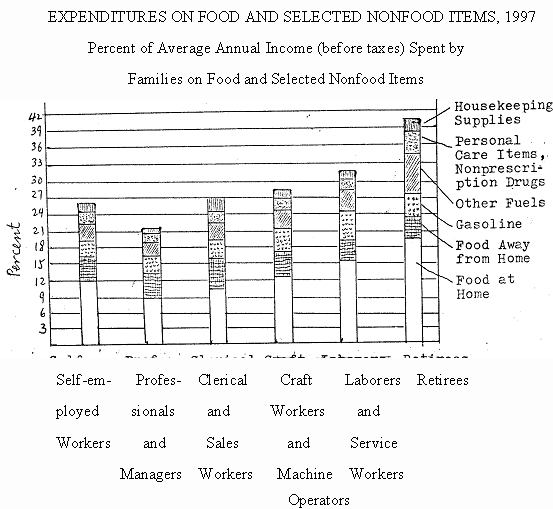
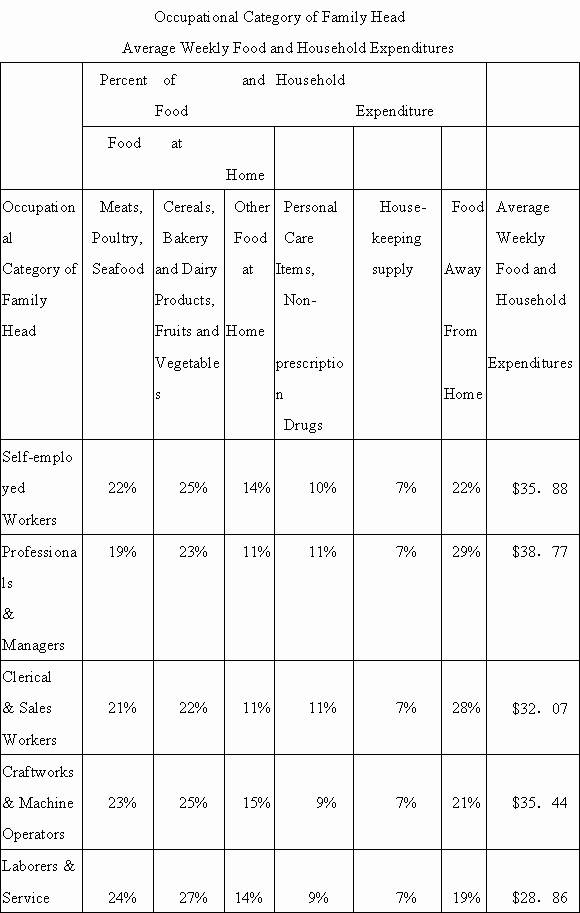
  Different people do different jobs in different places. We can divide their jobs into several groups;they do several kinds of jobs , which is called "Occupational Category ”. Those who work in their own shop or workshop are called self-employed workers ". Engineers, professors, lawyers, doctors, and teachers are called “ Professionals ”. Heads of shops, firms and companies are managers. People working in offices are clerical workers. Sales girls and sales men in shops are sales workers. Craft workers produce art works often made by hand while machine operators are factory workers operating machines. Laborers do such hard jobs as digging, carrying, cleaning and so on. Service workers work in hotels and restaurants. Retirees have more free time than all other people, because they are too old to work and they have retired or given up working.

  However, all people have to spend money on food and other things except food, which is called “Expenditures On Food and Nonfood Items”. The money their families spend is called “ Household Expenditures.” How much they spend every year is“average annual expenditures”. People and their families spend money on poultry--- chicken, hens, cocks, ducks and other birds. They buy fish and plants growing in the sea;that is called seafood. They also spend money on cereals--- food made of wheat bakery --- such food as bread and cake, dairy products --- cow milk or food made of milk. If anyone is ill, he has to spend some money before and after he gets better, which is personal care items. If he has no time or there is no need to see the doctor, he buys medicine from a shop, which is called “nonprescription drugs”. Besides, a house owner has to get his house painted or repaired once every two or three years, and he has to spend money making his house comfortable ;all that is called “House-keeping Supplies”. If one has a car, one has to buy gasoline or gas or other fuels to operate it. Now, let’s stop learning which is called which and look at the following graph and table about some interesting information.

1.For which of the following categories was the percent of the average annual income (before taxes) spent on food at home the least?

A.Self-employed workers.

B.Professionals and managers.

C.Clerical and sales workers.

D.Craft workers and machine operators.

2.About what average amount per week did the families of professionals and managers spend on food away from home

A.$ 2.  B. $ 8.  C. $ 11. D. $ 29.

3.About what percent of the average weekly food and household expenditures of clerical and sales workers was spent on fruits and vegetables?

A.4%. B. 7%. C.22%. D. It cannot be decided or made sure from the information given.

4.About what percent of the total average annual income (before taxes) of retirees was spent on meats, poultry, and seafood (used and eaten at home)?

A.7%.   B.10%. C.20%. D.23%.

5. Which of the following sayings or statements can be inferred from the information given?

I.Of the categories shown, retirees had the greatest average annual incomes (before taxes).

II.For all the categories shown, the average amount spent per week on housekeeping supplies was the same.

III.Of the categories shown, the average amount spent per week on meats, poultry, and seafood (eaten at home) was the greatest for craft workers and machine operators.

A.I only. B. II only. C. III only. D. I and II.

  There are different types of cars. For example, if you want to carry both persons and goods, you operate or drive a van --a car larger than a standard car or an ordinary car. But if you want to save money you'd better purchase or buy a compact car smaller than a standard car or even a subcompact car smaller than a compact car. However, if you didn't purchase or buy any car, you could save your money and put it into the bank , which will give you interest --- an extra amount of money every year or after a certain period of time . But if you are a car owner you'll have to spend money on such things as maintenance and tires --- your car may need repairing sometimes and one of your front tires or back tires may be flat or broken and you’ll have to get it repaired or buy a new one. Besides, you must pay a certain amount of money to the insurance company so that if your car happened to have an accident or even were completely destroyed they would pay you a large amount of money for that. Of course, whatever kind of car you operate or drive you'll have to burn oil or use fuel , a certain number of gallons of fuel for which you have to pay constantly . But if you sell your used car, the price will have to be much lower than that of a new one, so the resale value must be considered;that is to say, if you buy a new car for $8,000 your resale value is -2,000 and you'll get an extra amount of $ 2,000 for your resold car.

  Many drivers or neighbours who have cars made an agreement to take turns driving each other to work. This agreement is called a car pool or car pooling . A certain amount of money saved each year in this way is called "average annual savings through car-pooling or van-pooling to work ". Driving someone to and from work once is called a round trip . Now look at the following three tables and answer the questions below them:

1.What is the difference between the average purchase prices of a standard car and a compact car?

A.$600    B.$2,400    C.$2,800    D. $3,200

2.Over the four-year period, the average cost for insurance on a compact car is about what percent of the average total cost to operate a compact car?

A.11%.    B.13%.    C.15%.D.17%.

3.The average daily cost per passenger in a van pool traveling 50 miles round trip to work is about what percent greater than the average daily cost per passenger in a van pool traveling 40 miles round trip to work?

A.8%.   B. 10%.   C. 12%.   D.13%.

4.What is the mileage (average miles per gallon of fuel) of a compact car?

A.13.   B. 18.  C. 20.    D. 25.

5.If two people, who would otherwise be driving alone in subcompact cars, drive in a 2-person car pool using subcompact cars, what is the total of their average annual costs of car pooling to work?

A.$821   B.$1,400   C.$1,521   D. $1,642

  In addition to the need for food, man also has need of some kind of protection from heat and cold and from wind and rain. The first homes of man were very simple. The size and kind of buildings which he built were limited by his technical knowledge and also by the kind of building materials which were available (可得到的) to him. Climate also had an important influence. In some places, man's home would be nothing more than a cave in the side of a hill, with a fire at the entrance to give light and warmth and to keep dangerous wild animals away. In warmer areas primitive man (原始人) could use branches to make a framework (框架) which he then covered with leaves.

  The community’s way of life was another important influence on the kinds of houses which were built. For example, a hunting society had to move frequently from one place to another to find its food. Therefore, the houses of the people of a hunting society were made so that they could be moved easily. An agricultural society would probably stay in one place for a long time. The homes of these people could be more permanent.

  When settlements grew larger and civilization (文明) became more complex (复杂的), other differences developed in buildings. The most important men in the village, or the men with more property probably had larger and better homes. There were also buildings constructed for special purposes: some kind of large building for public meetings;shops and offices for commercial (商业的) activities;schools, churches, hospitals, theaters, jails or prisons, and many other specialized structures.

  The technical knowledge and skill of the twentieth century makes it possible for man to build structures which would have been impossible a hundred years ago. Construction is now an important industry. As the population of the world grows, more and more buildings of many different kinds will be needed. In planning the construction of these buildings, architects (建筑师) will be using knowledge gained through centuries of experience. At the same time they will be utilizing new materials and developing new methods and techniques in order to meet the needs of still larger and more complex societies.

1.The first homes of man were very simple

A.because he did not have fire.

B.because he did not know how to build very well

C.because he had no furniture.

D.because he had no building materials at all.

2.When people of a hunting society built houses

A.they built permanent homes.

B. they always built houses in trees if possible.

C. they built houses that could be moved easily.

D.they made use of caves in hills.

3.Men began to construct buildings for special purposes

A.when civilization became more complex.

B.when caves were no longer available.

C.when men with property wanted larger homes.

D.when important men wanted better homes.

4.Man could not build very tall buildings a hundred years ago

A.because he had no need for them.

B. because there wereno architects a hundred years ago .

C. because he did not yet have the technical knowledge .

D. because he did nothave enough building materials .

5.To meet the needs of future generations for different kinds of shelter

A.architects will no longer use methods and techniques they use today.

B.architects will need to develop new techniques.

C.architects will need to use new building materials.

D.both B and C.

6. A best title for this text would be

A.The Importance of Architects.

B.The Importance of Technical Knowledge.

C. The Development of Civilization.

D. The Development of Man’s Shelter.

  Man’s first real invention ,and one of the most important inventions in history , was the wheel. All transportation(运输)and every machine in the world depend on it.

  The wheel is the simplest yet perhaps the most remarkable(惊人的)of all inventions because there were no wheels in nature──no living things was ever created(创造)with wheels .How ,then, did man come to invent the wheel?

  Perhaps some early hunters found that they could roll the heavy animal they had killed through the forest on logs more easily than they could carry it. However ,the logs themselves weighed a lot.

  It must have taken a great thinker some time in ancient times to imagine two thin pieces of log connected at their centers by a strong stick. This would roll along just as the logs did yet be much lighter and easier to move by hand .Thus the wheel and axle(轮轴)were invented ,and with them the first cart.

1.The wheel important because _______.

[  ]

A.it was man’s first real invention

B.all transportation depends on it

C.both A and B

D.every machine depends on it

2.The wheel is called ________.

[  ]

A.simple
B.curious
C.strange
D.unusual

3.It was remarkable of man to invent the wheel because ________.

[  ]

A.it led to many other inventions

B.man had to use for it then

C.there were no wheels in nature

D.all of the above

4.The wheel was probably invented by ________.

[  ]

A.a group of early hunters

B.the first man on earth

C.a great thinker

D.the man who made the first cart

5.This passage says that the first wheel may have been a________.

[  ]

A.round piece of stone

B.Heavy log

C.piece of metal

D.piece of log

  Thirty children from China and eight from other countries and regions who won prizes in an international competition(竞赛)received their rewards(奖赏)in Beijing at the Great Hall of the People yesterday.

  The nine-month 1989 Sea-Ball Cup International Children Drawing Competition started last April.

  It received more than 6,000 works including 300 pieces of art from countries and regions outside china─the United States, the Soviet Union, the Philippines, Chili, Romania and Japan.

   “All the paintings express children’s longing for a peaceful world, their love for nature and dreams for the future,”said Fan Zeng , the well-known Chinese painter and chairman of the evaluation commission(评委会)of the competition.

  The Gold Prize was granted to five works, one of them is from the Soviet Union. Another 10 children were awarded the Silver Prize.“The prizewinning works are outstanding(杰出的)in the imagination and creativity(创造性),”Fan said. A Chinese boy at the age of five was the youngest prize winner, who won a Bronze Prize.

  Marjorie Michelle Villa, a Philippine girl at the age of thirteen, who won a Silver Prize, flew to Beijing for the award ceremony and gave a speech to an audience(听众)which included senior Chinese leaders and foreign diplomats(外交官)who received prizes on behalf of the winners from their countries.

1.No children from ________ sent their paintings for the competition.

[  ]

A.Asia
B.Africa
C.Europe
D.America

2.From their works we can see the children _______.

[  ]

A.love their own countries

B.have a strong good feeling for peace and nature, and they dream of a happy future

C.are proud of their own paintings

D.are sure of their bright future

3.A girl prize winner ________.

[  ]

A.took a plane to Beijing to tell the Chinese leaders about her paintings

B.attended the ceremony and visited Beijing

C.was absent from the ceremony

D.was present and spoke at the ceremony

4.The competition is ________.

[  ]

A.a full success

B.a successful experiment

C.a pleasnt surprise

D.a good imagination

5.The best title for the passage is ________.

[  ]

A.Boys and Girls Are Fond of Paintings

B.Children Are Praised for Their Love of Paintings

C.Children Painters Receive Their Prizes

D.Children Come to Beijing from Different Countries

阅读理解

阅读下列文,从每题所给的ABCD四个选项中,选出最佳答案。

Teens and young people—those folks who take the car without asking and pretend not to hear when you ask them to turn down the music—seem to be more likely to stop smoking if they think their smoke could harm those around them.

    “The kids were more concerned about the harmful effects of secondhand smoke than they were concerned about themselves,” says Stanton Glandz, a professor of medicine at the University of California, San Francisco.

    The belief that secondhand smoke harmed people around them more doubled the chances that the young smokers were planning to stop their habit in 30 days or already had given up.

    However, the same wasn't true when the young people were asked whether they were worried about their own health risks because of smoking. Glantz says the responses were not statistically (从统计上)important as a sign to show that concern would lead them to give up smoking.

    The research studies 300 smokers and 300 nonsmokers between 11 and 22 years of age.

    Previous studies have found that the ill effects of secondhand smoke are enough to cause adult smokers to give up or at least consider it, but Glantz says this is the first proof that teens also are affected by these concerns.

    “Like adults, kids are concerned about the effect of smoking on others,” he says. “One of the big mistakes that anti-smoking people have made is that they've treated kids differently from adults.”

    The tobacco companies treat kids like adults, and that's part of the attraction, Glantz says. Those trying to get kids to stop smoking should do the same, he says.

    About 4 million teenagers smoke, according to the American Heart Association (学会), and more than 3000 teens under the age of 18 become daily smokers every day. If these continue, about 5 million of those teens will die of some disease caused by smoking, the association estimates.

    Previous studies of how anti-tobacco advertising affects people have shown that worry about secondhand smoke, information about the addictive qualities of tobacco and reports about the tobacco industry's dishonest behavior are the three most highly effective messages that affect people to stop smoking. Glantz says.

    “People who design tobacco control programs for teens should be putting more emphasis on cleaning in-door air and secondhand smoke.” he says.

1In Stanton Glantz's opinion, young people in America give up smoking because they consider ________.

    A. non-smokers' health

    B. their own health

    C. their parents' worry

    D. the merchants' dishonesty

 2Glantz suggests anti-smoking people pay more attention to ________.

    A. the increasing number of teenage smokers

    B. the effects of smoking on teenagers

    C. the similarity between young people and adults

    D. the difference between young people and adults

3The “Addictive qualities of tobacco” make people ________.

A. start smoking

B. get rid of smoking

C. recover from illness

D. depend on smoking


 0  70323  70331  70337  70341  70347  70349  70353  70359  70361  70367  70373  70377  70379  70383  70389  70391  70397  70401  70403  70407  70409  70413  70415  70417  70418  70419  70421  70422  70423  70425  70427  70431  70433  70437  70439  70443  70449  70451  70457  70461  70463  70467  70473  70479  70481  70487  70491  70493  70499  70503  70509  70517  151629 
违法和不良信息举报电话:027-86699610 举报邮箱:58377363@163.com

精英家教网