There is a boy called Bill in my gym class who has unbearably yellow teeth that almost make everyone feel unpleasant. Recently another boy told Bill that he should “go Ajax” his teeth. Bill was crushed. If the other boy had been thinking, he would have realized that there is a better way to handle such a situation. He could have dealt with it with tact. He could have showed this hurtful truth in a more careful, sensitive way—that’s “tact”.
If a person isn’t sensitive to another’s feelings, there is no way he or she can be tactful. Yesterday, my 5-year-old brother proudly announced that he had cleaned the screen on our television set. Unfortunately, he used furniture polish, which produced an oily film on the television screen. My mother smiled arid thanked him for his efforts—and then showed how to clean the screen properly. Her sensitivity enables my brother to keep his self-respect. Yet, sensitivity alone does not make tact.
“Tactfulness” also requires “truthfulness”. Doctors, for example must be truthful. If a patient has just been disabled in an accident, a tactful doctor will tell the truth—but express it with sensitivity. The doctor may try to give the patient hope by telling them curing techniques under study or about advanced equipment now available. Doctors must use tact with patients’ relatives as well. Instead of bluntly saying, “Your husband is disabled,” a doctor might say, “I’m sorry, but your husband has lost feeling in his legs and. . .”
Tact should not be confused with trickery. Trickery occurs when a nurse is about to give a patient an injection(注射) and says, “This won’t hurt a bit. ” Instead of trickery, the nurse might guarantee the patient that the discomfort of the injection is a small thing compared to the benefits of it. It would also be thoughtful for the nurse to tell the patients about some of these benefits.
Tact is a wonderful skill to have, and tactful people are usually admired and respected. Without tact our society would become an intolerable place to live in.
1..
The underlined word “crushed” in the first paragraph probably means .
A. surprised B. cheated C. regretful D. painful
2..
According to the author, his mother’s praise for the brother is . A. sensitive and tactful B. sensitive but not tactful enough
C. truthful but not tactful enough D. sensitive but trickish
3..
Which of the following shows the structure of the passage?
 |
A. B. C. D.
(The numbers stand for the paragraphs)
|
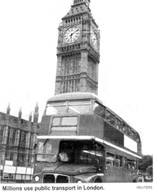 AN upper class British lady once declared: “Anyone seen on a bus
after the age of 30 has been a failure in life.”
AN upper class British lady once declared: “Anyone seen on a bus
after the age of 30 has been a failure in life.”
I guess she meant that if you’re middle aged and don’t have a car then you are a loser. How arrogant (傲慢) and ignorant!
Unfortunately, there are still people who think that way: that somehow public transport is only for the poor. And the rest have a right to their cars. Some wealthy folk in the West look down on buses and boast (吹嘘) about how many years it has been since they last traveled by one.
How sad is that? Our roads are packed with cars and the air is full of the pollution they emit (排放). But still, many car users are unwillingly to get on a bus or a bike or a train to take themselves to work.
It’s convenient to drive, they’ll say. Buses are so unreliable, they’ll claim. And trains are expensive ---- at least in the UK.
It’s an attitude which may have to change. It doesn’t make sense to drive a car in a city where there’s a public transport system. Also, these rush hour commuters (往返上班者) usually travel alone.
As a result, transport authorities in the UK are looking at solutions to city center congestion (拥堵).
One is to increase the number of parking spaces at out-of-town railway stations. More motorists (乘汽车的人) can then leave their cars and travel into the city by train.
Light rail or tramways are another environmentally friendly solution. Many cities across Europe have installed light rail or tramway systems.
The subway in London is used by everyone, rich and poor. It’s the quickest way of getting around the city, whatever your bank balance.
And then there are the cycle hire schemes you find in many modern cities. In London and Paris, you can hire a bike by the hour to get you where you need to go.
While commuters in Beijing abandon their bicycles for cars, cycling to work grows in popularity in the West.
Many cyclists are willing to pay more than 10,000 yuan for their bicycles. Mayor of London, Boris Johnson, is often pictured cycling to work. David Cameron, the British prime minister, cycled to the House of Commons before he became leader. These days he takes the prime ministerial limousine (豪华轿车).
1.. According to the article, some British people, like the upper class woman, think that .
A. buses are inconvenient B. bus services are unnecessary
C. having a car is a sign of success D. only the upper class should have cars
2. Which of the following measures is taken by transport authorities in the UK to solve city center congestion?
A. The development of cycle hire schemes.
B. Increasing the number of parking spaces in the city center.
C. Installing light rail or tramway systems in out-of-town areas.
D. Banning commuters from traveling alone during rush hour.
3.The author mentions the example of Boris Johnson in the last paragraph to .
A. express his respect for the mayor of London
B. point to the growing popularity of cycling to work in the West
C. criticize Beijing commuters for abandoning their bicycles for cars
D. show that cars are still the most common means of transportation for famous people in Britain
4. Which of the following might the writer agree with?
A. The British prime minister should give up his limousine.
B. Beijing commuters should learn from British commuters.
C. British solutions to public transport problems are inadequate.
D. Many car owners need to change their attitudes if the traffic problem is to