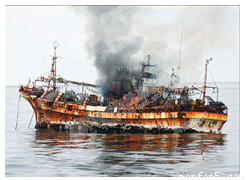
The long, lonely voyage of the Japanese ghost ship is over.

A US Coast Guard cutter poured cannon fire into an abandoned Japanese ghost ship that had been drifting since last year’s tsunami, sinking the vessel into waters more than 305 meters deep in the Gulf of Alaska and removing the danger it posed to shipping and the coastline on Thursday.

The cutter’s guns tore holes in the 164-foot Ryou-Un Maru, and then it began to take on water and lean to one side. In about four hours, the ship disappeared into the sea, said Chief Petty Officer Kip Wadlow.

The ship had no lights or communications system, and its tank was able to carry more than 7,570 liters of diesel fuel. Officials, however, didn’t know exactly how much fuel was aboard.

“It’s less risky than it would be running into shore or running into other ships,” coast guard spokesman Paul Webb said.

The US National Oceanic and Atmospheric Administration and the Environmental Protection Agency studied the problem and decided it is safer to sink the ship than let the fuel evaporate and pollute the sea environment.

Ryou-Un Maru was probably among the first wave of the 1.5 million tons of garbage of refrigerators, washing machines, televisions, roofs and fishing nets heading toward North America since last March when a magnitude-9.0 earthquake struck Japan.

As the coast guard was ready to fire on the vessel, a Canadian fishing vessel, the 19-meter Bernice C, claimed the rights to save the ghost ship in international waters.

Plans to sink it were paused so the Canadian crew could have a chance to take the stricken ship. A Canadian official with knowledge of the situation told the Associated Press that the Bernice C was unable to drag it.

Then the Canadian boat left, and once it was about 10 kilometers from the Japanese vessel, the Coast Guard began to fire, first with 25 mm shells, then a few hours later with ammunition twice that size.

State officials have been working to test the danger of garbage including materials affected by a damaged nuclear power plant, to see if Alaska residents, seafood or wild animals could be affected.

1.Which of the following is NOT the reason for sinking the Japanese ship?

A.It had no lights or communications system.

B.It might be washed up onto the shore.

C.It was a danger to other passing ships.

D.The oil it carried could pollute the sea.

2.The plan to fire on the Japanese ghost ship was paused because ____________.

A.the ghost ship was beyond the reach of the Coast Guard’s guns

B.the shells were not powerful enough to sink the ghost ship

C.state officials worried the ghost ship might give out radiation

D.a Canadian fishing boat wanted to save the ghost ship

3.Which of the following could be the best title for the passage?

A.Japanese ghost ship arriving at US

B.Tsunami garbage heading to US

C.Cannon fire sinking Japanese ghost ship

D.Japanese ghost ship polluting the Pacific


It’s good to make mistakes, and here is why.

First of all, mistakes are a clear sign that you are trying new things. It’s always good to try new things because when you are trying new things you are growing. If you never try anything new, how can you improve? How can you expand? The simple answer is “You can’t”. Look around you. With very few exceptions, either everything you see in your physical world or every single detail of every single thing is the result of someone trying something new.

Another good thing about mistakes is this: When you are making mistakes, you are learning. Consider this: Edison failed 10,000 times before he perfected the light bulb. When asked how it felt to fail that many times, he said that he hadn’t failed 10,000 times, but rather had learned 10,000 things that didn’t work.

Finally, when you make a mistake you are much closer to success. Why?

Because when all is said and done, you will have tried some number of things before you succeeded. Every time you make a mistake you eliminate one of those things and are one step closer.

But this all doesn’t mean that you should go ahead without considering the consequences of a mistake. Quite the contrary, when you try something new you have to be willing to set some reasonable limits so that in the event that it doesn’t work out the way you want it to, you will be in a position to try again.

We all have limited resources in the form of time and money so don’t blow them all on one approach to a problem. Realize that it probably won’t be perfect the first time and allocate (分配) these resources appropriately so you can learn, make corrections, and try it again. Only by accepting and using your mistakes in this way can you make significant advances in your business and your career.

There is an old saying that goes, “If you’re not making mistakes, you’re not trying hard enough.”

So go forth and make mistakes. And learn. And grow. And prosper(成功).

1.From the second paragraph, we can conclude that _______.

A.mistakes are unnecessary for development

B.we are afraid of trying new things

C.it’s common for people to make mistakes

D.mistakes are better than not trying

2.The underlined word “eliminate” means _______.

A.avoid             B.remove           C.accept            D.solve

3.According to the article, one thing you should pay attention to about making mistakes is   

A.avoiding making the same mistakes

B.accepting the punishment willingly

C.taking consequences into account

D.trying things out one by one

4.What would the writer probably suggest we say to ourselves when we make a mistake?

A.Never mind, I can always try again.

B.I’d better stay out of trouble.

C.Ok! Now I can learn something.

D.Look at this mess. Anyone would be upset.


根据短文内容,从短文后的选项中选出能填入空白处的最佳选项。选项中有两项为多余选项。

The First Americans

There was a time long ago when a land bridge connected Asia and North America.The first settlers in North America crossed this land bridge from what is now Siberia to Alaska.The people who made this initial crossing were probably following the animals they used for food.

Finally, the oceans rose and the land bridge between the continents disappeared.The settlers, who I shall call the "First Americans" , could not return to their homeland.  1  

For the next few thousand years, the First Americans moved south and east throughout North and South America.They made the journey all the way from Alaska to the southern tip of South America, a distance of more than 10,000 miles.    2   

In the far north, above the Arctic Circle, the First Americans became hunters of the ocean.  3 __  In the summer, they gathered berries and other plants.In the winter, they stayed in lodges much of the time preparing for the next summer.It was a hard life, but they learned to survive in these terrible conditions.

Farther south, in what is now Arizona, Utah, Colorado, and New Mexico, the First Americans became cliff dwellers.They began by living in caves that already existed in the cliffs.  4  The dwellings they built in many ways resembled today's apartment buildings.

5    They built a system of dams and canals so they could store and use water almost any time of the year.They were so successful that they could raise fruits and vegetables that were not found naturally in the desert.

A.They also discovered foods like corn and potatoes.

B.Along the way, they established many different civilizations.

C.They discovered how to add to the caves by building structures of wood and stone.

D.People living near each other tended to share similar environments and customs.

E. They built boats of animal skins and hunted or fished for their food.

F. They would have to survive in the New World, they had discovered.

G. The First Americans of the Southwest learned to water the desert.


 0  57491  57499  57505  57509  57515  57517  57521  57527  57529  57535  57541  57545  57547  57551  57557  57559  57565  57569  57571  57575  57577  57581  57583  57585  57586  57587  57589  57590  57591  57593  57595  57599  57601  57605  57607  57611  57617  57619  57625  57629  57631  57635  57641  57647  57649  57655  57659  57661  57667  57671  57677  57685  151629 

违法和不良信息举报电话:027-86699610 举报邮箱:58377363@163.com

精英家教网