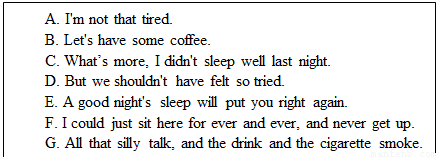
完形填空(共20小题, 每小题1分,满分20分)

Soon Tommy's parents, who had recently separated (分居), would arrive for a meeting on his failing schoolwork and 16 behavior. Neither parent knew that I had called up 17 .

Tommy, an only child, had 18 been happy, cooperative, and an excellent student. How could I make his father and mother 19  that his recent failing grades 20  a brokenhearted child's reaction to his respected parents' separation and possible 21 ?

Tommy's mother came in and 22  one of the chairs I had placed near my desk. Then the father 23  and was obviously surprised to see his wife. They pointedly(显然) ignored each other.

As I gave a detailed 24  of Tommy's behavior and schoolwork, I prayed for the 25  words to bring these two together to help them see what they were doing to their son. 26  somehow the words wouldn't come.

I found a crumpled (弄皱的), tear-stained 27  stuffed (塞) in the back of Tommy's desk. Writing covered both sides, a single 28  scribbled (乱写) over and over.

Silently I smoothed(弄平) it out and gave it to Tommy's mother. She read it and then without a word handed it to her husband. He 29  . Then his face softened. He studied the scribbled words for 30 seemed a future life.

At last he folded the paper carefully and 31   his wife's outstretched(伸出的) hand. She wiped the tears from her 32  and smiled up at him. I also couldn't keep back tears, but 33  seemed to notice.

In this way I used the words to 34  that family. On the sheet of yellow copy paper 35 with the painful outpouring of a small boy's troubled heart, it said.

"Dear Mother ... Dear Daddy ... I love you ... I love you ... I love you."

1.                A.satisfying       B.exciting         C.disappointing D.surprising


2.                A.the others       B.the other       C.another one   D.each other


3.                A.never          B.rarely          C.always    D.usually


4.                A.hope           B.believe         C.promise D.trust


5.                A.stood for        B.looked for       C.cared for D.made for


6.                A.happiness       B.cruelty         C.selfishness    D.divorce


7.                A.got            B.took           C.possessed     D.seated


8.                A.reached        B.sat             C.arrived   D.went


9.                A.account        B.record          C.comment D.paper


10.               A.common        B.exciting         C.mistaken   D.right


11.               A.So             B.And           C.But   D.Then


12.               A.letter          B.sheet          C.message   D.schoolwork


13.               A.word          B.article          C.phrase    D.sentence


14.               A.cried          B.laughed        C.frowned   D.smiled


15.               A.which          B.as if            C.what D.when


16.               A.reached for     B.hunted for      C.kept off   D.searched for


17.               A.faces          B.eyes           C.head D.nose


18.               A.both           B.neither         C.either     D.none


19.               A.reunite         B.unite           C.satisfy     D.help


20.               A.lined           B.formed         C.written    D.covered


Nickname: Hawaii’s Island of Adventure 

Size: 4,028 square miles(平方英里)

Population: 148,677. The most heavily populated areas are Hilo on the east side and Kailua-Kona on the west.

Temperature: Averages between 71°F and 77°F year around (expect the mercury (水银柱) to drop at higher heights).

Beaches: 47      Golf Courses: 20      Highest Peak: Mauna Kea, 13,796 feet.

Agriculture: The bulk (主体) of Hawaii’s farming products are grown and processed on the Big Island, including coffee, macadamia nuts and papaya.

Lodging: 9,655 rooms total; Nightly rates range from$ 35—$ 5,000.

Airports: Hilo International Airport on the east side and Kona International Airport on the west side.

Rental Cars: All of the nationally known rental car companies have locations at Hilo International and Kona International Airports as well as many resorts(度假胜地). In addition, Hilo, Kona and the major resort areas are serviced by taxis.

Resources: Call (800) 648—2441 to order a video, poster, brochures and maps from the Big Island Visitors Bureau. See www.bigisland.org for Updated information.

Shopping: The large shopping centers are in Hilo, Kona, Waimea and the Kohala Coast.

1.The passage is intended to be read by _______.

A.tourists                               B.businessmen

C.students                              D.immigrants(移民)

2.The average population per square mile on the island is about _________.

A.28               B.32               C.44               D.37

3. What does the underlined part “expect the mercury to drop at higher heights” mean?

A.Things are easy to lose weight at higher places.

B.Dropping things from higher places is expected.

C.Temperature is expected to be higher at higher places.

D.Temperature is expected to be lower at higher places.

4. Which of the following is NOT mentioned as a traffic means(交通工具) to get around the Big Island?

A.By rental car.                           B.By air.

C.By train.                              D.By taxi.

5. What can we infer from the passage?

A.You may pay a high price for spending one night on the island.

B.You can call (800) 648 – 2441 to order some food.

C.You can find some courses to play tennis on the island.

D.You can see www.bigisland.org for updated information.


I began working in journalism(新闻工作) when I was eight. It was my mother’s idea. She wanted me to “make something” of myself, and decided I had better start young if I was to have any chance of keeping up with the competition.

With my load of magazines I headed toward Belleville Avenue. The crowds were there. There were two gas stations on the corner of Belleville and Union. For several hours I made myself highly visible, making sure everyone could see me and the heavy black letters on the bag that said THE SATURDAY EVENING POST. When it was supper time, I walked back home.

“How many did you sell, my boy?” my mother asked.

“None.”

“Where did you go?”

“The corner of Belleville and Union Avenues.”

“What did you do?”

“Stood on the corner waiting for somebody to buy a Saturday Evening Post.”

“You just stood there?”

“Didn’t sell a single one.”

“My God, Russell!”

Uncle Allen put in, “Well, I’ve decided to take the Post.” I handed him a copy and he paid me a nickel(五分镍币). It was the first nickel I earned.

Afterwards my mother taught me how to be a salesman. I would have to ring doorbells, address adults with self-confidence, and persuade them by saying that no one, no matter how poor, could afford to be without the Saturday Evening Post in the home.

One day, I told my mother I’d changed my mind. I didn’t want to make a success in the magazine business.

“If you think you can change your mind like this,” she replied, “you’ll become a good-for-nothing.” She insisted that, as soon as school was over, I should start ringing doorbells, selling magazines. Whenever I said no, she would scold me.

My mother and I had fought this battle almost as long as I could remember. My mother, dissatisfied with my father’s plain workman’s life, determined that I would not grow up like him and his people. But never did she expect that, forty years later, such a successful journalist as me would go back to her husband’s people for true life and love.

1. Why did the boy start his job young?

A.He wanted to be famous in the future.

B.The job was quite easy for him.

C.His mother had high hopes for him.

D.The competition for the job was fierce.

2.From the dialogue between the boy and his mother, we learn that the mother was _______.

A.excited                               B.interested

C.ashamed                              D.disappointed

3.What did the mother do when the boy wanted to give up?

A.She forced him to continue.

B.She punished him.

C.She gave him some money.

D.She changed her plan.

4. What does the underlined phrase “this battle” refer to?

A.The war between the boy’s parents.

B.The arguing between the boy and his mother.

C.The quarrel between the boy and his customers.

D.The fight between the boy and his father.

5. What is the text mainly about?

A.The early life of a journalist.

B.The early success of a journalist.

C.The happy childhood of the writer.

D.The important role of the writer in his family.


An allowance(零花钱) is an important tool for teaching kids how to make plans for the use of money, save and make their own decisions. Children remem­ber and learn from mistakes when their own dollars are lost or spent foolishly.

How large an allowance is suitable? Experts say there is not right amount. Actual amounts differ from region to re­gion, and from family to family.

To set an suitable allowance for your child, work up a weekly plan. Allow for entertainment costs such as movies and snacks. Next, include everyday expenses such as lunch money, bus fare, school supplies. "If you make the child responsible for these bills’," says Josephine Swanson, a consumer specialist, " he or she will learn to plan for nec­essary costs."

Finally, add some extra money to make saving possible. If you can keep your child’s allowance in line with that of his friends. A child whose buying power falls away below his peers’ can feel left out.

It can be tough, but don’t excuse your children when they make a mistake with their allowance. When Brooke Ste­phens was ten and growing up in Jacksonville, her mother gave her $5 a week, $1.75 of which was for bus fare and lunch." If you lose your money," Brooke’s mother told her, "you walk home."

One week the girl spent all her allowance in a candy store, then she called home for a ride. " Mom made me walk home," recalls Stephens, now a financial planner in Brook­lyn. " At first I was angry. But I finally realized that she was trying to teach me an important lesson. "

Experts advise that an allowance should not be tied di­rectly to a child’s daily housework at home. Kids should help around the house not because they get paid for it but because they share responsibilities as members of a family. You might, however, pay a child for doing extra jobs at home, which can develop his or her early habits.

1.Which of the following is the possible title of the passage?

A.How to develop a child’s early habits.

B.How to work up an amount of pocket money.

C.How to teach a child about money.

D.How to teach a child to save money.

2. It can be inferred from the passage that if a child is given an allowance, he or she may ________.

A.spend all the money very soon

B.fall into the bad habit of wasting money

C.feel responsible and careful about money

D.lose the money and can not return home

3. In Paragraph 4, the words “his peers” refer to ________.

A.his parents                            B.his friends

C.his financial experts                     D.his teachers

4. Why does the writer mention Brooke Stephens?

A.To question the opinion about pocket money.

B.To compare Stephens with other financial experts.

C.To explain that parents should be strict when children are developing good habits about money.

D.To suggest pocket money is useless in developing a child’s sense of responsibility.

5. The writer implies in the passage that ________.

A.children may feel lonely if they have no pocket money

B.a child’s early good habits can be developed if he or she is paid for all the housework

C.paying children for their housework is no good

D.children may learn to put aside some money if they are given a great amount of pocket money


Holidaymakers who are bored with baking beaches and overheated hotel rooms head for a big igloo. Swedish businessman Nile Bergqvist is delighted with his new hotel, the world’s first igloo hotel. Built in a small town in Lapland, it has been attracting lots of visitors, but soon the fun will be over.

In two weeks’ time Bergqvist’s ice creation(作品) will be nothing more than a pool of water. “We don’t see it as a big problem,” he says. “We just look forward to replacing it.”

Bergqvist built his first igloo in 1991 for an art exhibition. It was so successful that he designed the present one, which measures roughly 200 square meters. Six workmen spent more than eight weeks piling 1,000 tons of snow onto a wooden base; when the snow froze, the base was removed. “The only wooden thing we have left in the igloo is the front door,” he says.

After their stay, all visitors receive a survival certificate recording their success. With no windows, nowhere to hang clothes and temperatures below 0℃, it may seem more like a survival test than a relaxing(轻松的) hotel break. “It’s great fun,” Bergqvist explains, “As well as a good start in survival training.”

The popularity of the igloo is beyond doubt: it is now attracting tourists from all over the world. At least 800 people have stayed at the igloo this season even though there are only 10 rooms. “You can get a lot of people in,” explains Bergqvist. “The beds are three meters wide by two meters long, and can fit at least four at one time.”

1. Bergqvist designed and built the world’s first igloo hotel because ________.

A.an art exhibition was about to open

B.he wanted to make a name for the small town

C.he believed people would enjoy trying something new

D.more hotel rooms were needed

2. When the writer says “the fun will be over,” he refers to the fact that ________.

A.hotel guests will be frightened at the thought of the hard test

B.a bigger igloo will replace the present one

C.holidaymakers will soon get tired of the big igloo

D.Bergqvist’s hotel will soon become a pool of water

3.According to the text, the first thing to do in building an igloo is ________.

A.to gather a pool of water

B.to prepare a wooden base

C.to cover the ground with ice

D.to pile a large amount of snow

4. When guests leave the igloo hotel they will receive a paper stating that ________.

A.they have had a taste of adventure

B.they have had an ice-snow holiday

C.they have had great fun sleeping on ice

D.they have visited Lapland

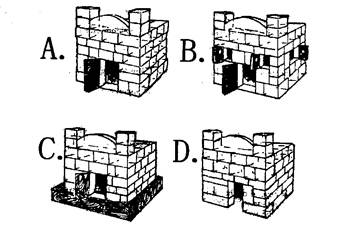
5.Which of the following pictures below is closest to the igloo hotel as described in the text?


 0  57115  57123  57129  57133  57139  57141  57145  57151  57153  57159  57165  57169  57171  57175  57181  57183  57189  57193  57195  57199  57201  57205  57207  57209  57210  57211  57213  57214  57215  57217  57219  57223  57225  57229  57231  57235  57241  57243  57249  57253  57255  57259  57265  57271  57273  57279  57283  57285  57291  57295  57301  57309  151629 
违法和不良信息举报电话:027-86699610 举报邮箱:58377363@163.com

精英家教网