The house next door had been empty for so long that we had quite forgotten what it was to have neighbors. One day, __36__, a great furniture lorry drew up near our front gate and a short time, all kinds of furniture were __37__ on the pavement. A small car arrived, out of which came seven people , a man a woman and five children of __38__ ages. The children rushed out and began laughing__39__ as the whole family moved into the house. Windows were __40__ open; furniture was put into__41__; and little faces looked curiously at us over the fence and disappeared. It was our first__42__ to the Robinsons.

  Though we became firm__43__ with our neighbors, we often had causes to be made angry by them. Our garden became an unsafe place: little boys __44__up as cowboys or Indians would jump up from somewhere, __45__wooden guns at us and __46__ us to put up our hands. Sometimes our lives were __47__; at others, we were killed with a __48__ “Bang, Bang!”. Even more dangerous were the arrows that occasionally came sailing __49__ the garden fence.

  But we did not __50__ go in fear for our lives. The Robinsons were friendly and helpful and when we left for our holidays, we knew we had nothing to fear __51__our neighbors were around. We understood what it was like to have __52__ in the long, dull winter evening __53__ Mr Robinson would __54__ in for a cup of tea and chat; or when Mr. Robinson would __55__ over the fence and talk endlessly with father about gardening problems.

1.A. so                        B. but                                   C. however                                    D. therefore

2.A. unloaded            B. loaded                              C. moved                                       D. bought

3.A. the same             B. various                    C. same                                          D. young

4.A. delightedly                   B. angrily                              C. sadly                                           D. friendly

5.A. forced                           B. broken                             C. kicked                                        D. pushed

6.A. place                    B. order                                C. room                                          D, building

7.A. interview   B. introduction           C. arrangement                            D. management

8.A. strangers             B. enemies                           C. friends                                       D. relatives

9.A. pretending         B. looking                    C. dressing                                     D. making

10.A. put    B. take                     C. throw                                         D. point

11.A. leadB. order                                 C. ask                                              D. make

12.A. wasted                        B. saved                                C. devoted                                     D. spared

13.A. fast                     B. soft                                    C. sharp                                          D. slow

14.A. in              B. on                                      C. over                                           D. under

15.A. always                         B. often                                 C. even                                           D. then

16.A. though     B. unless                               C. so long as                                  D. even if

17.A. cheers     B. fun                                    C. discussion                                 D. company

18.A. as                       B. when                                C. while                                          D. since

19.A. drop         B. jump                                 C. slip                                              D. break

20.A. fall              B. swim                             C. lean                                            D. lie


When John Weston awoke that morning, he remembered that his mother was going into hospital. He hadn’t worked out quite what was wrong with her. He knew, though that she hadn’t been well for some time now, and it had become almost familiar to him to see her eyes narrowed in a sudden attack of pain, and her hand pressing against her heart. Their own doctor, who she had finally gone to for advice, had sent her to an expert who knew all about these things. He had told her that just as soon as there was a bed for her, she would have to come into his hospital where he could look after her himself.

During the weeks since then the pains had come even more frequently, and the narrowed eyes became an almost permanent part of her expression. Always rather sharp, she began losing her temper over little things so that John’s father kept his thoughts to himself more and more. John, as ready as possible to make allowances, tried to think what it would be like to have toothache all the time and how bad-tempered that would make you.

So his mother would go into hospital for a few days. He was going to stay with his Aunt Daisy till she came back, and his father would stay on at home by himself. John’s cousin, Mona, was to come in and make the bed and wash the pots and dust round now and again. That was the arrangement, and John didn’t care much for it. Apart from missing his mother(and he was glad she was going away because they would make her better), he wasn’t very fond of his Aunt Daisy because she was even more bad-tempered than his mother.

1.Mrs Weston went to see her doctor_________.

A.as soon as she realized that something was wrong

B.only after her husband advised her to

C.a long time after the trouble began

D.when John asked what was wrong with her

2.what did Mrs Weston’s own doctor decide to do?

A.he decided to send her to hospital

B.he decided to get an expert to examine her

C.He decided to treat her himself

D.He advised her to wait for a few weeks.

3.how did John react to his mother’s bad temper?

A.he tried to imagine himself in her place.

B.He tried not to notice it.

C.He pretended that he had toothache.

D.He behaved himself as well as possible.

4.John regarded ______as most bad-tempered.

A. his father   B. his mother    C. his cousin Mona   D. his aunt Daisy


There is very simple way of measuring the height of a water-tower, which we cannot measure by climbing.

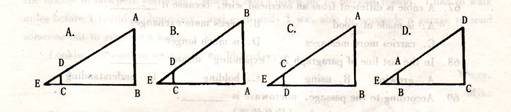
Suppose, for example, that we wish to find out the height of the water-tower, AB, in a factory. We first of all go to where the water-tower is standing and measure a distance of, say, 25 feet from it. Then we take a stick, and stand it in the ground at the spot we have just marked.

Let us suppose the stick we are using is 4 feet in height. We now walk farther away from the water –tower in the same straight line as when we measured off the distance of 25 feet. We go from the water-tower until we come to point E, where with our head on the ground, we see the top of the stick and the top of the water-tower in the same height line---that is, the top of the stick just covers the highest part of the water-tower. Every schoolboy can work out the height of the water-tower now.

Suppose that the line CE is five feet. We know that the stick is 4 feet high and the distance BE is 30 feet. Thus, 5 is to 4 as 30 is to AB.

1.If we want to know how high a tall tree is,_______.

A. we have to climb up the tree

B. we have no way out

C. we must cut down the tree

D we needn’t climb up the tree

2. According to the passage, which of the following is correct?


3.It is clear from this that the problem can be settled by _________.

A. a child

B. the boy who has little schooling

C. everyone

D. a girl at middle school

4.To measure a water-tower in this way, _________.

A. no tool is needed

B. Besides a stick, tape-measure (卷尺) or at least a ruler is necessary.

C. we have to use nothing but a stick

D. we have to prepare a set of expensive tools


Ever since man began to use the telephone, there have been new problems arising from the carrying of messages. At first, each message was carried by a pair of overhead wires. As a result, telephone exchanges were soon surrounded by thousands of wires. The wires were then replaced by cables (电缆),each containing many pairs of wires. Each cable is capable of carrying many messages. These cables, laid underground, replaced the overhead wires.

The more extensive telephone services have become, the more demand for these services has increased, particularly the demand for long-distance services. In China, for example, this growth is now over 30% every year. Long-distance telephone exchanges are usually in crowded cities, where is not easy to lay new labels for expanding services.

The use of radio to send telephone message and to link all telephone exchanges makes it possible to get rid of overhead wires and some underground cables.

Now man has invented the microwave system ( 微波系统 ). In a microwave system messages from various places can be brought together, and then they are sent out and received by radio. After that, the messages are split into their original form. Finally, they are sent to the places where they are going to be sent.

1.The word “message” ( in paragraph 1) is close in meaning to “______”.

A. electricity     B. industry     C. information    D. wave

2.A cable is different from an overhead wire, because it ________.

A. is made of wood

B. needs more exchange

C. carries more messages

D. is much longer

3.What does the word extensive mean?

A. growing       B. using       C. holding     D. understanding

4.The best title for the passage would be “________”.

A. The Telephone and Its Past

B. From the Wire to the Microwave System

C. The Needs for Better Telephones

D. How to Use the Telephone


 0  56023  56031  56037  56041  56047  56049  56053  56059  56061  56067  56073  56077  56079  56083  56089  56091  56097  56101  56103  56107  56109  56113  56115  56117  56118  56119  56121  56122  56123  56125  56127  56131  56133  56137  56139  56143  56149  56151  56157  56161  56163  56167  56173  56179  56181  56187  56191  56193  56199  56203  56209  56217  151629 
违法和不良信息举报电话:027-86699610 举报邮箱:58377363@163.com

精英家教网