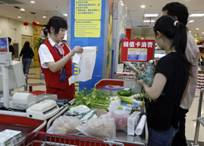
 Jiang Nan, a full-time mother in Beijing, keeps a dozen or so cloth bags at home, carefully selecting one or two before heading out to get groceries. “Most of them were giveaways from advertising marketing campaigns, but
others had been handed out in the street by various environmental protection organizations,” she explained.
Since June 2008 China has forbidden the production,
sale and usage of plastic bags thinner than 0.025 millimeter (毫米), and retailers(零售商) are not allowed to provide free plastic bags to their customers, regardless of the thickness.
Many Chinese consumers like Jiang have learned to refuse plastic bags whenever possible in their shopping. “A plastic bag may only cost a few jiao, but it’s more about how bad they are for the environment,” Jiang said.
The plastic ban is for the most part well carried out in big cities, and has been distinctly effective in reducing white waste. On the first anniversary of the plastic ban Global Village of Beijing, an NGO environmental organization, shows that during the year of the ban the consumption of plastic bags fell by about 40 billion pieces in chain supermarkets alone, saving more than 1.2 million tons of petroleum.
However, enforcement shows considerably less muscle in smaller cities, towns and country-
side. In a remote town like Lichuan, the awareness of environmental protection is not as strong as that in big cities. Street vendors(街头小贩) worry that they are likely to lose customers if they charge them for plastic bags. Seeing no significance in the issue, local government often turn a blind eye to banned bag traffic in the market.
There are still those who don’t have an interest in living green. Cui Lin, another Beijinger, often forgets to bring a cloth bag when shopping, and has to buy plastic bags. “Anyway I think plastic bags are neater and cleaner, and I don’t mind paying a couple more jiao,” he shrugged.
Mrs Yu, a vegetable vendor in Lichuan County, Jiangxi Province, recalled that before plastic bags became popular in the early 1990s, Chinese people always carried a bamboo basket when they visited the market. “Plastic bags are more convenient,” she comments, and her view might be that of the tens of millions of people in the nation who still cling to plastic bags, paid or free. This is suggested by her trade where piles of plastic bags are still passed out every day.
49. In Paragraph 1, the writer uses Jiang Nan’s case to __________.
| A. introduce a topic | B. tell a story |
| C. describe a person | D. offer an argument |
How did Jiang Nan get her cloth bags?
| A. She bought them at a low price. C. She borrowed them from her relatives. | B. She got them for free. D. She made them herself. |
51. Which is NOT the reason why some people still use plastic bags when shopping?
| A. Cloth bags are difficult to get and heavy to carry. |
| B. People’s awareness of environmental protection is not strong enough. |
| C. People don’t mind paying a couple more jiao for plastic bags. |
| D. Street vendors worry that they are likely to lose customers if they charge them. |
52. What message does the writer mostly convey in the passage?
| A. To reduce white waste is urgent. |
| B. The plastic bag ban has achieved great success. |
| C. There is still a long way to go for the plastic bag ban. |
| D. People’s awareness of environmental protection should be stressed. |
I'm from the South Bronx. At 7, my neighborhood was the beginning and end of my universe. It was a small town to me. Everyone knew each other, so if you got into trouble in school, chances are your mom knew about it before you got home. I felt watched over and safe.
But just before I turned 8, things began to change. I watched two buildings on my block burn down. I remember seeing my neighbor Pito go up and down the fire escape to get people out. Where were the firemen? Where was the truck? Somebody must have called them.
That same summer, after serving two tours in Vietnam, my brother was killed in the South Bronx. He was shot above the left eye and died instantly.
People who could moved out of the neighborhood, and all I wanted to do was get out, too. I used education to get away from there and got good at avoiding the topic of where I was from. To be from the South Bronx meant that you were not a good person. It felt like a stain.
After college, I didn't want to come back to the South Bronx, but in order to afford graduate school, I had to. I was almost 30 and could only afford to live at my parents' home. It felt like a defeat, and I hated it.
At the same time, the city was planning a huge waste facility here, and no one seemed to care — including many of us who lived here. They were like, "Well, it's a poor community; what's the difference?"
I was very angry. It drove me to act. It moved my spirit in a way that I didn't know was possible. And it changed my beliefs — it changed the way I felt about myself and my community. I worked hard with others who felt the same way, and together, we defeated the plan.
After that, I realized it's just as important to fight for something as it is to fight against something. So we dreamed up a new park on the site of an illegal waste dump — and after many community clean-ups, along with $3 million from the city, we have one. And it's a glory. It was the seed from which many new plans for our community have grown.
Today, the South Bronx is no longer a stain; it's a badge(象征) of honor for me. I believe that where I'm from helps me to really see the world. Today, when I say I'm from the South Bronx, I stand up straight. This is home, and it always will be.
Paragraphs 2 and 3 make the readers believe ____________.
| A. the author felt watched over and safe |
| B. he author’s brother was a bad man |
| C. the author’s neighbor Pito was braver than a fireman |
| D. the author felt his hometown was not a safe place to live in |
The author went back to the South Bronx after college because ____________.
| A. he couldn’t afford to live without his parents’ help |
| B. he loved his hometown very much |
| C. he was defeated in studies at college |
| D. he almost reached the age of 30 |
The underlined sentences(Paragraph 2) imply that ____________.
| A. the author wondered where the firemen and the truck were |
| B. the author wanted someone to call the firemen |
| C. the firemen didn’t come to help although called |
| D. the firemen didn’t find a place to park the truck |
What does the author want to convey in the passage?
| A. Great changes have taken place in the South Bronx. |
| B. The South Bronx is a beautiful place. |
| C. You can make a difference to your hometown if you act. |
| D. Everyone should love his hometown. |