第二节:完形填空(共20小题,每小题1.5分,满分30分)

阅读下面短文,掌握其大意,然后从36—55各题所给的四个选项(A、B、C和D)中,选出最佳选项,并在答题卡上将该项涂黑。

The story of how I got my job was a funny one .

One day , I was  36  along a street to the interview  37  a yellow car suddenly cut in front of me .  38  another car coming in the other  39  , I had to brake hard and  40  another cyclist . We both fell , but  41  neither of us was hurt . I became angry and cycled as fast as possible to the driver of the yellow car to tell him  42  I considered him . I told him what a bad  43  I thought he was and he was a(n)  44  to other people on the road . His face turned  45  . I warned him not to drive  46  in the future so that everyone else could enjoy a long life .

I was in time for the  47  . Having walked into the room , to my  48  , I found one of the three interviewers  49  to be the driver of the yellow car . We looked at each other for a while ,  50  silent . Then I decided to look  51  the whole matter as a great joke !

I laughed and told him that I talked  52  the last time we met and this time it was turn for him to talk a great deal .

Lost in thought for a while , he  53  that I was not going to say anything about his bad driving . The interview went  54  . Two days later , I received a letter offering me the job . I was pleased that the manager—the driver of the yellow car , didn’t  55  my rudeness to him .

Through the experience , I find something that seems impossible at first sometimes turns out to be good .

36. A.    cycling    B.    walking   C.   running   D.    driving

37. A.    then B.    when       C.   while      D.    as

38.   A.    As   B.    For  C.   With       D.    By

39.   A.    condition B.    position   C.   location   D.    direction

40.   A.    knocked  B.    bumped   C.   beat D.    rushed

41.   A.    happily    B.    unfortunately  C.   luckily    D. disappointedly

42.   A.    which      B.    that  C.   what       D.    how

43.   A.    driver      B.    worker    C.   cyclist     D.    boss

44.   A.    pity  B.    idiot C.   risk  D.    fool

45.   A.    black       B.    white      C.   pale D.    red

46. A.    carelessly B.    carefully  C.   slowly     D.    patiently

47.   A.    job   B.    interview C.   meeting   D.    appointment

48.   A.    excitement      B.    joy   C.   anger      D.    astonishment

49.   A.    happened B.    wanted    C.   seemed    D.    planned

50.   A.    making    B.    keeping   C.   breaking  D.    stopping

51. A.    up    B.    at     C.   on    D.    into

52.   A.    much      B.    little C.   more       D.    less

53.   A.    hoped      B.    found      C.   heard      D.    wished

54.   A.    fast  B.    terribly    C.   well D.    slowly

55.   A.    realize     B.    want       C.   know      D.    mind

Not long ago , Richard Denniston found himself suffering the same pain that millions of other pet owners have faced . His little Scottish dog had a brain tumor(肿块)and would soon die. Like others who faced the problem before him , Denniston just wanted to end his pet’s suffering . However , he took one step further.

Deniston , an expert who studies animals , collected a tiny skin sample from the dog and took it to his laboratory at Louisiana State University. There he  cultivated  it and froze it in liquid nitrogen.

From that idea , Denniston started a new technology .Denniston’s company will save pet’s DNA $500,plus a monthly storage fee of Us $10, until cloning becomes a reality .

Thanks mostly to the contribution of a California multimillionaire , that day may not be so far off.

“It could happen extremely soon if everything went on well.”says Mark Westhusin , a professor leading a dog cloning team . Most experts put successful dog cloning a year to five years down the road . The cost is bound to be expensive at first , but it would eventually drop to a few thousand dollars.

Since Dolly , the sheep which was first cloned in 1997 ,cattle ,goats ,mice and monkeys have been cloned in labs . Pets are likely to be next.

“I really believe that the technology is going to become available for many species in the near future ,”Denniston says .

1. After his pet died ,Richard Denniston_______.

A. did something more than the ordinary pet owners

B. did as other pet owners

C. did nothing but feel very sad

D.could not help feeling lonely without his dear pet

2. Richard Denniston_________in liquid nitrogen for an experiment.

A. was a doctor who put his dog

B. was an animal expert who put a piece of his dog’s skin

C.was an expert at collecting skin samples who then put them

D.took great interest in freezing things

3. The underlined word “cultivated ”in Para . 2 probably means_________.

A. bought     B.discovered    C.caught     D.trained

4. Cloning will cost people_______.

A. a lot of money in five years .

B. much in the beginning and then be reduced to a thousand dollars.

C. much and then will surely be reduced to thousands of dollars.

D.much at first and then might be reduced to a few thousand dollars.

第II卷 非选择题 (共35分)

第四部分:任务型阅读(共10小题;每小题1分,满分10分)

请认真阅读下列短文,并根据所读内容在文章后表格中的空格里填入一个最恰当的单词。

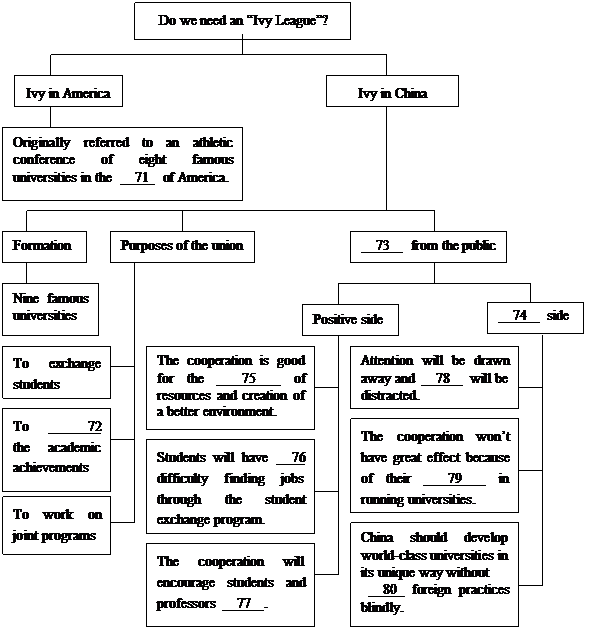
Do we need an “Ivy League”?

China may soon have its own “Ivy League”, with a union of top universities.

The term originally referred to an athletic conference of eight top universities in the northeastern US. The Chinese version, which was officially started in mid-October, consists of nine famous universities, including Peking, Tsinghua, Zhejiang and Fudan. The union is supposed to result in student exchange programs, recognition of academic achievements, and other joint programs.

The news of this Chinese “Ivy League” has received mixed responses from the public and press. Some negative critics have dismissed it as yet another example of the wishful copying of international practices without fully understanding them. Others say that the “Ivy League” is not necessary but that the union is a good idea, one that could promote academic development.

So what’s your opinion on a Chinese “Ivy League”? Do we need one?

Yes. Ivy League or not, nine of China’s best universities cooperating is a good thing.

These universities combining resources could create a better environment for students and for research. It could also save a lot of time and resources because it would mean fewer unnecessary investments for some of the universities.

Allowing students to move to or have exchanges with other universities could broaden their horizons, improve their social skills and create more employment opportunities. The results could be more important than lessons and achievements.

The term “Ivy League” carries a sense of academic excellence, tradition and reputation. If borrowing such a term could encourage students’ and professors’ mental state and improve Chinese higher education, then there’s no reason not to do it.

No. Universities should do some work on increasing cooperation instead of copying an “Ivy League” model.

Many Chinese universities already have such cooperation with each other. If this cooperation were associated with the “Ivy League”, it would just distract (分散) attention and resources and have a negative effect.

These Chinese universities are all state-run and most get their funding from the government. They’re quite similar to each other in many ways and more cooperation wouldn’t bring about as much potential ability as between , say, public and private, or Chinese and foreign universities.

China should find its own way to develop world-class universities instead of by copying some foreign practices. We have our own unique conditions and foreign lessons often don’t apply well here.

 0  30505  30513  30519  30523  30529  30531  30535  30541  30543  30549  30555  30559  30561  30565  30571  30573  30579  30583  30585  30589  30591  30595  30597  30599  30600  30601  30603  30604  30605  30607  30609  30613  30615  30619  30621  30625  30631  30633  30639  30643  30645  30649  30655  30661  30663  30669  30673  30675  30681  30685  30691  30699  151629 
违法和不良信息举报电话:027-86699610 举报邮箱:58377363@163.com

精英家教网