第二部分  阅读理解(共两节,满分 40分)

第一节 (共15小题;每小题2分,满分30分)

阅读下列四篇短文,从每小题后所给的A、B、C、D四个选项中,选出最佳选项。并在答题卡上将该选项涂黑。

       Imagine a classroom missing the one thing that’s long been considered a necessary part to reading and writing ------ paper. No notebooks, no textbooks, no test paper. Nor are there any pencils or pens, which always seem to run out of ink at the critical moment.

       A “paperless classroom” is what more and more schools are trying to achieve.

       Students don’t do any handwriting in this class. Instead, they use palm size, or specially-designed computers. The teacher downloads texts from Internet libraries and sends them to every student’s personal computer.

       Having computers also means that students can use the Web. They can look up information on any subject they’re studying from math to social science.

       High school teacher Judy Harrel in Florida, US, described how her class used the Web to learn about the war in Afghanistan (阿富汗) before.

       “We could touch every side of the country through different sites from the forest to refugee camps (难民营)”, she said. “Using a book that’s three or four years old is impossible.”

       And exams can go online too. At a high school in Tennessee, US, students take tests on their own computers. The teacher records the grades on the network for everyone to see and then copies them to his own electronic grade book.

       A paperless classroom is a big step towards reducing the waste of paper. High school teacher Stephanie Sorrell in Kentucky, US, said she used to give about 900 pieces of paper each week to each student.

       “Think about the money and trees we could save with the computer,” she said.

       But, with all this technology, there’s always the risk that the machines will break down. So, in case of a power failure or technical problems, paper textbooks are still widely available for these hi-tech students.

46. What does “run out of ink at the critical moment” in the first paragraph mean?

A. Pens may not write well at the critical moment.

B. Pens get lost easily, so you may not find them at the critical moment.

C. Pens may have little or no ink at the critical moment.

D. Pens use ink, while pencils don’t.

47. The high school teacher, Judy Harrell, used the example of her class to show that ______.

A. the Web could take them everywhere

B. the Web taught them a lot

C. the Web is a good tool for information

D. the Web, better than the textbooks, can give the latest and comprehensive (全面的)information

48. The paperless classrooms will benefit ______ most.

A. students            B. teachers              C. trees     D. computers 

四、写作(共两节,满分35分)

第一节  短文改错(共10小题;每小题1分,满分10分)

  以下标有题号的每一行均有一个错误,请找出,并按下列情况改正:

  此行多一个词:把多余的词用斜线(\)划掉,在该行右边横线上写出该词,并也用斜线划掉。

  此行缺一个词:在缺词处加一个漏字符号(∧),在该行右边横线上写出该加的词。

  此行错一个词:在错的词下划一横线,在该行右边横线上写出改正后的词。

注意:请在答题卡上作答。

John stayed up late last night, so while he woke up in the                      76.__________

morning, it was already 9 o’clock. He thought, “I was late for                        77.__________

school.” Then he got dressed quickly and washed him                                           78.__________

in no more than ten seconds and hurried into living-room                               79.__________

where his mother was preparing for breakfast. Before his mother                           80.__________

could say anything, he told her, “Mum, it is too late that I                              81.__________

have no time enjoy my breakfast. Good-bye!” With these words                            82.__________

he got his schoolbag but ran out. On the way to school, he                              83.__________

rode fast. It took him ten minutes, four minutes less than usually, to                84.__________

come to the school gate. To his great surprises, it was closed. “Ha!                  85.__________

It is Saturday! How forgetful I am today!”

The following are some important sights in New York.

American Museum of Natural History

   Four floors of exhibition halls here include the world-famous fossil halls with their skeletons of enormous dinosaurs and other creatures; the culture halls, representing a variety of indigenous peoples; and mammal, bird and reptile halls. The renovated Milstein hall of Ocean Life showcases the profusion of life in Earth’s “last frontier”. Also here: Rose Center for Earth and space, with Hayden Planetarium and exhibits on Earth and our universe.

   Open: Sunday-Thursday, 10:00-17:45; Friday-Saturday: 10:00-20:45

Empire State Building

   At 102 stories tall, the Empire State Building commands an inspiring view of Manhattan. Each year, over 3.5 million people come here for the view from the 86th-floor observatory, where they can take in the sights of the city from a glass-enclosed pavilion or the encircling open-air promenade.

   Observatory Hours: 8:00am to midnight daily. Last elevators go up at 11:15pm. Open daily 365 days a year.

Metropolitan Museum of Art (One of the greatest museums in the world)

   It is impossible to “do” the entire museum in one day or describe everything you can see here. Go to the museum & spend some time in the Great Hall where you will find all types of help in many languages for planning your visit. If you can, get a guide before your visit or look at their website where you can plan well & learn about their many special exhibitions & programs.

   Fee: $12 adults, $7 students & seniors, under 12 with adult free.

   Open: Tuesday-Thursday and Sunday. 9:30-17:15; Friday-Saturday, 9:30-20:45.

Museum of Modern Art (MoMA)

   MoMA houses an outstanding collection of American & European paintings & sculptures from late 19th C. to present. Innovative in its definition of “art”, it was a pioneer in exhibiting film, photography, and industrial design. Its retrospectives can draw record-breaking attendance. A happy place to take small children, as strollers are allowed.

   Open: Sunday-Tuesday, Thursday and Saturday, 10:30-17:45; Friday, 10:30-20:15.

64. Varieties of ocean life are exhibited in ________.

A. American Museum of Natural History       B. Empire State Building

C. Metropolitan Museum of Art               D. Statue of liberty

65. You can visit Museum of Modern Art at the following time EXCEPT ________.

A. at 14:30 on Monday                       B. at 7:00 pm on Friday

C. at 10:40 on Wednesday                    D. at 12:00 on Sunday

66. Suppose you are a high school student, who is going to visit Metropolitan Museum of Art with your parents, your 70-year-old Grandpa and your 6-year-old younger brother, how much will you have to pay in total?

   A. $42            B. $38         C. $45           D. $50

第四部分 任务型阅读 (共10小题;每小题1分, 满分10分)

    请认真阅读下列短文, 并根据所读内容在文章后表格的空格处里填人最恰当的单词。注意:每个空格填1个单词。

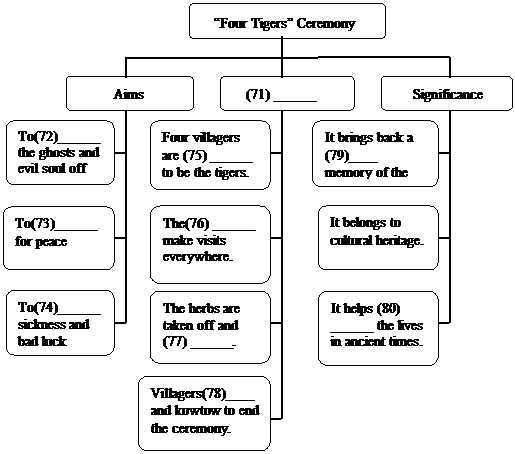
“Four Tigers” Ceremony of the Tu Minority

Heigouding Village, Ledu County in the west of Qinghai province is a place where many people of the Tu minority have lived for centuries. As the little village is comparatively closed to the outside world, a custom called “Four Tigers” was created 200 years ago to protect its inhabitants(栖息地) from sickness and bad luck.

Every year the ceremony is held on the eve of January 15th according to the Chinese lunar calendar to frighten off ghosts and evil souls, and to pray for peace.

Normally four local villagers are selected to be the “tigers” in the ceremony. At first, they gathered with village elders at the mountain-god temple to offer sacrifices of wine, food and incense, and to ask the god to help the tigers. Then the tigers were adorned with herbs, candles and two batches of incense to serve as the tiger’s ears. Two red ribbons held in their mouths represented the tiger’s tongue. The “Tigers” drank wine, knelt and kowtowed to the mountain god before they received Hada, a kind of white silk scarf representing respects and good luck, from the village head with firecrackers crackling.

As night fell, the candles on the tigers’ bodies were lit and the tigers began their visits to one household after another. Villagers followed, shouting “Tigers are coming!” The elder from each household welcomed the tigers at the gate, while the rest of the family knelt down in the courtyard. Firecrackers were set off, a toast made and candies, meat and wine were presented to the villagers following the tigers. After twirling (快速转动)in three circles in the courtyard while those present kowtowed and prayed, the tigers went through every corner of every room to drive away any hiding ghosts. If there was a sick person in the house, the tigers jumped around him or her, scratched their body and said lucky words to drive away diseases and ghosts. After the ceremony, the family would present wine and food to the tigers. Then, shouting “The tigers are leaving!” the whole family saw them off.

After visiting all 30 or 40 households, the herbs were removed from the tigers and burned, to indicate that all the ghosts had been conquered. Then the villagers knelt and kowtowed with the sound of firecrackers, marking the end of the ceremony.

The tiger image exists in other minority groups, also. In ancient times, people entrusted their happiness to gods. The “four tigers” ceremony is vividly held in memory of ancient times and a living fossil for academics studying the lives of ancient people. As it is not popular nowadays, this cultural heritage is on the edge of extinction and needs to be rescued.

 0  27810  27818  27824  27828  27834  27836  27840  27846  27848  27854  27860  27864  27866  27870  27876  27878  27884  27888  27890  27894  27896  27900  27902  27904  27905  27906  27908  27909  27910  27912  27914  27918  27920  27924  27926  27930  27936  27938  27944  27948  27950  27954  27960  27966  27968  27974  27978  27980  27986  27990  27996  28004  151629 

违法和不良信息举报电话:027-86699610 举报邮箱:58377363@163.com

精英家教网