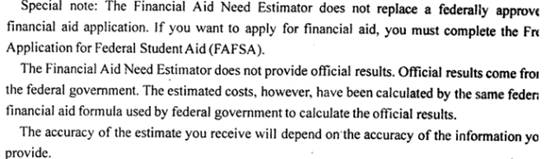
Welcome to Financial Aid Need Estimator! This free service can help you plan more effectively to meet college costs. The Financial Aid Need Estimator allows you to figure out your family costs at specific intitutions by taking you through two steps.

Step 1:during the first step, the Financial Aid Need Estimator will help you estimate how much you and your family will be expected to pay.

Step 2:Using the second step, you may estimate the costs of attending specific institution. Your results will show your results will show your eligibility(合格) for financial aid based on both your expected family costs and the costs of attending the institution you selected. By selecting another institution, you may repeat these calculations for as many institutions as you wish without entering your personal information.

The Financial Aid Need Estimator does not ask you to identify yourself and will not keep your personal information.

Because  international students are not eligible for federal need-based financial aid program results from the Financial Aid Need Estimator will apply only to students who are the U citizens.

41.The result of calculation you get from the Financial Aid Need Estimator will      .

A.help you get the financial aid

B.provide database for official results

C.help you meet your college costs

D.show your eligibility for financial aid

42.The Financial Aid Need Estimator is reliable because        .

A.it is controlled by government

B.it uses the same formula as the government’s official results

C.it can make sure of its accuracy

D.it provides good services free of charge

43.Who will be most interested in the passage?

A.The Us students who want to apply for financial aid.

B.The international students who have financial difficulty.

C.The US students who want to go to college.

D.The international students who want further study.

44. The Financial Aid Need Estimator may mainly consider      .

A.the college you want to go to

B.the accuracy of the information you provide

C.family costs and college costs

D.the application for financial aid

45.The purpose of writing this passage is probably to      .

A.tell the possible ways to get financial aid

B.tell who will the eligible for financial aid

C.introduce the financial Aid Need Estimator

D.introduce the financial aid to college students

Can you believe your eyes? A recent experiment suggests that the answer to that question may depend on your age.

Martin Doherty, a psychologist at the University of Stirling in Scotland, led the team of scientists. In this experiment, Doherty and his team tested the perception(观察力) of some people, using pictures of some orange circles. The researchers showed the same pictures to two groups of people. The first group included 151 children aged 4 to 10, and the second group included 24 adults aged 18 to 25.

The first group of pictures showed two circles alone on a white background. One of the circles was larger than the other, and these people were asked to identify the larger one. Four-year-olds identified the correct circle 79 percent of the time. Adults identified the correct circle 95 percent of the time.

Next, both groups were shown a picture where the orange circles, again of different sizes, were surrounded by gray circles. Here’s where the trick lies in. In some of the pictures, the smaller orange circle was surrounded by even smaller gray circles — making the orange circle appear larger than the other orange circle, which was the real larger one. And the larger orange circle was surrounded by even bigger gray circles — so it appeared to be smaller than the real smaller orange circle.

When young children aged 4 to 6 looked at these tricky pictures, they weren’t fooled — they were still able to find the bigger circle with roughly the same accuracy as before. Older children and adults, on the other hand, did not do as well. Older children often identified the smaller circle as the larger one, and adults got it wrong most of the time.

As children get older, Doherty said, their brains may develop the ability to identify visual context. In other words, they will begin to process the whole picture at once: the tricky gray circles, as well as the orange circle in the middle. As a result, they’re more likely to fall for this kind of visual trick.

55.Doherty and his team of scientists did an experiment to evaluate        .

A.children’s and adults’ eye-sight

B.people’s ability to see accurately

C.children’s and adults’ brains

D.the influence of people’s age

56.When asked to find the larger circle,        .

A.children at 6 got it wrong 79 % of the time with no gray ones around

B.only adults over 18 got it right 95% of the time with gray ones around

C.children at 4 got it right about 79 % of the time with gray ones around

D.adults got it right most of the time with gray ones around

57.Visual context may work when children get older than        .

A.4                           B.6                            C.10                          D.18

58.Why are younger children not fooled?

A.Because they are smarter than older children and adults.

B.Because older people are influenced by their experience.

C.Because people’s eyes become weaker as they grow older.

D.Because their brain can hardly notice related things together.

 0  23095  23103  23109  23113  23119  23121  23125  23131  23133  23139  23145  23149  23151  23155  23161  23163  23169  23173  23175  23179  23181  23185  23187  23189  23190  23191  23193  23194  23195  23197  23199  23203  23205  23209  23211  23215  23221  23223  23229  23233  23235  23239  23245  23251  23253  23259  23263  23265  23271  23275  23281  23289  151629 
违法和不良信息举报电话:027-86699610 举报邮箱:58377363@163.com

精英家教网