I found the imagination of becoming a grandmother somewhat discouraging. I was younger than I thought a grandmother should be when I got the news that I was going to become one myself. I admit, it was not a role that I was emotionally ready to accept. I had been a young mother, and had certainly hoped my daughter would not face that same challenge. I remarried when she was a teenager, and then had two more children. On getting the news that she was expecting, I remember thinking “What do I know about being a grandmother? —I haven’t even finished raising my own kids yet!” I dont like to be unprepared, so I read a few books about grandparenting. That gave me a little help, but I was still uncertain. I thought about other grandmothers I knew, and got a few ideas I liked and a few more that I didn't. But I couldn't quite figure out what kind of grandmother I wanted to be. Then I thought about my own grandmother, Granny, as she’s known by most people, and I knew I had the answer.

I didn’t realize it until that moment, but my own grandmother was the example for the kind of grandmother I wanted to be. I am fortunate that I got to spend a lot of time with my grandparents when I was a little kid. Here's what I learned from my Granny:

Grandmothers always have a cookie jar. For my entire life, Granny always had a cookie jar full of cookies. When I was a little tiny girl, just at eye level with the counter, Granny would get the cookie jar down for me. When I was a little older I learned how to pull the chair over so I could reach. As I got taller, if I really stretched, I could reach the cookie jar with my finger tips and move it close enough to get it down off the counter to find out what kind of treat was inside. Always the first thing I did when I went to Granny 's house was check the cookie jar and there were always cookies in it. Many years later, I’ll drive my own children to Granny’s house and the first thing Pd do is get us all a cookie.

So grandmothers must have a cookie jar and on my granddaughte’ s first Christmas, my daughter bought me my own cookie jar. She said when they came to see me, her daughter would find the treat the way she did and I did.

The writer thought it was a little discouraging to be a grandmother because________.

A.  she was not old enough to be one

B.  she was not emotionally ready to be one

C.  she thought her daughter was too young to be a mother

D.  grandmother should be older than she was

The underlined phrase “that same challenge ” in the first paragraph refers to” ________”

A. taking care of a grandchild  B. taking care of a baby

C. being a young grandmother    D. being a young mother

It can be inferred from the last paragraph that________.

A.  the writer has many happy memories of her grandmother’s cookie jar

B.  the writer always wanted to know what was inside her grandmother’s cookie jar

C.  the writer often drove her grandchildren to see her grandmother’s cookie jar

D.  women   of the writer ‘s age all have a cookie jar for their grandchildren

What kind of grandmother did the writer want to be?

A.  One who has a jar filled with many kinds of cookies for children and herself.

B.  One who grows up with her grandmother's cookie jar with all kinds of cookies.

C.  One who is like her own grandmother with a cookie jar to treat her grandchildren.

D.  One who always makes different kinds of cookies to treat her grandchildren.

Which of the following can be the best title of this text?

A.  Grandmother’s Cookie Jar                 B.Grandmother’s Treat for Children

C.  Grandmothers and Grandchildren          D. Happy Memories of Cookies

In England three foreign gentlemen came to a bus stop. They studied the information on the post sign and decided which bus to take. About five minutes later the bus they wanted came along. They prepared to get on. Suddenly people rushed onto the bus and tried to push them out of the way. Someone shouted insulting remarks about the foreigners. The bus conductor   came rushing down the stairs to see what all the trouble was about. The three foreign gentlemen looked puzzled and ashamed. No one had told them about the British custom of lining up for a bus so that the first person who arrived at a bus-stop is the first person to get on the bus.

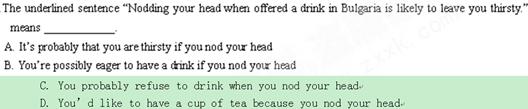
Learning the language of a country isn’t enough. If you want to ensure a pleasant visit, find out as much as possible about the manners and customs of your hosts. You will probably be surprised just how different they can be from your own. A visitor to India would do well to remember that people there consider it impolite to use the left hand for passing food at table. The left hand is supposed to be used for washing yourself. Also in India, you might see a man apparently(显然地)shaking his head at another and assume (认为) that he is disagreeing. But in many parts of India a rotating (旋转) movement of the head is a gesture that express agreement or acceptance. Nodding your head when offered a drink in Bulgaria is likely to leave you thirsty. In that country you shake your head to express “yes” — a nod means “no”.

In Europe it is quite usual to cross your legs when sitting talking to someone, even at an important meeting. Doing this when meeting an important person in Thailand, however, could cause offence (冒犯). It is considered too informal an attitude for such an occasion. Also when in Thailand avoid touching the head of an adult — it’s just not done.

Attitudes to women vary considerably(相当地)around the world. In Japan, for example, it is quite usual for men to plan evening entertainments for themselves and leave their wives at home.

Knowing about customs and attitudes is useful when you are travelling, but you also need to know the language used to express different degrees of formality (礼节).

The three foreign gentlemen looked puzzled and ashamed because __________________.

   A. they didn’t know the English language        B. someone called their names

   C. they didn’t know the custom of lining up for a bus

   D. they knocked someone down while getting on the bus

According to the passage, which attitude to women is usual in Japan?

   A. Men always go to parties with women.  

B. Men plan evening entertainments for their wives.

   C. Men and women have equal rights to go to parties.

   D. Men plan evening entertainments for themselves, while their wives stay home.

What’s the meaning of the underlined word “insulting” in Para. 1 ?

   A. 善意的           B. 咨询的            C. 商量的         D. 无礼的

 0  18241  18249  18255  18259  18265  18267  18271  18277  18279  18285  18291  18295  18297  18301  18307  18309  18315  18319  18321  18325  18327  18331  18333  18335  18336  18337  18339  18340  18341  18343  18345  18349  18351  18355  18357  18361  18367  18369  18375  18379  18381  18385  18391  18397  18399  18405  18409  18411  18417  18421  18427  18435  151629 
违法和不良信息举报电话:027-86699610 举报邮箱:58377363@163.com

精英家教网