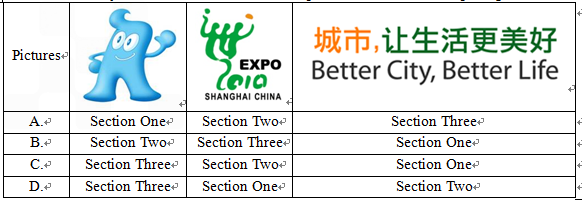
阅读理解Section One The city is an accumulation (积累)of human civilization. Just as the American social philosopher (哲学家) Lewis Mumford put it, it is a special system which, fine and compact(简洁的), has been designed to preserve the fruits of human civilization. Many Western languages have developed their versions of the term “civilization” from the same Latin (拉丁语的) word “civitas”(meaning “city”), and it is by no means a coincidence(巧合). The city has played a significant role in the perfection of order in human society. Section Two The emblem, showing the image of three people ? you, me, him/her holding hands together, symbolizes the big family of mankind. Inspired by the shape of the Chinese character “世” (meaning the world), the design conveys the organizers' wish to host an Expo which is of global scale and which displays the various urban cultures of the world.Section Three Created from the inspiration of Chinese character “人”, the design roots deeply in Chinese culture. It tells the world the eternal core (永恒的核心) and theme of Shanghai World Expo will be always human. The mascot(吉祥物) “Haibao” will become the messenger for the theme of World Expo 2010 Shanghai China “Better City, Better Life”. The basic structure of the Chinese character “人” in which each stroke(一笔,一划) supports each other also shows the concept that the beautiful life should depends on mutual-help. If the human are willing to support one another, the harmony among human, nature, and society will be available. Such an urban life will be nice. Haibao’s confident smile is expressing his sincere greeting from China ? “World Expo 2010 Shanghai China welcomes you!”1. Section One mainly tells us about ______. A. the part cities play in human civilization B. the development of the word “city” C. why the Expo is held in Shanghai D. where human civilization originated2. The underlined word “it” in Section One refers to ______. A. the civilization B. the philosopher C. the word D. the city3. Which correctly matches the sections with the pictures described in the passage? 4. The second paragraph in Section Three explains how the creation is connected with the _____ of the Chinese word “人”. A. story B. meaning C. shape D. usage
课文填空,按照首字母提示或上下文的逻辑意思填空。 Many art lovers would r __1___visit this small art g __2___than any other in New York. Henry Clay Frick, a rich New Yorker, died in 1919, l__3___ his house, f __4___ and art collection to the American people. Frick had a preference for pre-twentieth century Western paintings, and these are well-represented in this excellent collection. You can also explore Frick’s beautiful home and garden which are well w__5___ a visit. The reputation of this museum lies in the v__6___ of its art collection. This c __7___ more than 5,000 years of c___8__ from many parts of the world, i___9__ America, Europe, China, Egypt, other countries and South America. The museum d ___10___ more than just the visual delights of art.
阅读理解
This tour takes you back in history to a moment that “will live in infamy (声名狼藉).” Explore the historic artifacts at the Arizona Memorial Visitor Center commemorating(纪念) the attack on Pearl Harbor, then travel around beautiful Oahu on a Circle Island guided bus tour. The Arizona Me morial Visitor Center is Hawaii’s number one visitor attraction.View the film of the attack on Pearl Harbor and browse the historic artifacts on display.Then ride the Navy launch across Pearl Harbor to visit the Arizona Memorial.Then, board a tour bus for a scenic trip around the island of Oahu.Get your cameras ready for the beautiful view over Windward Oahu at Nu’uanu Pali Lookout.Visit Byodo-In Temple, which is set against a picturesque mountain backdrop. You’ll also see the famous North Shore surfing beaches of Sunset, Banzai Pipeline, and Waimea Bay and drive through rustic Haleiwa Town.Visit Dole Plantation and discover the history of Hawaii’s pineapple industry before enjoying a no host lunch at the Polynesian Cultural Center (lunch isnot included in the listed-price). Inclusions:Scenic bus tour of Oahu islandFilm viewing at Arizona Memorial Visitor Center.Pearl HarborVisit of Byodo-In Temple and Dole Plantation Available:Mon.-Fri. Hours of operation:7 AM to 5 PM Note: Strict security measures forbid purses, handbags, fanny packs, backpacks, camera bags, diaper bags, luggage and/or other items.Visitors may bring a camera and cam-recorder.A storage facility, operated by a private vendor, is available for visitors coming to the USS Arizona Memorial, USS Bowfin Submarine Museum & Park, the Battleship Missouri and the Pacific Aviation Museum.1. What is the purpose of the passage above?A.To introduce the beautiful scene in Oahu B.To tell the writer attractions in Hawaii.C.To attract more tourists. D.To describe a wonderful tour in Oahu.2. Which of the following is the right order of the tour?A. The Arizona Memorial, Byodo-In Temple, Nu’uanu Pali Lookout, Polynesian Cultural CenterB. Pearl Habor, Dole Plantation, Nu’uanu Pali Lookout, Sunset BeachC. Pearl Habor, North Shore, Byodo-In Temple, Dole PlantationD. The Arizona Memorial, Nu’uanu Pali Lookout, Dole Plantation, Polynesian Cultural Center3. A tourist will see everything below at Pearl Harbor except _________.A. the Arizona Memorial B. some historic artifacts C. a film D. Windward Oahu4. Which of the persons below will not be allowed to enter the attractions in Pearl Harbor?A. Alice, a student from LA, comes with her parents, with a Sony digital camera in her hand.B. Geogre Zhang, from Shanghai, leaves his backpack in a locker outside the entrance.C. Billy, from Italy, with small bag in hand and inside the bag is a cam-recorder.D. Hose, from Spain, who has left his luggage in the hotel.