题目内容

Ask someone what they have done to help the environment recently and they will almost certainly mention recycling (循环利用). Recycling in the home is very important of course. However, being forced to recycle often means we already have more material than we need. We are dealing with the results of that over-consumption in the greenest way possible, but it would be far better if we did not need to bring so much material home in the first place.

The total amount of packaging increased by 12% between 1999 and 2005. It now makes up a third of a typical household’s waste in the UK. In many supermarkets nowadays food items are packaged twice with plastic and cardboard.

Too much packaging is doing serious damage to the environment. The UK, for example, is running out of areas for burying this unnecessary waste. If such packaging is burnt, it gives off greenhouse gases which go on to cause the greenhouse effect. Recycling helps, but the process itself uses energy. The solution is not to produce such items in the first place. Food waste is a serious problem, too. Too many supermarkets encourage customers to buy more than they need. However, a few of them are coming round to the idea that this cannot continue, encouraging customers to reuse their plastic bags, for example.

But this is not just about supermarkets. It is about all of us. We have learned to associate packaging with quality. We have learned to think that something unpackaged is of poor quality. This is especially true of food. But it also applies to a wide range of consumer products, which often have far more packaging than necessary.

There are signs of hope. As more of us recycle, we are beginning to realize just how much unnecessary material we are collecting. We need to face the wastefulness of our consumer culture, but we have a mountain to climb.

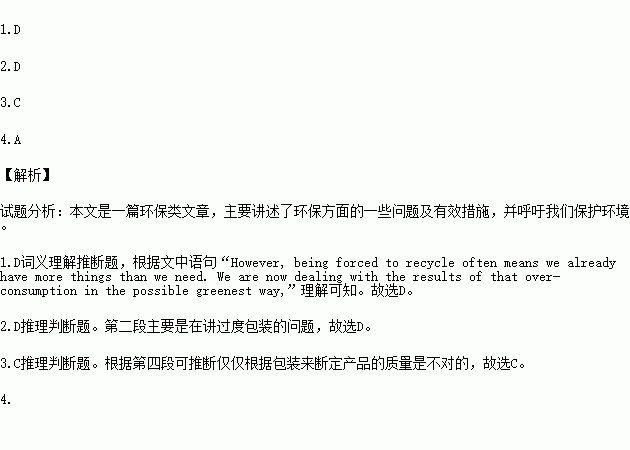
1.What does the underlined phrase “that over-consumption” refer to?

A. Using too much packaging.

B. Recycling too many wastes.

C. Making more products than necessary.

D. Having more material than is needed.

2.The author uses figures in Paragraph 2 to show_________________.

A. the tendency of cutting household waste

B. the increase of packaging recycling

C. the rapid growth of supermarkets

D. the fact of packaging overuse

3.What can be inferred from Paragraph 4?

A. Unpackaged products are of bad quality.

B. Supermarkets care more about packaging.

C. It is improper to judge quality by packaging.

D. Other products are better packaged than food.

4.What can we learn from the last paragraph?

A. Fighting wastefulness is difficult.

B. Needless material is mostly recycled.

C. People like collecting recyclable wastes.

D. The author is proud of their consumer culture.
练习册系列答案
相关题目

根据短文内容,从短文后的选项中选出能填入空白处的最佳选项。选项中有两项为多余选项。(E=AB, F=AC, G=AD)

Benefits of summer camps for kids

Summer camps are great for children of all ages. If you go to a summer camp as a child, you are likely to have good memories of things you did and people you met. With more and more children sitting inside playing computer games, the importance of camps has never been greater. ___1.___

Getting in touch with nature is an exciting experience. __2.___ They will enjoy the experiences of camping, hiking and exploring in forests, deserts or on the seashore. They can also enjoy the beauty of nature and learn about the importance of environmental protection.

Activities at summer camps stress the importance of teamwork. _3.__ Throughout life, people have to be comfortably operating as part of a team in order to be successful. Summer camps teach kids how to be productive members of a team.

___4.__Whether they are afraid of heights, water, the dark or being away from home, they are encouraged to face them and deal with them in an environment surrounded by supportive people. __5.___ It is also a valuable life lesson that will help them through adulthood.

Summer camps are perfect ways for kids to have fun and develop themselves. So parents should try to find out what interests their kids, and choose the right camp for them.

A. Kids can make friends there.

B. Many activities there are designed to stress it.

C. Kids can learn about the natural world at camps.

D. So kids gain courage and confidence by challenging themselves.

E. In fact, staying healthy is not the only benefit kids can get from it.

F. Learning to live on their own may be an extremely hard lesson for kids.

G. Having the courage to face fears is another skill kids can learn at camps.

完形填空,阅读下面短文,从短文后各题所给的四个选项(A、B、C和D)中,选出可以填入空白处的最佳选项,并在答题卡上将该项涂黑。

A girl complained to her father about her hard life. She didn’t know what she could do and wanted to ________ . She was tired of fighting and fighting. One problem had been settled, but ________ appeared.

Her father, a cook, took her into the ________ . He poured water into three pots and boiled it. After the water came to a boil, he put some ________ in the first pot, eggs in the second and coffee in the last. He waited for them for a few minutes ________ any words.

The girl closed her mouth and waited, impatient and ________ by what her father was doing. After about 20 minutes, her father ______ the stove, took out the carrots and put them in a bowl. He took the eggs and put them in another bowl. After that he ________ the coffee into a cup. Turning back to his ________ , he asked, “Sweetheart, what do you see?”

“Carrots, eggs and coffee,” she replied.

Her father asked her to ________ the carrots. She did and felt that the carrots were ________.

________ he asked her to take the eggs and break them. After peeling them, she felt the eggs were hard.

Last, her father asked her to smell the coffee.

She asked, “What does this ________ , Father?”

He ________ that each of the things had felt the same unfortunate fate. They were all boiled in ________ , but with a ________ result. The strong and hard carrots became soft and weak after being boiled. The fragile eggs became________ after cooking. Coffee grounds were very unique. They could change the water.

________ one are you?” asked her father, “When calamity(不幸的事) ________ on your door, what will your ________ be? Are you carrots, eggs of coffee?”

1.A. give inB. go onC. give upD. carry on

2.A. the otherB. the restC. anotherD. the second

3.A. bedroomB. storeroomC. backyardD. kitchen

4.A. potatoesB. carrotsC. tomatoesD. apples

5.A. withoutB. overC. beyondD. with

6.A. confusedB. excitedC. surprisedD. relaxed

7.A. turned onB. turned downC. turned outD. turned off

8.A. putB. pouredC. flewD. picked

9.A. sonB. potC. kitchenD. daughter

10.A. tasteB. eatC. smellD. touch

11.A. strongB. heavyC. softD.light

12.A. Now thatB. Since thenC. After thatD.Once again

13.A. thinkB. sayC. referD. mean

14.A. questionedB. explainedC. requiredD. suggested

15.A. waterB. potC. stoveD. fire

16.A. similarB. sameC.wonderfulD. different

17.A. hardB. calmC. deliciousD. broken

18.A. WhatB. WhicheverC. WhichD. Whose

19.A. looksB. touchesC. knocksD. waits

20.A.impressionB. reactionC. answerD.responsibility

The Great Plague(瘟疫) of London in 1665 was the last in a long senies of plague that first began in London in June 1499.1t killed between 75,000 and 100,000. First suspected in late 1664,it began to spread eastwards in April 1665 from the poor suburb of St. Giles to the crowded and dirty communities on its way to the walled City of London.

The Great Plague at Its Peak

By September 1665 ,the death rate had reached 8,000 per week. Helpless city authorities began to abandon quarantine(隔离) measures. Houses containing the dead and dying were no longer locked. London's mournful silence was broken by the noise of carts carrying the dead for burial in churches or public plague pits.

Well-off residents soon fled to the countryside, leaving the poor behind in poor old commun/ties. Thousands of dogs and cats were killed to remove a feared source of contagion (传染) ,and piles of rotting garbage were burned. Doctors cut swellings and bled black spots in attempts to cure plague victims.

Plague Orders prohibited churches from keeping dead bodies in their buildings during public assemblies or services, and camers of the dead had to identify themselves and could not mix with the public.

Samuel Pepys: Eyewitness Accounts

In his famous diary, Samuel Pepys, a member of Parliament, conveyed the sad image of desperate people wandering the streets in search of relief from the ruins of the plague. His notes during 1665 indicated the severity of London's Great Plague. In July, he mourned " the sad news of the death of so manv in the community, forty last night, the bell always going either for deaths or burials. " A month later, when London's death rate rose sharply, Pepys noted that surviors are forced to carry the dead to be buried by daylight, the nights not enough to do it

The Plague Declines and the Government Reacts

By February 1666,the Great Plague had nearly run its course.lt died out during the Great Fire that same year and never returned. Central parts of London were rebuilt with wider streets to relieve crowding and better waste water svstems to improve public cleanliness. New Plague Orders were issued in May 1666,which banned the burial of future plague victims in churches and small churchyards, enforced the use of quicklime (生石灰) at chosen burial sites, and strictly prohibited opening graves less than one year after burial as a safeguard against the spread of infection.

1.1n the course of the Great PJague,it was a common practice to .

A. keep dead bodies in the church buildings

B. burn piles of rotting garbage in the streets

C. carry the dead for church burials in the daytime

D. unlock the houses containing the dead and dying

2.lt can be inferred from the passage that .

A. dogs and cats were certain to spread the piague

B. doctors' treatment of plague victims was effective

C. city authorities allowed rich residents to go to the countryside

D. quarantine measures were powerless in preventing the plague

3.How did Samuel Pepys feel when the bell was going all the night during the Great Plague?

A. Frightened. B. Relieved.

C. Sorrowful. D. Moody.

4.What's the main purpose of this writing?

A. To blame poor public cleanliness for plague.

B. To inform readers of what happened in the Great Plague.

C. To show that plague was closely related to church activities.

D. To prove that plague could be controlled by humans.

违法和不良信息举报电话:027-86699610 举报邮箱:58377363@163.com

精英家教网