题目内容

【题目】There's no __________ in the way they do their accounts (记账).

A. approaches B. means C. method D. ways

【答案】C

【解析】句意:他们记账没有条理。approach作“方法,步 骤”讲时后面经常接介词to;meansway的意思是“方 法”,后面经常接动词不定式或of doing;method在本句 中的意思是“秩序,条理”。根据句意,选C最合适。

练习册系列答案
相关题目

【题目】That robots, automation, and software can replace people might seem obvious to anyone who’s worked in automotive manufacturing. But MIT business scholars Erik Brynjolfsson and Andrew McAfee’s claim is more troubling and controversial. They believe that rapid technological change has been destroying jobs faster than it is creating them.

They believe that technology increases productivity and makes societies wealthier, but it became clear to them that the same technologies making many jobs safer, easier, and more productive were also reducing the demand for many types of human workers. Technologies like the Web, artificial intelligence, and big data are automating many routine tasks. Countless traditional white-collar jobs, such as many in the post office and in customer service, have disappeared.

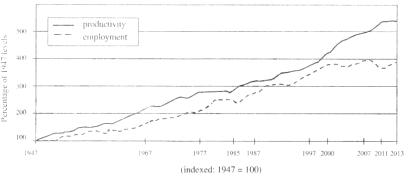
As evidence, Brynjolfsson and McAfee point to a chart on which separate lines represent productivity and total employment in the United States. For years after World War II, the two lines closely tracked each other, with increases in jobs corresponding to increases in productivity. Then, beginning in 2000, the lines diverge; productivity continues to rise steadily, but employment suddenly shrinks. By 2011, a significant gap appears between the two lines, showing economic growth with no parallel increase in job creation.

United States Productivity and Employment

But are these new technologies really responsible for a decade of lackluster (无生气) job growth? David Autor, an economist at MIT who has studied the connections between jobs and technology, doubts that technology could account for such a sudden change in total employment. Moreover, he also doubts that productivity has, in fact, risen steadily in the United States in the past decade. If he’s right, it raises the possibility that poor job growth could be simply a result of a depressed economy. The sudden slowdown in job creation “is a big puzzle,” he says, “but there’s not a lot of evidence that it’s linked to computers.” “To be sure, computer technologies are changing the types of jobs available, but that is very different from saying technology is affecting the total number of jobs,” he adds. “Jobs can change a lot without there being huge changes in employment rates.”

Lawrence Katz, a Harvard economist, says that while technological changes can be painful for workers whose skills no longer match the needs of employers, no historical pattern shows these shifts leading to a net decrease in jobs over an extended period. Still, Katz doesn’t dismiss the notion that there is something different about today’s digital technologies. Though he expects the historical pattern to hold, it is “genuinely a question,” he says. “If technology disrupts enough, who knows what will happen?”

1Which period on the chart strongly supports McAfee’s claim?

A. 1947—1967. B. 1985—1987.

C. 1997—2000. D. 2011—2013.

2According to David Autor, the change in job growth ________.

A. is not necessarily caused by technology

B. results from a weakening economy

C. has no connection with productivity

D. affects the current types of jobs

3What is Lawrence Katz’s attitude towards the topic?

A. Optimistic. B. Defensive.

C. Objective. D. Disapproving.

4The main purpose of the passage is to ________.

A. show the relation between productivity and job creation

B. discuss the effect of technological advances on employment

C. argue against the wide use of artificial intelligence

D. explain the impact of technologies on productivity

【题目】Directions: Fill in each blank with a proper word chosen from the box. Each word can be used only once. Note that there is one word more than you need.

Is it possible to make paper without trees? Australian businessmen Kevin Garcia and Jon Tse spent a year researching a possible 1 that could serve as a possible raw material for making paper. Then Garcia read about a Taiwanese company making commercial paper out of stone and a(n) 2 struck.

A year later, in July 2017, they launched Karst Stone Paper. The company produces paper without using wood or water. Their source is stone waste 3 from construction sites and other industrial waste dumps.

"If you look at the whole process of how paper is traditionally made, it 4 chopping trees, adding chemicals, using lots of water and then 5 , drying and flattening it into sheets of paper," said Garcia. "It contributes to high carbon emission and deforestation."

In 2019, Garcia estimates Karst's paper production has helped save 540 large limber trees (成材木) from being deforested, 83,100 liters (21,953 gallons) of water from being used and 25,500 kilograms (56,218 pounds) of carbon dioxide from being 6.

"We collect disposed limestone (石灰石) from wherever we can find it, wash it, and grind it into fine powder," he said. The powder is mixed with a HDPE resin(高密度聚乙烯树脂), which 7 over time from sunlight, leaving only calcium carbonate (碳酸钙) behind.

The paper can be as thin as notebook paper or as thick as a cardboard paper and is waterproof, 8 and difficult to tear. The notebooks cost $10 to $25. Karst's products are mainly sold through the company's website, but are also stocked in 100 stores, 9 throughout Australia, the United States and the United Kingdom. "Over 70% of the customers are US-based," he said.

They hope to have the notebooks in 1,000 stores by the end of the year. Garcia said they are now thinking about 10 investors for the first time in order to scale up their operations. They declined to reveal how much the company makes or their annual revenue.

违法和不良信息举报电话:027-86699610 举报邮箱:58377363@163.com

精英家教网