题目内容

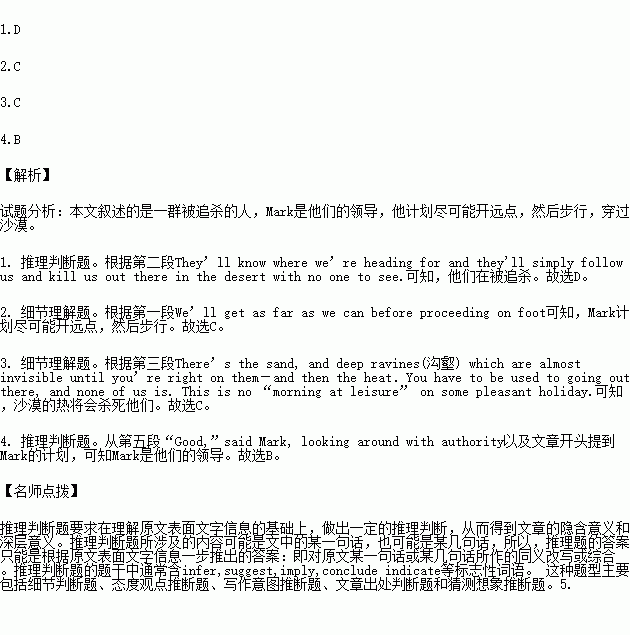
“We leave at dawn and head out overland by jeep towards Base One. We will get as far as we can before proceeding on foot,” Mark explained. The others sat and listened. Sarah, particularly, as a “casualty of events”, wouldn't have known what to say or suggest even if she’d been asked. But Harry had a lot to say.

“We'll never make it,” he protested(抗议). “We'll still be crossing the desert when they catch up with us. They’ll know where we’re heading for and they seem to know every move we make or are going to make.”

Mark said nothing, but spread his hands out as if to say “Well, what do we do then?” “We wouldn’t be in this mess now,” Harry went on, almost ignoring Mark’s gesture, “if we hadn't stopped to rescue Sarah.”( He glanced at her briefly.) “But since we did, we must get on—but not across the desert. There is the sand, and deep ravines (沟壑) which are almost invisible until you’re right on them and then the heat. You have to be used to going out there, and none of us is. This is no ‘morning at leisure’ on some pleasant holiday, you know! If we went north instead and made for the river,…"

He broke off and looked around at the others, feeling somehow that his argument was pointless. No one said anything.

“Good,” said Mark, look around with authority, and returned to checking their stores.

A beautiful sunrise was about to burst over the horizon as the jeep headed out towards Base One.

1.What can we know about the group of people?

A. They were being trained.

B. They were doing research.

C. They were on holiday.

D. They were being hunted.

2.What’s Mark’s plan?

A. To drive across the desert.

B. To make for the river on foot.

C. To drive as far as possible and then walk.

D. To leave before dawn and leave Sarah behind.

3.Why did Harry think that they should make for the river?

A. The journey would be more pleasant.

B. A river trip would be much safer.

C. The desert heat would kill them.

D. He knew the road leading north.

4.What can be inferred from the passage?

A. The group accepted Harry’s plan.

B. Mark was the leaders in the action.

C. They wanted to see the sunrise.

D. They had no other choice but to wait.
练习册系列答案
相关题目

How I Turned to Be Optimistic

I began to grow up that winter night when my parents and I were returning from my aunt’s house,and my mother said that we might soon be leaving for America. We were on the bus then. I was crying, and some people on the bus were turning around to look at me.I remember that I could not bear the thought of never hearing again the radio programs for school children to which I listened every morning.

I do not remember myself crying for this reason again. In fact,I think I cried very little when I was saying goodbye to my friends and relatives. When we were leaving I thought about all the places I was going to see—the strange and magical places I had known only from books and pictures. The country I was leaving never to come

back was hardly in my head then.

The four years that followed taught me the importance of optimism, but the idea did not come to me at once. For the first two years in New York I was really lost—having to study in three schools as a result of family moves. I did not quite know what I was or what I should be. Mother remarried, and things became even more complex for me. Some time passed before my stepfather and I got used to each other. I was often sad, and saw no end to “the hard times”.

My responsibilities in the family increased a lot since I knew English better than everyone else at home. I wrote letters, filled out forms, translated at interviews with immigration officers, took my grandparents to the doctor and translated there, and even discussed telephone bills with company representatives.

From my experiences I have learned one important rule:almost all common troubles eventually go away! Something good is certain to happen in the end when you do not give up,and just wait a little!I believe that my life will turn out all right, even though it will not be that easy.

1.How did the author get to know America before she went there?

A.From her relatives.

B.From her mother.

C.From books and pictures.

D.From radio programs.

2.Upon leaving for America the author felt ________.

A.confusedB.excitedC.frightenedD.amazed

3.For the first two years in New York,the author ________.

A.often lost her way

B.did not think about her future

C.studied in three different schools

D.got on well with her stepfather

4.What can we learn about the author from Paragraph 4?

A.She worked as a translator.

B.She attended a lot of job interviews.

C.She paid telephone bills for her family.

D.She helped her family with her English.

At heart, parents always wish the best for their children, and they work hard for that. Nowadays, we see parents deciding the schools for their little ones before the baby is even born. Once kids start going to school, some parents want to have a time-to-time update of their kid’s activities. They want to come to the classroom every day, keep an eye on whom they talk to, know the friends they keep, start telling them how to do their job, and keep talking or giving a feedback(反馈)to them about everything under the sun. Besides, they send their kids for extra hobby classes, as they want their children to do best in every field.

When it comes to the education, super mom and dad have all the plans made for their children, and I am sure that they have come up with the best. So, try to fight for the dreams that your parents have set for you. However, in some cases, it may happen that the kids have some different dreams. Parents sometimes don’t even consider the choices of their kids and may force them to do what they wanted to do in life. It’s good to plan the future for the children, but leave at least some decisions to them.

So what should the children do? First, hear out all the plans that your parents have made for you. If you have some different ideas, then sit down and talk to your family about it. Be patient and respect their decisions, but put your plan forth, and make them understand what you want to do and why. Many times, you are not aware of the difficulties that you may have to face while pursuing your dreams. Ask your parents for suggestions, which will make them feel good and involved. That way, they may support you if you are going on the right path.

1.The parent described in Paragraph 1 tend to ________.

A. have a good understanding of their children

B. worry a lot about their children

C. take good care of their children

D. expect too much from their children

2.With respect to educational plans, the author advises ________.

A. children to do as they are told

B. children to turn a deaf ear to their parents

C. parents to respect their children’s choices

D. parents to do everything for their children

3.The underlined word “pursuing” in Paragraph 3 in closest in meaning to “________”.

A. going afterB. planning forC. adapting toD. preparing for

4.What is the author’s attitude towards these super parents’ behaviors?

A. Opposed.B. Doubtful.C. Uncaring.D. Supportive.

违法和不良信息举报电话:027-86699610 举报邮箱:58377363@163.com

精英家教网