题目内容
The Pacific island nation of Nauru used to be a beautiful place. Now it is an ecological disaster area. Nauru’s heartbreaking story could have one good consequence — other countries might learn from its mistakes.
For thousands of years, Polynesian people lived the remote island of Nauru, far from western civilization. The first European to arrive was John Fearn in 1798. He was the British captain of the Hunter, a whaling ship. He called the island Pleasant Island.
However, because it was very remote, Nauru had little communication with Europeans at first. The whaling ships and other traders began to visit, bringing guns and alcohol. These elements destroyed the social balance of the twelve family groups on the island. A ten-year civil war started, which reduced the population from 1,400 to 900.
Nauru’s real troubles began in 1899 when a British mining company discovered phosphate (磷酸盐)on the island. In fact, it found that the island of Nauru was nearly all phosphate, which a very important fertilizer for farming. The company began mining the phosphate.
A phosphate mine is not a hole in the ground; it is a strip mine. When a company strip-mines, it removes the top layer of soil. Then it takes away the material it wants. Strip mining totally destroys the land. Gradually, the lovely island of Nauru started to look like the moon.
In 1968, Nauru became one of the richest countries in the world. Every year the government received millions and millions of dollars for its phosphate.
Unfortunately, the leaders invested the money unwisely and lost millions of dollars. In addition, they used millions more dollars for personal expenses. Soon people realized that they had a terrible problem — their phosphate was running out. Ninety percent of their island was destroyed and they had nothing. By 2000, Nauru was financially ruined. Experts say that it would take approximately $433,600,000 and more than 20 years to repair the island. This will probably never happen.
- 1.
What might be the author’s purpose in writing the text?
- A.To seek help for Nauru’s problems.
- B.To give a warning to other countries
- C.To show the importance of money
- D.To tell a heartbreaking story of a war.
- A.
- 2.
What was Nauru like before the Europeans came?
- A.Rich and powerful
- B.Modern and open
- C.Peaceful and attractive
- D.Greedy and aggressive
- A.
- 3.
The ecological disaster in Nauru resulted from _______.
- A.soil pollution
- B.phosphate overmining
- C.farming activity
- D.whale hunting
- A.
- 4.
Which of the following was a cause of Nauru’s financial problem?
- A.Its leaders misused the money
- B.It spent too much repairing the island
- C.Its phosphate mining cost much money
- D.It lost millions of dollars in the civil war.
- A.
- 5.
What can we learn about Nauru from the last paragraph?
- A.The ecological damage is difficult to repair.
- B.The leaders will take the experts’ words seriously.
- C.The island was abandoned by the Nauruans
- D.The phosphate mines were destroyed
- A.
本文是一篇记叙文。太平洋岛国瑙鲁曾经是一个美丽富饶的海岛,但是,由于内战和岛上磷酸盐矿的过度开采,很快使之成为一个生态灾难的贫瘠的海岛。作者写这一骇人听闻的故事,旨在提醒其他国家要引以为戒。
1.考查作者写作意图。根据第一段Nauru’s heartbreak story could have one good consequence—other countries might learn from its mistakes.可知,作者认为瑙鲁的故事可以让其他国家从他们的错误中学到一些东西,作者的目的是警示其他国家。
2.考查细节理解。根据第二段中的…lived on the remote island of Nauru和第五段最后一句中的Gradually, the lovely island of Nauru started to look like the moon可知,瑙鲁以前是一个平静美丽的小岛。
3.考查细节理解。瑙鲁岛上的生态灾难是因为对磷酸盐的过度开采。由第五段中的Strip-mining totally destroy the island和Gradually, the lovely island of Nauru started to look like the moon可知B正确。
4.考查细节理解。由第七段中的Unfortunately, the leaders invested the money unwisely and lost millions of dollar可知,领导人投资的不明智,加上还要把更多的钱用在个人消费上,所以导致了财政问题。
5.考查判断推理。根据文中最后一段的“Experts say that it would take approximately $433,600,000 and more than 20 years to repair the island. This will probably never happen. ”可知,瑙鲁的生态灾难几乎很难恢复。所以A正确。

 名校课堂系列答案
 visitors can camp, hike, and bike. Cottonwoods and willows are thriving along streams, creating habitats for bobcats, beavers, and other animals.
 protecting the grassland
The long, lonely voyage of the Japanese ghost ship is over.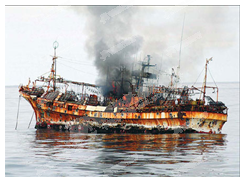
A US Coast Guard cutter poured cannon fire into an abandoned Japanese ghost ship that had been drifting since last year’s tsunami, sinking the vessel into waters more than 305 meters deep in the Gulf of Alaska and removing the danger it posed to shipping and the coastline on Thursday.
The cutter’s guns tore holes in the 164-foot Ryou-Un Maru, and then it began to take on water and lean to one side. In about four hours, the ship disappeared into the sea, said Chief Petty Officer Kip Wadlow.
The ship had no lights or communications system, and its tank was able to carry more than 7,570 liters of diesel fuel. Officials, however, didn’t know exactly how much fuel was aboard.
“It’s less risky than it would be running into shore or running into other ships,” coast guard spokesman Paul Webb said.
The US National Oceanic and Atmospheric Administration and the Environmental Protection Agency studied the problem and decided it is safer to sink the ship than let the fuel evaporate and pollute the sea environment.
Ryou-Un Maru was probably among the first wave of the 1.5 million tons of garbage of refrigerators, washing machines, televisions, roofs and fishing nets heading toward North America since last March when a magnitude-9.0 earthquake struck Japan.
As the coast guard was ready to fire on the vessel, a Canadian fishing vessel, the 19-meter Bernice C, claimed the rights to save the ghost ship in international waters.
Plans to sink it were paused so the Canadian crew could have a chance to take the stricken ship. A Canadian official with knowledge of the situation told the Associated Press that the Bernice C was unable to drag it.
Then the Canadian boat left, and once it was about 10 kilometers from the Japanese vessel, the Coast Guard began to fire, first with 25 mm shells, then a few hours later with ammunition twice that size.
State officials have been working to test the danger of garbage including materials affected by a damaged nuclear power plant, to see if Alaska residents, seafood or wild animals could be affected.
【小题1】Which of the following is NOT the reason for sinking the Japanese ship?
| A.It had no lights or communications system. |
| B.It might be washed up onto the shore. |
| C.It was a danger to other passing ships. |
| D.The oil it carried could pollute the sea. |
| A.the ghost ship was beyond the reach of the Coast Guard’s guns |
| B.the shells were not powerful enough to sink the ghost ship |
| C.state officials worried the ghost ship might give out radiation |
| D.a Canadian fishing boat wanted to save the ghost ship |
| A.Japanese ghost ship arriving at US |
| B.Tsunami garbage heading to US |
| C.Cannon fire sinking Japanese ghost ship |
| D.Japanese ghost ship polluting the Pacific |
Early last Tuesday, six men carrying machine guns, a pistol and a hunting rifle got on a four—car electric “ milk train” at the Dutch town of Assen. Shortly after it left Beilen, ten miles away, the terrorists stopped the train and seized the passenger as hostages. As police and Dutch soldiers ringed the train, another group of terrorists stuck in Amsterdam, forcing their way into the Indonesian consulate and taking 41 more hostages, including 16 children. By week’s end the terrorists had murdered three people aboard the train, and four more had been wounded in the raid on the consulate.
The kidnapping, and the subsequent cold—blooded murders, virtually rocked the Netherlands. While the Cabinet met in emergency sessions, television and radio station paused normal programming in favor of solemn music and news bulletins.
The terrorists were Indonesians from the South Moluccan Islands in the Pacific Ocean, and they were demanding that the Dutch help them gain independence from the Jakarta regime.(雅加达政权)
The twin acts of violence were not the first signs of South Molucca anger. Just before a 1970 visit to the Netherlands by Indonesia’s President Suharto, they attacked the Indonesian embassy in the Hague, killing a Dutch policeman. Last week’s kidnappings are two days before the Dutch Appeals Court was to trial 16 South Moluccan’s who were implicated in a plot last April to kidnap Queen Juliana and other members of the Royal family. They planned to storm the palace at Soestdijk after attacking the gates with an armoured car(装甲车).
The Moluccan headache is a heritage(遗留问题) of the old days of empire. A chain of islands at the eastern of the Indonesian archipelago, the Moluccas were once known as the Spice Islands. When the Netherlands gave up its East Indies colonies in 1949, the Moluccans wanted to set up a South Moluccan Republic, some 12,000 islanders were allowed to settle to the Netherlands. Their number swollen by Dutch—born children now reached 35,000. the young Moluccans here are demanding that the Dutch help them gain independence from the Jakarta regime.
1.Which of the following is not mentioned in the passage?
|
A.Dozens of people were seized by the terrorist as hostages. |
|
B.The Indonesian consulate was located in Amsterdam. |
|
C.The terrorists were Indonesians living in the Netherlands. |
|
D.The terrorists all surrendered(投降) to the police and soldiers. |
2.Why did television and radio stations pause normal programming?
|
A.The acts of violence shocked the whole country. |
|
B.The terrorists destroyed necessary equipment. |
|
C.the Cabinet needed to think quietly. |
|
D.Their men were too sad to produce good program. |
3.The last paragraph __________.
|
A.is mainly about the history of Indonesia |
|
B.tells us how Indonesia won its independence |
|
C.tell us how the Netherlands gave up its rule |
|
D.briefly accounts for the acts of violence |