题目内容

  If the world were a village of 1,000 people it would include:

  ·584 Asians

  ·124 Africans

  ·95 Eastern and Western Europeans

  ·84 Latin Americans

  ·55 Former Soviets(including Lithuanians, Latvians, Estonians, and other national groups)

  ·52 North Americans

  ·6 Australians and New Zealanders

  The people of the village would speak:

  ·165 Mandarin

  ·86 English

  ·83 Hindu/Urdu

  ·64 Spanish

  ·58 Russian

  ·37 Arabic

  The above list covers the mother tongues of only half the village.

  One-third of the people in the village are children, and only 60 are over the age of 65. Just under half of the married women in the village have access to modern equipments.

  This year 28 babies will be born. Ten people will die, 3 of them for lack of food, 1 from cancer. Two of the deaths will be of babies born within the year. With the 28 births and 10 deaths, the population of the village next year will be 1, 018.

  In this village of 1, 000 persons, 200 people receive 75 percent of the income; another 200 receive only 2 percent of the income.

  About one-third have access to clean, safe drinking water.

  Of the 670 adults in the village, half can not read or write.

  The village has a total yearly budget(预算), public and private, of over $ 3 million-$ 3, 000 per person if it is distributed evenly. Of the total $ 3 million:

  $ 181, 000 goes to weapons and warfare

  $ 159, 000 to education

  $ 132, 000 to health care

  These weapons are under the control of just 100 of the people. The other 900 are watching them with deep anxiety, wondering whether they can learn to get along together.

1.Which of the following is true about Mandarin according to the text?

[  ]

A.Nearly one-third of Asian people speak Mandarin in the village.

B.About 8.25 percent of the people speak Mandarin in the village.

C.About 16.5 percent of the people speak Mandarin in the village.

D.Nearly all the Mandarin-speaking people are from Asia in the village.

2.Which of the following problems is NOT mentioned in the text?

[  ]

A.Poverty.
B.Education.
C.Environment.
D.Marriage.

3.The underlined part “have access to” (in Para. 4) means ________.

[  ]

A.use
B.buy
C.produce
D.try

4.The last sentence in the text implies that most of the people long for ________.

[  ]

A.a peaceful world
B.good education
C.better health care
D.a life without anxiety
答案:C;D;A;A
解析:

  1.这是一道正误辨认题。这篇短文假设这个村里有1,000人,其中165人说Mandarin语,占整个人口的16.5%。

  2.这是一道正误辨认题。这篇短文讲到了财富、教育和环境,没有讲有关婚姻的问题。

  3.这是一道猜测词义题。根据这个动词的宾语modern equipments可猜测出,have access to的意思是“使用”。

  4.这是一道推理判断题。短文尾段中These weapons are under the control of just 100 of the people.说明,其中10%的人掌握着武器,90%的人处于深深的焦虑之中,大多数人渴望着生活在一个和平的世界里。


练习册系列答案
相关题目
I don’t often lose things and I’m especially careful with money, so I was quite surprised when I   1   for my wallet and it wasn’t there. At first, I thought it was possible that I could have   2   it home. Then I remember taking it out to   3   for the taxi,   4   I knew I had it with me just   5   I walked into the restaurant. I wondered if it was possible   6   it could have slipped out of my pocket while I was eating dinner.   7   about that possibility, I turned and walked back to the table   8   I had been sitting.

Unfortunately, there were several people   9   at the table at the time, so I called a waiter and   10   to him that my wallet had   11   out of my pocket while I was sitting at the table a few minutes earlier. I   12   the waiter go over to the table to see if my wallet was on the floor. While the waiter was looking for it, the manager of the restaurant   13   to me and asked me if anything was wrong. I didn't want to get a lot of people involved(牵涉) in the problem, but I knew I   14   to get the wallet back. I told the manager   15   had happened. He had me   16   the wallet to him, and then he insisted that I report the   17   to the police. I told him that I didn’t particularly want to get the police involved in it;   18  , I was in a hurry because I had an appointment with my doctor in just a few minutes.

I explained to him that my biggest worry   19   was how I was going to pay back. He told me not to worry about that. He had me write down my name and address, and he said he would send me a   20  .

1. A. brought          B. reached           C. searched           D. looked

2. A. forgotten           B. taken              C. left              D. put

3. A. pay            B. wait             C. look             D. reach

4. A. and            B. or                C. but              D. so

5. A. before          B. after             C. for               D. since

6. A. what            B. that              C. which            D. where

7. A. Thought         B. Think             C. Thinking          D. To think

8. A. that            B. where            C. which            D. there

9. A. crowding           B. seated            C. working           D. arranged

10. A. explained       B. told              C. shouted            D. pointed

11. A. dropped           B. fallen              C. run              D. stepped

12. A. let            B. allowed            C. told              D. had

13. A. showed         B. came out          C. came up           D. came into

14. A. must           B. had              C. may             D. ought

15. A. what           B. that              C. how             D. why

16. A. speak          B. tell               C. describe           D. talk

17. A. missed          B. missing            C. stolen             D. stealing

18. A. but           B. except            C. besides           D. however

19. A. for a moment    B. at any moment      C. in a moment       D. at the moment

20. A. letter           B. card             C. message           D. bill


阅读理解

Nelson Mandela

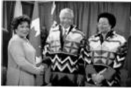
  Nelson Mandela is one of the great political leaders of our time.His lifelong efforts to the fight against racial(种族)oppression(压迫)in his country won him the admiration(钦慕)of millions worldwide, as well as the 1993 Nobel Peace Prize.As the leader of South Africa’s anti-apartheid movement, Mandela was a key player in helping to move his country toward multiracial government and majority rule.

  Mandela’s long, hard struggle is a victory of dignity(尊严)and hope.During his 27 years of imprisonment, he gained support the world over for his fight against apartheid(种族隔离).His determination and self-sacrifice(自我牺牲)eventually resulted in a free, multiracial democracy(多种族民主)for South Africa.In December 1996, he personally signed his country’s new constitution(宪法), which put an end to the unjust policies of the former racist(种族)government.

  Mandela has always spoken out for what he believes in.He’s a man of true courage.If determination and patience were considered talents, Mandela would win hands down in any sort of competition.

Accomplishments(成就)&fame(名誉)

  Nelson Mandela’s greatest accomplishments were his role in ending apartheid, and becoming South Africa’s first elected black president.He has been the recipient(收件人)of dozens upon dozens of awards, prizes and honors from countless associations and organizations, but perhaps none more prestigious(声望很高)than the Nobel Peace Prize, which he shared with former South African President Frederik W.de Klerk, in 1993.

  He has been awarded several other major peace prizes, such as the UNESCO(United Nations Educational, Scientific and Cultural Organization)Peace Prize in 1991(also shared with F.W.de Klerk); the Africa Peace Award in 1995 and the International Gandhi Peace Prize in 2002.

  Mr.Mandela also received dozens of honorary degrees(名誉学位)from universities the world over, including the Universities of Bristol, Cambridge, Glasgow, London, Nottingham, and Oxford, as well as an Honorary Doctorate from the Sorbonne University in Paris(all in July 1996), and Harvard Business School’s Statesman of the Year Award in 1995-to name but a few.He has also been presented(赠送)with the key to cities such as Rome, Rio de Janeiro, London, Dublin, and Sydney, Australia(where he became the first person ever to receive the Freedom of that city).In July of 2002, he received the Presidential Medal of Freedom, the United States’ highest civilian(公民)award.

Model

  There’s something admirable about having been a leader fighting for a person’s freedom and equality in an unjust society.Mandela has become a worldwide symbol(楷模)of the struggle of the oppressed(被压迫者)over the oppressor.He has been celebrated in song by artists the world over, in many different languages.One entitled “Nelson Mandela” was recorded by British 2-Tone group The Special A.K.A(formerly The Specials); making the top 10 in the UK and a few other European nations in 1984.

personal style

  As a president, Mandela sported the typical garb(服饰)of high-ranking government officials:expensive, well-tailored(缝制精致的)suits.Now retired(退役)from public life, Mandela the elder statesman dresses in an ordinary way.

  He attends many activities, often where he is the guest of honor, in bright, colorfully patterned(典型的)traditional African robes(长袍)or shirts all the better for getting down when the music begins.

1.Mandela was not only admired(钦慕)for his long fight against ________ but also for ________.

2.How many peaceful prize has Mandela got? He has got ________ in 1991, ________ in 1995 and ________ in 2002.

3.Where did he got the Presidential Medal of Freedom, highest civilian award?________.

4.Mandela is a man full of ________ and his greatest success was to play a part in getting rid of ________ and to be elected ________.

Even though he has been caught, the former Iraqi President Saddam Hussein is still causing trouble. His arrest ? 1 ? as many questions as it has answers. Top of the list is  2  should happen to Saddam now, closely ? 3 ? by calls for information from him about Iraq's weapons of mass destruction (毁坏).

He is currently being held by  4  troops at a secret place. The US says he will stand trial(审判) for his cruel actions during his years in  5 .This is likely to take place at a court  6  two weeks ago by the US-backed Iraqi Governing Council.

The council's president Abdul Aziz al-hakim has warned Saddam could be executed (处死) if

   7  guilty (有罪的) by the court. And the US  8  this.

“I think he ought to receive the  9  punishment for what he has done to people,” said US president George W. Bush, 10  directly stating that Saddam should be put to death.

  However, many  11 ,including Saddam's long time enemy Iran, believe he would receive a fairer trial in an international court. 12  Britain, American's closest supporter, said it would not take part in any trial that could lead to Saddam's execution.

The UN Security Council has yet to  13  its position clear. But UN Secretary—General Kofi Annan ? 14 ? say that “the UN does not support a death penalty.”

  Besides  15 a trial of Saddam, the world wants to see  16  the US and Britain can find the  17  weapons they gave as the  18  for the war in Iraq. Asked if Saddam's capture (捕获) could  19  a breakthrough (突破) in the hunt for the weapons of mass destruction, British Prime Minister Tony Blair said, “I think we should  20  what we're doing in Iraq.”

1.A. threw     B. throws      C. has thrown      D. had thrown

2.A. which     B. that        C. it             D. what

3.A. followed   B. following    C. to follow        D. to be followed

4.A. British     B. American    C. Iraqi           D. Iranian

5.A. strength       B. power       C. politics         D. force

6.A. set out     B. set on       C. set off         D. set up

7.A. found     B. finding      C. was found       D. find

8.A. supports   B. opposes     C. agrees         D. disappoints

9.A. better     B. good       C. best           D. worst

10.A. with     B. for         C. without         D. of

11.A. people    B. officers     C. nations         D. armies

12.A. But      B. And        C. Though         D. Even

13.A. have     B. let         C. make           D. allow

14.A. does     B. did         C. was           D. is

15.A. wait     B. waited      C. waiting         D. waiting for

16.A. that      B. why       C. if             D. which

17.A. banned   B. advanced    C. modern         D. new

18.A. cause     B. reason      C. result           D. end

19.A. result from B. come from C. lead to          D. solve

20.A. carry off  B. carry forward C. carry through     D. carry on

听力(共两节,满分30分)

第一节(共5小题;每小题1.5分,满分7.5分)

听下面5段对话。每段对话后有一个小题,从题中所给的A、B、C三个选项中选出最佳选项。听完每段对话后,你都有10秒钟的时间来回答有关小题和阅读下一小题。每段对话仅读一遍。

1.How much will the woman pay if she buys two pounds of tomatoes?

A.$0.80.

B.$2.20.

C.$0.30.

2.How long does it take the woman to drive home when it isn’t rush hour?

A.Twenty minutes.

B.Twenty-five minutes.

C.Fifty minutes.

3.What does the man mean about Betty?

A.She doesn’t like going shopping.

B.She went shopping yesterday.

C.She prefers shopping to studying.

4.What do you know from the conversation?

A.The man had to work overtime.

B.Henry failed to meet the man.

C.The man had a traffic accident.

5.What does the woman mean?

A.She doesn’t believe the man.

B.They are not going to land.

C.She isn’t afraid.

听力原文:(Text 1)

W:I thought that your tomatoes are eighty cents a pound.

M:They used to, but the price has gone up thirty cents.

(Text 2)

M:How long does it take you to drive home when there is not much traffic?

W:Only twenty-five minutes.But if I can’t leave my office before 5∶30 p,m., it sometimes takes me fifty minutes.

(Text 3)

W:Didn’t Betty go shopping with you yesterday?

M:Even if she hadn’t had a lot of studying, she would have preferred staying at home to going shopping.

(Text 4)

W:If the traffic wasn’t so bad, I should have been home at six o’clock.

M:What a pity!Henry was here to see you.

(Text 5)

W:What was that noise?

M:It was the pilot putting the wheels down.We must be coming to land.Are you frightened?

W:You must be joking.

第二节(共15小题;每小题1.5分,满分22.5分)

  听下面5段对话或独白。每段对话或独白后有几个小题,从题中所给的A、B、C三个选项中选出最佳选项。听每段对话或独白前,你将有时间阅读各个小题,每小题5秒钟;听完后,各小题将给出5秒钟的作答时间。每段对话或独白读两遍。

听第6段材料,回答第6~8题。

6.What can the woman be?

A.She is a waitress at a hotel.

B.She is the secretary of Mr Li.

C.She works at the Blackwood Hotel.

7.How could the man get in touch with Mr Green?

A.Dial 411 to find a proper phone number.

B.Dial 707.

C.Find the hotel.

8.Why did the man ask the woman to change the dollar?

A.To pay for the information.

B.To get on the bus.

C.To make the phone call.

听力原文:(Text 6)

W:Oh, excuse me, Mr.Li.I almost forget there is a phone message here for you.A Dr Green called and asked you to call him back.

M:Where is he now, do you know?

W:He’s staying at the Blackwood Hotel, Room 707.

M:Thank you very much.Do you happen to have the number of the Blackwood?

W:I’m sorry, I don’t.But you can get it from information.Just dial 411.

M:Oh, and could I trouble you for changing a dollar?

W:All right.Here is your change.By the way, the public phones are over there on your right.

M:I see.Thank you.

听第7段材料,回答第9~11题。

9.What does the man want to learn?

A.Computer science.

B.Skills, such as driving.

C.language.

10.How long does the course last?

A.About 20 days.

B.About 35 days.

C.About 2 months and 5 days.

11.When can he take the final exams?

A.From September 15 to 17.

B.From August 16 to 18.

C.From July 12 to 16.

听力原文:(Text 7)

M:Excuse me, Miss.

W:Yes, young man.May I help you?

M:Yes, I’d like to get some information about the summer course at the English Training Center.

W:Sure.What can I tell you?

M:Can you tell me the starting and finishing time of course, please?

W:Yes.The course begins on July 15 and runs until August 20.

M:Right, and what course will we learn?

W:Well, you have varieties of courses.You have listening and speaking courses, reading and writing.There are also classes in audio-visual training and chances to use the language laboratory as well.

M:Right, and what time will the classes be held?

W:Well, most of them are in the morning.There are only a few classes in the afternoon.

M:Right.Do you have a timetable?

W:I’m sorry.My workmate isn’t here at the moment, so I can’t get a timetable for you yet.

M:That’s OK.And when will the final exams be held?

W:At the end of the term.They begin on August 16 and run until August 18.

M:OK.Well, thank you, Miss.

听第8段材料, 回答第12~14题。

12.Who answers the telephone?

A.Tom.

B.Susan’s husband.

C.Susan.

13.When are they going to New Zealand?

A.In two weeks.

B.In a couple of months.

C.In half a year.

14.Where are they going to meet?

A.At Susan’s.

B.At Tom’s.

C.In New Zealand.

听力原文:(Text 8)

M:Hello!Can I speak to Susan, please?

W:Speaking.Is that you, Tom?

M:Yes, it is.I am going to New Zealand in two weeks, and my wife is going with me.

W:Oh, how lucky you are!How long are you going for?

M:For a couple of months, maybe half a year.My boss wants me to help set up a branch company there.Well, Susan, you have been to New Zealand several times.Can you give us some suggestions or just tell us about that country?

W:I’d love to.We can have a talk sometime.

M:Why not come over to dinner in my house this weekend.My wife wants to meet you as well.

W:All right.What about Saturday?

M:OK.See you at 6∶00 p.m., this coming Saturday, Goodbye!

听第9段材料,回答第15~17题。

15.When does this conversation take place?

A.Just before the term begins.

B.After the first week of classes.

C.In the middle of the term.

16.Why has the woman come to see Dr.Taylor?

A.She had promised that she would.

B.She has been sick.

C.She needs his approval(赞成)for her courses.

17.What does Dr.Taylor seem most worried about?

A.She already knew the material.

B.She entered the hospital.

C.Her course load was too heavy.

听力原文:(Text 9)

W:Excuse me, Dr.Taylor.Your secretary said that I should come right in.

M:Please do, Jennie.How can I help you?

W:Would you please sign your name on my schedule card.Here, on the line above “Adviser’s Agreement.”

M:Sure.But let’s look it over together first.How many courses do you have here?

W:Six.

M:Six? That’s quite a heavy load.Any particular reason?

W:I had to drop my chemistry course last term when I went into the hospital.So, I need to take it again.

M:So, you’ve already learned a lot of the material.

W:Right.And calculus is the part of second-year requirement.

M:Let’s see, chemistry, calculus.Oh, I see, you will be in my seminar on modern American novel.

W:Yes, I’m looking forward to it, and Romantic poetry seminar.too.

M:Two seminars? That’s rather a lot.Can you manage the work?

W:I think so.The introductory economics is fairly easy, and so is the music course.

M:Well, then I’ll be happy to sign the card.However, I insist you come to see me after the first week of classes, so we can make sure this isn’t too much for you.

W:That’s a promise.

听第10段材料,回答第18~20题。

18.What’s the weather like today?

A.Cool.

B.Warm.

C.Hot.

19.What special view will the tourists get in this park?

A.Houses of all shapes and styles.

B.Birds of all colors.

C.School and teachers and the pupils.

20.What do people do here in autumn and winter?

A.Take photos.

B.Watch birds.

C.Enjoy the beauty.

听力原文:(Text 10)?

Ladies and gentlemen, your attention, please.Our bus will arrive at Lake Park in a few minutes.You can feel the comfortable cool air coming from the lake.This is the favorite place for tourists in the summer, especially on a hot summer afternoon like today.This lake is one of the great wonders of nature.No one knows when and how it was formed.But people began to build houses around the lake a hundred years ago, so in this park you can have a special view of houses of all shapes and styles and colors.It is like an architecture show.In late autumn and winter, this park is the best place for bird watching.School teachers like to bring children here and they just love it.Now our bus is driving around the lake.You can sit back and enjoy the beauty of everything here.The bus will take us to a good spot, where you can take the most wonderful photos you have ever taken.Here we are.Please get off and watch your step.Return to the bus in twenty minutes.Thank you!

阅读理解

阅读下列短文,从每题所给的四个选项(A、B、C和D)中,选出最佳选项并在答题卡上将该项涂黑。

  European Work Experience Program(E.W.E.P.)is an independent British organization which began in 1991 in the city of London.E.W.E.P.provides the opportunity for students from the 25 countries of the European Union and nationals(公民)from Norway,Iceland,Switzerland and Liechtenstein to live in England,to gain work experience,to practice their English and to get a better insight into the British social and eulturallife.

  To apply you must meet the following requirements:

  *Preferred age:18 to 28 years old

  *Be able to work in the UK for a period of at least two months.

  *Must have a good knowledge of English.

  *Due to work permit restrictions,European Work Experience Program Ltd will only select you if you are a European Union Member or national from Norway,Iceland,Switzerland and Liechtenstein.

  European Work Experience Program Ltd will find you a suitable job and an accommodation.A representative of E.W.E.P.will be available during your stay to help you and you will get a 24-hour help line service during your stay.The TOTAl fee for our services is £264.63(394.35 Euros).

  Should you require any further information,please contact us:

  European Work Experience Program Ltd

  Unit 1,Red Lion Court, Alexandra Road

  Hounslow,Middlesex,TW3 1 JS

  United Kingdom

  Tel:44 208 572 2993

  Fax:44 208 572 1114

  E-mail:sales@ewep.com

(1)

What's the purpose of writing the text?

[  ]

A.

To introduce a new program in England.

B.

To attract more students to work in England.

C.

To describe the working conditions in England.

D.

To make clear the requirements for students working in England.

(2)

Which of the following is NOT the purpose of the program?

[  ]

A.

To get a lot of work experience.

B.

To improve their English rapidly.

C.

To have better understanding of the British culture.

D.

To make more money in Britain.

(3)

If you apply for the program.you ________

[  ]

A.

must be 18 to 26 years old

B.

must be able to speak at least three languages

C.

must be nationals from the countries mentioned in the text

D.

should have some working experience in a foreign country

(4)

You can get in touch with E.W.E.P.by the following ways EXCEPT by ________

[  ]

A.

making a teJephone call

B.

sending the organization a fax

C.

writing an e-mail to the organization

D.

going there in person by air

(5)

Which of the following statements is TRUE according to the text?

[  ]

A.

European Work Experience Program Was set up in the 19 th century.

B.

You'll work in the UK for at least two months if you attend the program.

C.

You can get a 24-hour help from a representative during your stay.

D.

You don't have to hand in 394.35 Euros after you have got a job in Britain.

违法和不良信息举报电话:027-86699610 举报邮箱:58377363@163.com

精英家教网