题目内容
They encouraged me _____________ again
- A.trying
- B.tried
- C.to try
- D.have tried

 课堂练加测系列答案
 轻松课堂单元测试AB卷系列答案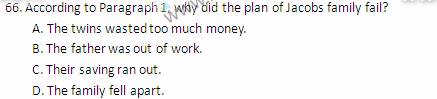
“Creativity is the key to a brighter future,” say education and business experts. Here is how schools and parents can encourage this important skill in children.
If Dick had listened to his boss in 1925, we might not have a product that we now think of as of great importance: a new type of tape. Dick worked for the Minnesota Mining Company. At work he developed a kind of material strong enough to hold things together. But his boss told him not to think more about the idea. Finally, using his own time, Dick improved the tape, which now is used everywhere by many people. And his former company learned from its mistake. Now it encourages people to spend 15 percent of their work time just thinking about and developing new ideas.
Creativity is not something one is just born with, nor is it necessarily a character of high intelligence. The fact that a person is highly intelligent does not mean that he uses it creatively. Creativity is the matter of using the resources one has to produce new ideas that are good for something.
Unfortunately, schools have not tried to encourage creativity. With strong attention to test results and the development of reading, writing and mathematical skills, many educators give up creativity for correct answers. The result is that children can give back information but can’t recognize ways to use it in new situation. They may know the rules correctly but they are unable to use them to work out practical problems.
It is important to give children choices. From the earlier age, children should be allowed to make decisions and understand their results. Even if it’s choosing between two food items for lunch, decision-making helps thinking skills. As children grow older, parents should let their children decide how to use their time or spend their money. This is because the most important character of creative people is a very strong desire to find a way out of trouble.
【小题1】What did the company where Dick once worked learn from its mistake?
| A.They encouraged people to work a longer time. |
| B.They discouraged people to think freely. |
| C.They asked people to spend all their work time developing new ideas. |
| D.They encouraged people to spend some of their work time considering and improving new ideas. |
| A.that people are born with |
| B.that depends on intelligence |
| C.that is a way of using what one has learnt to work out new problems |
| D.that is not important at all |
| A.They don’t understand the importance of education. |
| B.They don’t want their students to make mistakes. |
| C.They pay too much attention to exam marks, language and mathematical skills. |
| D.They think it more important to remember some information. |
| A.Try to help them as much as possible. |
| B.Take no notice of whatever they do. |
| C.Leave them as they are. |
| D.Help them if their decision is wrong, but not too much. |
Diana Jacobs thought her family had a workable plan to pay for college for her 21-year-old twin sons: a combination of savings, income, scholarships, and a modest amount of borrowing. Then her husband lost his job, and the plan fell apart.
"I have two kids in college, and I want to say come home. ' but at the same time I want to provide them with a good education," says Jacobs.
The Jacobs family, did work out a solution: They asked and received more aid from the schools, and each son increased his' borrowing to the maximum amount through the federal loan (贷款) program. They will each graduate with $ 20,000 of debt, but at least they will be able to finish school.
With unemployment rising, financial aid administrators expect to hear from more families like the Jacobses. More students are applying for aid, and more families expect to need student loans. College administrators are concerned that they will not have enough aid money to go around.
At the same time, tuition (学费) continues to rise. A report from the National Center for Public Policy and Higher Education found that college tuition and fees increased 439% from 1982 to 2007, while average family income rose just 147% . Student borrowing has more than doubled in the last decade.
"If we go on this way for another 25 years, we won't have an affordable system of higher education," says Patrick M. Calan, president of the center. "The middle class families have been financing it through debt. They will send kids to college whatever it takes, even if that means a huge amount of debt."
Financial aid administrators have been having a hard time as many companies decide that student loans are not profitable enough and have stopped making them. The good news, however, is that federal loans account for about three quarters of student borrowing, and the government says that money will flow uninterrupted.
1.According to Paragraph 1. why did the plan of the Jacobs family fail?
|
A.The twins wasted too much money. |
B.The father was out of work. |
|
C.Their saving ran out. |
D.The family fell apart. |
2.How did the Jacobses manage to solve their problem?
|
A.They asked their kids to come home. |
|
B.They borrowed $20, 000 from the schools. |
|
C.They encouraged their twin sons to do part-time jobs. |
|
D.They got help from the schools and the federal government. |
3.Financial aid administrators believe that________.
|
A.more families will face the same problem as the Jacobses |
|
B.the government will receive more letters of complaint |
|
C.college tuition fees will double soon |
|
D.America's unemployment will fall |
4.What can we learn about the middle class families from they text?
|
A.They blamed the government for the tuition increase. |
|
B.Their income increased steady in the last decade. |
|
C.They will try their best to send kids to college. |
|
D.Their debts will be paid off within 25 years. |
5.According to the last paragraph the government will________.
|
A.provide most students with scholarships |
|
B.dismiss some financial aid administrators |
|
C.stop the companies from making student loans |
|
D.go on providing financial support for college students |