题目内容

Japanese people may bow and even give out their business cards to greet others, but they dislike ______ when you just put the cards in your pocket without looking .

A. this B. you C. it D. that

C

【解析】

试题分析:考查it作形式宾语的使用。it作形式宾语,而when引导的从句作真正的宾语。句意:日本人将会鞠躬,分发他们的名片和别人打招呼,但是他们不喜欢你不看而是仅仅把明信片放在口袋里。故选C。

考点:考查特殊疑问词引导的宾语从句

练习册系列答案
相关题目
Choosing the right job is probably one of the most important decisions we have to make in life, and it is frequently one of the hardest decisions we have to make. One important question that you might ask yourself is: “How do I get a good job?”___1.____.

There are people who can answer an insignificant advertisement in the local paper and land the best job in the world; others write to all sorts of places all over the country, and never seem to get a reply at all. Still others believe that the in-person, door-to-door approach is by far the best way to get a job; and then there are those who, through no active decision of their own, just seem to be in the right place at the right time. ___2.___. He used to spend a lot of his free time down by the sea watching the tall ships, but never thinking that he might one day sail one of them. His father was a farmer, and being a sailor could never be anything for the boy but an idle dream. One day, on his usual wandering, he heard the captain of the ship complaining that he could not sail because one member of his crew was sick. Without stopping to think, the lad(少年) offered to take his place. __3.__.

_4.__. If the lad had gone home to ponder(考虑)his decision for a week, he may have missed his chance. It is one thing to be offered an opportunity; it is another thing to take it and use it well.

Sometimes we hear stories about people who break all the rules and still seem to land plum jobs(美差). When you go for a job interview or fill out an application, you are expected to say nice things about the company to which you are applying. __5.___ And within a year this person had become general manger of the company.

A.This story also illustrates the importance of seizing an opportunity when it presents itself.

B.People find jobs in an infinite number of ways.

C.it’s almost impossible to find a good job by answering advertisement in newspapers

D.Take for example the young man who wanted to be a sailor.

E.But there was one person who landed an excellent job by telling the interviewer all the company’s faults.

F.He spent the rest of his life happily sailing the ships he had always loved.

G.It is very important to seize an opportunity when it presents itself.

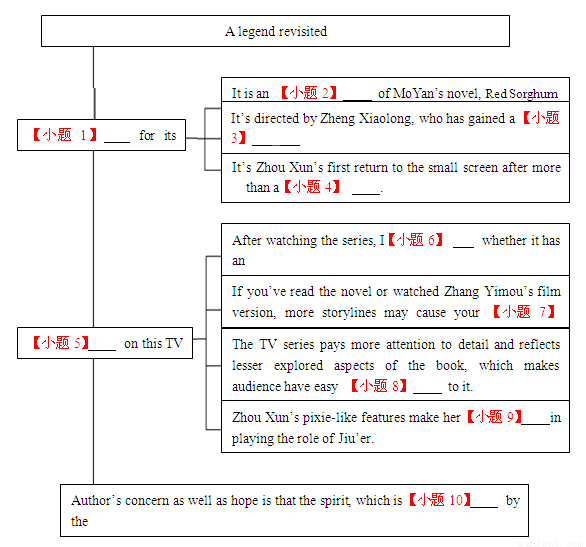
Apparently, the most talked about TV series in China right now is Red Sorghum(红高粱), currently broadcasting on four major networks. And here are a few reasons why you might want to tune in: 1) It’s adapted from the novel Red Sorghum Clan by Nobel Prize-winning author Mo Yan, which already had a renowned film adaptation in 1987; 2) it’s directed by Zheng Xiaolong, best known for helming Legend of Zhen Huan; 3) and it’s Zhou Xun’s first return to the small screen after more than ten years.

After watching almost one third of the whole series, I’m pretty sure the series doesn’t disappoint — and sometimes it’s even better than I expected. But can it have an enduring impact like the Legend of Zhen Huan, or even its film version? I’m a little skeptical.

It’s the same story of the unrest of rural China in the late 1920s and 30s. But if you’ve read the novel or watched Zhang Yimou’s film version, it’s easy to get confused early in the show. There’re quite a few newly added characters, such as Jiu’er’s first love and sister-in-law, and more storylines that you’re just not familiar with.

This doesn’t mean it’s a bad adaptation, though. Whereas the film focuses more on social and political dynamics to reflect the spirit of the novel, the TV series pays more attention to detail and reflects lesser explored aspects of the book. To some extent, it has no choice — a TV series requires more substance to fill in long hours with content. Meanwhile, it’s more accessible to a television audience.

The biggest surprise in Red Sorghum is undoubtedly Zhou Xun. Although she’s mostly known for making movies, Zhou has portrayed a couple of classic TV characters, such as Huang Rong and the young Princess Taiping. Obviously, her elegant pixie-like(古灵精怪的) features haven’t kept her from playing the role of the 19-year-old Jiu’er successfully. Not as natural as Gong Li’s portrayal, though, Zhou certainly delivers a powerful new voice through the character.

Mo’s novel conveys a strong and evocative tone. My concern, also my hope, is that the symbolism of red sorghum, the metaphor for change and loss in a particular time and place, can shine through.

违法和不良信息举报电话:027-86699610 举报邮箱:58377363@163.com

精英家教网