题目内容

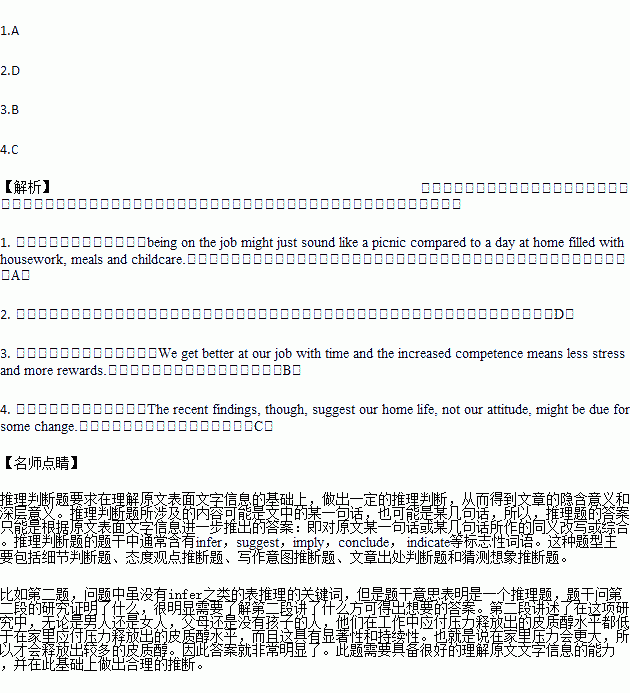
For many people, being on the job might just sound like a picnic compared to a day at home filled with housework, meals and childcare. Even for those with a happy family life, home can sometimes feel more taxing than work.

In a new study, researchers at Penn State University found significantly and consistently lower levels of cortisol(皮质醇) released in response to stress, in a majority of subjects when they were at work compared to when they were at home. This was true for both men and women, and parents and people without children.

Both men and women showed less stress at work. But women were more likely to report feeling happier there. Men were more likely to feel happier at home. Experts say there are other reasons why work is less stressful than home for many. “Paid work is more valued in society,” says Sarah Damaske, the lead researcher on the study. “Household work is boring and not particularly rewarding.”

We get better at our job with time and the increased competence means less stress and more rewards. Yet none of us, no matter how long we’ve been doing it, ever truly feels like an expert at parenting or even at marriage.

The support and friendship of co-workers also offer stress relief. At home, meanwhile, stress spreads and accumulates quickly. “That’s the reason why most housewives wish they were the bread earners,” Dr. Damaske says.

Much of the advice to families and couples include the warning to “leave work stress at the office” and even to change our mind-set from work to home, for example, a walk around the block. The recent findings, though, suggest our home life, not our attitude, might be due for some change.

1.Which of the following can replace the underlined word “taxing”?

A. stressful. B. cheerful. C. worthwhile. D. rewarding.

2.What did the research in the second paragraph prove?

A. Men felt better at home.

B. Women felt they had less time.

C. Women were easier to feel happier.

D. Most people felt more stress at home.

3.What do most people think of work at office?

A. It is competitive. B. It improves ability.

C. It can’t relieve stress. D. It doesn’t always pay off.

4.According to the recent findings, what should we change to solve the problem mentioned?

A. Our attitude. B. Our mind-set.

C. Our home life. D. Our working style.
练习册系列答案
相关题目

Just like rice and Noodles are different from bread, snacks in China are a world apart from those in the UK and the US. For one thing, I never imagined that sunflower seeds(葵花籽) would be so popular here. I found people having them while waiting for tables outside restaurants, before dinner and, of course, while watching TV. I also saw that a plate of sunflower seeds is always on tables during the Spring Festival holidays.

I had seldom tried sunflower seeds when I came to China. In the UK, young people love their snacks. In fact, young people in Britain eat more snacks than people of the same age in other European countries. A recent Survey has discovered that 64% of under 20-year-olds snack between meals, according to an article on a British website. In comparison(对比), 58.7% of young people snack in Germany, 53% in France, and only 40.7% in Spain.

In Britain, we always looked forward to our favorite potato chips and chocolate bars after school. In U.S. One of things that I found the most wonderful when I first visited the US was the number of snacks in their supermarkets; I was surprised to find huge shelves just for snacks were bigger than some stores in the UK. Snack tastes in the US are much the same as in the UK.

All in all, it’s probably best for your health if you like sunflower seeds rather than potato chips and chocolate. But eating these delicious snacks sometimes couldn’t be wrong, could it?

1.What is the article mainly about?

A. The most popular snack in China.

B. Snacks in the UK and the US.

C. Snacks young Western people like.

D. Some tips for choosing snacks in the UK.

2.According to the British Council, snacks are most popular among young people in_______.

A. Britain B. Germany C. France D. Spain

3.What surprised the author when he went to supermarkets in the US?

A. How the snacks tasted.

B. The size of the snacks’ packages.

C. The lack of choice when it came to snacks.

D. The large number of snacks.

4.What does the author think of potato chips and chocolate?

A. They don’t taste as good as sunflower seeds.

B. They are unhealthy, so people should stop eating them.

C. It’s better eat them with sandwiches and fruit.

D. It’s fine to enjoy them sometimes although they are unhealthy.

Learning experiences happen to us throughout our lives, and not too long ago, I had one that I would like to ________. This story began with a _______ three years ago. It's a story of pizza and being _______of buying ice cream with a US $20 bill.

I was going to Marblehead, Massachusetts, with my racing team on the highway and we were all ______Luckily, we saw a rest area ______. I had a brand-new US $ 20 bill, and I had ______ had that kind of cash before. Spending it on food ______to me like throwing it away.

We all rushed into the pizza line.______ I got a cheese pizza and drink. Halfway through the _______, I realized I had not actually ________any money to the cashier. I felt terrible. I just couldn't go back to the cashier and ______my stolen pizza. I would feel embarrassed.

I was so upset that I refused to give myself the_______of an ice cream in fear that someone would say, "Hey, Jeff, why don't you _______ the change from the pizza instead of that nice, new US $20 bill?" I was not so proud of my _______ now.

For the next two years, whenever I was ______of the "Pizza incident," I _______my eyes and said to myself, "Not gonna think about it, not gonna think about it…"

I think this ______ the saying, "A coward (懦夫) dies a thousand deaths, a hero dies _______." I was a coward and have felt______ about that incident at least a thousand times. If I had been a "hero" and gone ______up to pay for the pizza, then I would have felt a little embarrassed about it only once, or maybe twice.

1.A. introduce B. perform C. share D. explain

2.A. game B. trip C. party D. race

3.A. afraid of B. fond of C. careless in D. eager for

4.A. late B. hungry C. lost D. slow

5.A. inside B. behind C. below D. ahead

6.A. even B. once C. never D. ever

7.A. proved B. showed C. turned D. seemed

8.A. Gradually B. Finally C. Usually D. Lately

9.A. meal B. journey C. talk D. job

10.A. returned B. offered C. handed D. supplied

11.A. give away B. give back C. ask for D. pay for

12.A. pleasure B. chance C. idea D. effort

13.A. find B. receive C. use D. return

14.A. cash B. pizza C. ice cream D. change

15.A. blamed B. warned C. told D. reminded

16.A. fixed B. closed C. raised D. wiped

17.A. brings B. concerns C. impresses D. reflects

18.A. more B. less C. one D. none

19.A. terrible B. puzzled C. nervous D. curious

20.A. away B. back C. near D. out

违法和不良信息举报电话:027-86699610 举报邮箱:58377363@163.com

精英家教网