题目内容

根据短文内容,从短文后的选项中选出能填入空白处的最佳选项。选项中有两项多余选项。

Money Matters

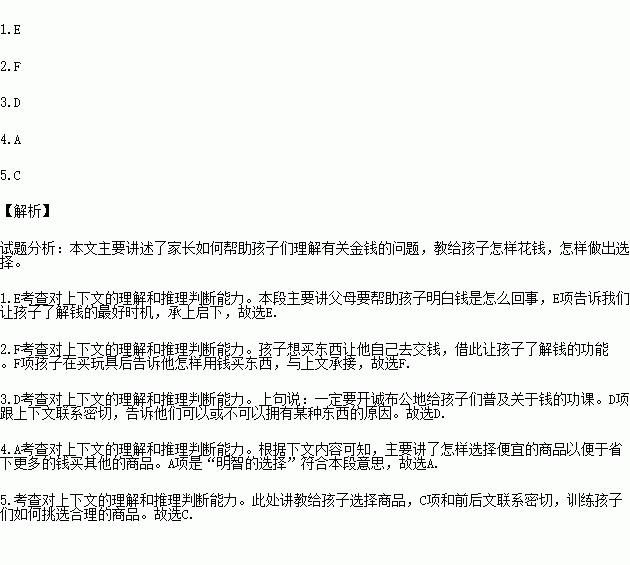
Parents should help their children understand money. 1. So you may start talking about money when your child shows an interest in buying things, candy or toys, for example.

1. The basic function of money

Begin explaining the basic function of money by showing how people trade money for goods or services. It is important to show your child how money is traded for the things he wants to have. If he wants to have a toy, give him the money and let him hand the money to the cashier(收银员). 2. When your child grows a bit older and understands the basic function of money, you can start explaining more ways of using money.

2. Money lessons

Approach money lessons with openness and honesty. 3. If you must say no to a child’s request to spend money, explain, “You have to make a choice between this and that toy.”

3. 4.

Begin at the grocery store. Pick out two similar brands of a product –a name-brand butter and a generic(无商标产品), for example. You can show your child how to make choices between different brands of a product so that you can save money. 5. If he chooses the cheaper brand, allow him to make another purchase with the money saved. Later, you may explain how more expensive choice leaves less money for other purchases.

A. Wise decision

B. The value of money

C. Permit the child to choose between them.

D. Tell your child why he can –or cannot –have certain things.

E. The best time to teach a child anything about money is when he shows an interest.

F. Talk about how the money bought the thing after you leave the toy store.

G. Ask yourself what things that cost money are most important to you.
练习册系列答案
相关题目

It was a hot, humid day, and my brother Walt and I had decided that the only way to survive it would be to go swimming in a deep swimming hole across Mr. Blickez’s pasture(牧场) and through some woods.

The only problem with our plan was that this pasture was guarded by a huge, mean Hereford bull. Mr. Blickez had told us that Elsie was the meanest bull in the township, maybe even the county, and we believed him. But the hotter it got, the more we thought there was something doubtful about his claim. For one thing, we remembered Mr. Blickez liked telling tall tales; for another, Elsie seemed like an odd name for a bull.

Finally, I talked Mom into asking permission for us to walk through the pasture, but then another problem surfaced. Mom said she would talk to Mr. Blickez if we would take our cousin Joanie along with us. Joanie was almost two years older than me and a head taller. If her teasing ever got around my grade school, it would be all over for me. In fact, I still had a headache from a quarrel with her that morning. “I’m not going swimming with that dumb girl cousin.” I told my mom.

“Either Joanie goes with, or you stay home alone,” Mom said in her serious tone. I gave in and we set out. On our way across the pasture, Walt yelled suddenly. Elsie had approached him quietly and was licking(舔) his back. Joanie and I dove under the wire fence, but while I was on the ground I looked up and saw that Elsie wasn’t a big mean bull after all. She was going to keep licking my brother’s back as long as he stood still.

We had many good days growing up and visiting our secret swimming hole guarded by the so-called “big mean bull”. And as it turned out, for a girl cousin, Joanie hasn’t been too bad. She’s been one of my best friends over the years.

1.What’s the second problem the author has to face?

A. His mother insisted on his cousin going with him.

B. His cousin made jokes on him in his grade school.

C. He quarreled with his cousin and had a headache.

D. His mother failed to ask permission for him.

2.What does the author think of Elsie in the end?

A. Aggressive. B. Unkind.

C. Bad-tempered. D. Friendly.

3.What’s the passage mainly about?

A. The bull guarding Mr. Blickez’s farm.

B. The story of visiting the swimming hole.

C. How friendly the so-called mean bull was.

D. How the author changed his attitude to Joanie.

Bill McIntosh and Royce Wedding had been the best friends for 30 years. Now, living alone 12 miles east of the town, Bill earned his living by hunting foxes and rabbits.

"Coming to the football match this afternoon?" Bill McIntosh asked 54-year-old Royce Wedding as they drank beer at the Eureka Hotel. Royce shook his head, "I promised Mom I’d burn off the weeds in one of our fields." “I’ll give you a hand," Bill said.

Driving slowly from the southern edge of the field, they worked their way upwind, leaving a line of burning weeds in their wake. Suddenly the fire was on them. Bill pushed open his door only to find himself thrown through the air, the gasoline tank exploded and the car jumped three feet off the ground. When it crashed back down Royce found himself unable to move. Bill lay where he fell. “Royce!" he cried, struggling to his feet and heading for the car. Pulling open the door, he seized Royce’s arms through the smoke. "I’m stuck," Royce said. “Get yourself away!" The fire bit at Bill’s arms, face and legs, but he said, "I'm not leaving you here.” Now Bill pulled as hard as he could. Suddenly he fell backward. Royce was free and out of the car.

"What's the matter with that dog?" said Vicky Wedding, Royce’s mom. Shocked by noise behind her, she turned to see Bill leaning against the door.

Six months after the fire, when Royce went out of hospital, he walked into the Eureka Hotel and bought Bill a beer.

1.Bill and Royce became the best friends when _______.

A. Bill was in his thirties.

B. Bill was in his sixties

C. Royce was a teenager

D. Royce was in his twenties

2.The explosion of the gasoline tank _______.

A. threw Royce from the car

B. brought Bill to his senses

C. left Royce trapped

D. blew open the car doors

3.Why did Royce tell Bill to leave?

A. It was dangerous for Bill to save Royce.

B. Royce was injured badly.

C. Royce hated Bill.

D. Royce asked Bill to find rescuers.

完形填空

阅读下面短文,掌握其大意,然后从1~20各题所给的四个选项(A、B、C和D)中,选出最佳选项,并在答题卡上将该项涂黑。

Some people are afraid of starting a casual(随意的) conversation with a stranger because of a fear of not having anything interesting to say. Fear of refused is also a _________ for keeping silent. Small talk in a conversation can _________ as a way of warming up and getting to _________ each other. Most people, no matter _________ successful they are at work, will find the process of _________ small talk uncomfortable, even meaningless. _________ , you will have a pretty small world _________ you refuse to let others in. Starting off with a casual comment or question will make others _________, and even just greeting them with a simple “hello” will often be enough.

Once you have made the first _________ , there is no turning back. You need to keep things _________ before you can politely say goodbye. Think about what you would like to _________ with a new friend and that is what you can ask the other person about. Work, family, hobbies or interests are some _________ points of discussion. To keep the ball rolling, you can show that you are really _________in what they are saying. Once you find common _________ of interest, things will certainly _________ off from there.

Small talk can _________ out to be a pleasant experience. The conversation _________ be brief and casual without turning into a long and boring discussion. Do not let yourself _________ the conversation. Stop worrying about how big of a fool you may appear to be. You may _________ find out later on that you have the “ _________ ” of getting people to open up to you by engaging them in small talk.

1.A. right B. reason C. result D. sign

2.A. take B. use C. mean D. act

3.A. know B. learn C. recognize D. realize

4.A. what B. whether C. why D. how

5.A. giving B. leaving C. making D. forcing

6.A. So B. Instead C. However D. Besides

7.A. unless B. until C. if D. Though

8.A. comfortable B. upset C. nervous D. satisfied

9.A. decision B. plan C. wish D. move

10.A. changing B. rising C. improving D. going

11.A. know B. share C. do D. show

12.A. private B. present C. important D. general

13.A. careful B. surprised C. interested D. encouraged

14.A. ideas B. experiences C. points D. senses

15.A. take B. put C. get D. set

16.A. come B. turn C. find D. figure

17.A. should B. can C. will D. may

18.A. start B. complete C. consider D. control

19.A. still B. even C. ever D. almost

20.A. right B. advantage C. talent D. habit

I grew up in a family that ate dinner together every evening. Although my parents enjoyed wine, they rarely drank during the week and always in moderation(节制).As for myself,1 wasn't interested in alcoholic drinks and neither were my high school friends.

So when I arrived on campus for my first year of university life, I was a bit shocked. Many different events had been organized for the freshmen, but they all had one thing in common-alcohol, and plenty of .it wanting to be left out, I joined a few of the events. But I always returned home early, feeling disappointed. Your personality, interests and experiences didn't matter at all, only how many alcoholic drinks you could absorb before passing out(喝醉). It seemed shallow to me. I wanted to get to know my new coursemates, not how fast they. could down a pint of beer.

Gradually, however, I realized that real friends don't judge you by how much you can drink and there were other ways of making friends. I joined a photography society, took a first aid course, and every weekend l went cycling with a coursemate. I found that by engaging in these activities and sharing the fun of learning new skills together in a group ,I formed much stronger bonds with my new friends than even the strongest alcoholic drinks could encourage.

Another valuable lesson I learned is that it's perfectly okay to say "No" if you don't want to drink. However, in many Western societies, especially the UK, binge drinking(狂喝)has become the norm. Many people who drink don't necessarily want to, but they give in to the peer pressure(同伴压力)-they're afraid to say "No".

1.What shocked the author when he entered university?

A. The strange campus. B. The popularity of alcohol.

C. The drunken coursemates. D. The limited activities.

2.Why did the author return home early from the events at first?

A. He wasn't good at drinking.

B. He had no familiar coursemates.

C. He hated the way people got along.

D. He was left out by the organizers.

3.How did the author finally make real friends at university?

A. By saying "No" to alcoholic drinks.

B. By staying away from group activities.

C. By giving in to the peer pressure.

D. By joining people with common interests.

违法和不良信息举报电话:027-86699610 举报邮箱:58377363@163.com

精英家教网