题目内容

Most mornings, the line begins to form at dawn: scores of silent women with babies on their backs, buckets balanced on their heads, and in each hand a bright-blue plastic jug. On good days, they will wait less than an hour before a water tanker goes across the dirt path that serves as a road in Kesum Purbahari, a slum on the southern edge of New Delhi. On bad days, when there is no electricity for the pumps, the tankers don’t come at all. “That water kills people,” a young mother named Shoba said one recent Saturday morning, pointing to a row of pails filled with thick, caramel (焦糖)-colored liquid. “Whoever drinks it will die.” The water was from a pipe shared by thousands of people in the poor neighborhood. Women often use it to wash clothes and bathe their children, but no­body is desperate enough to drink it.

There is no standard for how much water a person needs each day, but ex­perts usually put the minimum at fifty li­ters. The government of India promises (but rarely provides) forty. Most people drink two or three liters—less than it takes to wash a toilet. The rest is typically used for cooking and bathing. Americans consume between four hundred and six hundred liters of water each day, more than any other people on earth. Most Europeans use less than half that. The women of Kesum Purbahari each hoped to drag away a hundred liters that day—two or three buckets’ worth. Shoba has a husband and five children, and that much water doesn’t go far in a family of seven, particularly when the temperature reaches a hundred and ten degrees before noon. She often makes up the difference with bottled water, which costs more than water delivered any other way. Sometimes she just buys milk; it’s cheaper. Like the poorest people every­where, the people of New Delhi’s slums spend a far greater percentage of their incomes on water than anyone lucky enough to live in a house connected to a system of pipes.

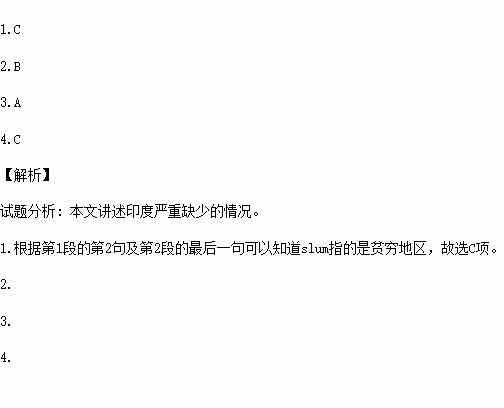
1.The underlined word “slum” most likely means ______.

A. a village

B. a small town

C. a poor area of a town with badly-built, over-crowded buildings

D. the part of a town that lacks water

2.Sometimes the water tanker doesn’t come because ______.

A. the weather is bad

B. there is no electricity

C. there is no water

D. people don’t want the dirty water

3.Which of the following statements is wrong?

A. water is the biggest expense for people in New Delhi’s slums

B. Shoba has a family of seven people

C. in Kesum Purbahari milk is cheaper than bottled water

D. Americans uses the largest amount of water each day

4.The passage mainly tells us ______.

A. how women in Kesum Purbahari gets their water

B. how much water a day a person deeds

C. that India lacks water badly

D. how India government manages to solve the problem of water
练习册系列答案
相关题目

To have a second child or not, this is a question.

A concern about only one child is whether one child necessarily means a lonely child. Many parents of only child feel guilty of their decision to have only one child. There are no other children in the family for the child to associate with, which may lead to the child feeling lonely at times.

Another common argument against having just one child may be more spoiled than one with siblings. Many people believe that a single child will not have learned to negotiate with others, and respect the give-and-take involved in many relationships. Some think this may leave the child less capable of interacting well with people his or her own age.

Despite these arguments, the number of parents choosing to have only one child is increasing in the world. For some single-child parents, the pressures of devoting time and energy to a second child can result in them selecting have no more children. For other parents, the financial burden of having a second child may be the major consideration. Another important consideration is the increasing age at which women give birth to children.

Advocates of single-child families argue that there are advantages for the child as well as the parents. With just one child, the parents can give, and the child can receive, more quality time and attention.

However, there is no simple answer to the question of whether or not to have a second child. The circumstances affecting each set of parents are unique. The important thing, in the end, is to make a decision that both the wife and the husband feel confident.

1.What are the advantages of children with brothers or sisters?

A. Less pressure and better energy

B. More respect and greater family wealth

C. Higher intelligence and more attention

D. Less loneliness and better social competence

2.What prevent some parents from having a second child according to the passage?

A. Work pressures

B. Limited time, energy and money

C. The health and wealth of the first child

D. The negotiations between parents and children

3.What can we learn from the passage?

A. The birth of a second child makes many parents guilty

B. The number of single-child parents is decreasing

C. Nowadays women delay giving birth to children

D. Family circumstances have little effect on parents’ decision

4.How is the passage developed?

A. By providing examples B. By listing suggestions

C. By offering descriptions D. By analyzing reasons

阅读下面材料,在空白处填入适当的内容(1个单词)或括号内单词的正确形式(不多于3个单词)。

Billy: Hello, Jennifer. I haven’t seen you for months. What have you been doing?

Jennifer: Oh, I was occupied 1. ________ job-hunting. It was really tiring.

Billy: How did it go?

Jennifer: Finally, I am going to be employed by a foreign company.

Billy: Oh, that’s good. Why not take a little trip to relax before 2.________ (start) your new job?

Jennifer: 3.________ (actual) I’m thinking of going to Guilin and staying there for a few days. I heard you’ve been there before.

Billy: Yes, I have. The famous boat trip down the Li River is very impressive. You can also take 4.________ short bamboo raft (筏) ride on a calm, shallow part of the river. It is great fun and peaceful 5. ________ (surround) by those towering peaks.

Jennifer: Wow, it sounds great! But I think the rafts are not safe.

Billy: Well, at first, I felt the same way, but everyone on the rafts seemed so content and 6. ________ (comfort) that I decided to do it. I’m glad I did as it was even better than I7.________ (imagine).

Jennifer: Oh, I’d like to try it. I saw a picture of Elephant Trunk Hill in my guide book, 8. ________ looks exactly like a big elephant!

Billy: You’ll see many other interesting mountains. And I recommend you to book a hotel room in Yangshuo, 9.________ you can enjoy an impressive musical outdoor performance on the river with the peaks as a backdrop (背景) at night. I do believe it will meet your demanding10.________ (require).

Jennifer: Thanks for your advice.

She is a cute, quiet girl. As a daughter, she has no secrets from her mother, who is very pleased with her. But recently she has become somewhat mysterious, and not so open as before. She has a diary that she keeps under lock and key. Her mother can’t help worrying about her: what if she falls in love, which is too early for a girl of her age? After all, she is reaching the “dangerous stage”. These thoughts have caused trouble in the mother’s mind.

One weekend the girl came to tell her mother that she was going to the cinema with her schoolmate and would return late. As this was the first time, her mother agreed, but she couldn’t help worrying because her daughter had never been away at night before. The mother waited till nine and decided to go out to meet her daughter. Just at that moment the noise of a car pulling up drew her to the window and there was her daughter, waving goodbye to a boy. Her heart missed a beat. When the girl came in, the mother was watching TV, pretending nothing had happened. “Mom, I’m back.” “Yeah.” “Sorry to be late. Still sitting up?” “Yes, oh, that… who’s that boy?” The daughter was silent for a moment. “Ah. It’s my monitor. He gave me a lift on his way home. Mom, I’m going to bed.” “All right. Go to sleep early.”

Next morning when the mother went to the daughter’s room to do some cleaning, she found her diary left at her pillow. Finally she opened it. It read: Mom, it’s love that made you ask, but it would show your understanding of me if you hadn’t.

Holding the diary, the mother fell into thought.

1.Which is the correct order according to the story?

a. She took a lift back in her monitor’s car.

b. She went to see a film with her schoolmate.

c. She wrote in her diary to tell her mother.

d. Her mother worried about her daughter’s returning late.

A. b,d,a,c B. d,b,a,c C. b,a,d,c D. b,d,c,a

2.Which of the following is true according to the story?

A. The girl knew her mother wouldn’t ask her the question about the boy.

B. What the daughter did recently had worried her mother.

C. The mother didn’t read her daughter’s diary the next day.

D. The girl’s diary was always unlocked.

3.The main purpose of this article is to show that parents should______.

A. care about what their children really think and feel

B. talk with their children about their early love

C. not give much freedom to their children

D. keep silent about their children’s early love

4.From the diary, we can see the daughter ______.

A. thanked her mother for asking her

B. thought her mother cared about her very much

C. thought it was her mother's duty to ask

D. thought her mother's understanding is better than simple love

违法和不良信息举报电话:027-86699610 举报邮箱:58377363@163.com

精英家教网
