题目内容

How fit are your teeth? Are you lazy about brushing them? Never fear: An inventor is on the case. An electric toothbrush senses how long and how well you brush, and it lets you track(跟踪) your performance on your phone.

The Kolibree toothbrush was exhibited at the International Consumer Electronics Show in Las Vegas this week. It senses how it is moved and can send the information to an Android phone or iPhone via a Bluetooth wireless connection.

The toothbrush will be able to teach you to brush right (don’t forget the insides of the teeth!) and make sure you’re brushing long enough. “It’s kind of like having a dentist actually watch your brushing on a day-to-day basis,” says Thomas Serval, the French inventor.

The toothbrush will also be able to talk to other applications on your phone, so developers could, for example, create a game controlled by your toothbrush. You could score points for beating monsters among your teeth. “We try to make it smart and fun,” Serval says.

Serval says he was inspired by his experience as a father. He would come home from work and ask his kids if they had brushed their teeth. They said “yes,” but Serval would find their toothbrush heads dry. He decided he needed a brush that really told him how well his children brushed.

The company says the Kolibree will go on sale this summer, from $99 to $199, and the U.S. is the first target market.

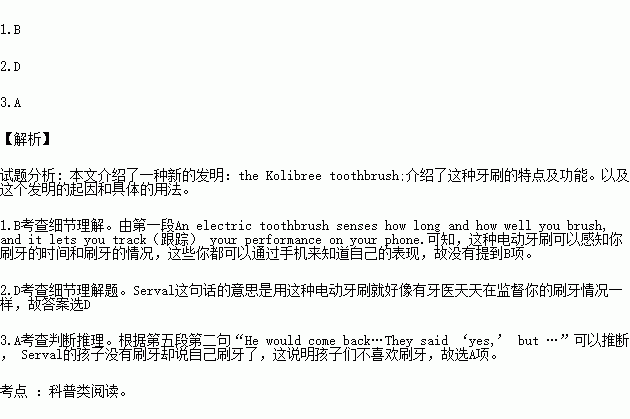
1.All of the following statements are wrong except ____________.

A.It can track users’ school performance.

B. It can sense how users brush their teeth.

C. It can check users’ fear of seeing a dentist.

D. It can help users find their phones.

2.What can we learn from Serval’s words in Paragraph 3?

A. You will find it enjoyable to see a dentist.

B. You should see your dentist on a day-to –day basis.

C. You’d like a dentist to watch you brush your teeth every day.

D. You can brush with the Kolibree as if guided by a dentist.

3.What can we infer about Serval’s children?

A. They were unwilling to brush their teeth

B. They often failed to clean their toothbrushes.

C. They preferred to use a toothbrush with a dry head.

D. They liked brushing their teeth after Serval came home.
练习册系列答案
相关题目

In 1943, when I was 4, my parents moved from Coeur d'Alene, Idaho, to Fairbanks, Alaska, where adventure was never very far away.

We arrived in the summer, just in time to enjoy the midnight sun. All that sunlight was fantastic for Mom's vegetable garden. Working in the garden at midnight tended to throw her timing off, so she didn't care much about my bedtime.

Dad was a Railway Express agent and Mom was his clerk. That left me in a mess. I usually managed to find some trouble to get into. Once I had a little fire going in the dirt basement of a hotel. I had tried to light a barrel (桶) of paint but couldn't really get a good fire going. The smoke got pretty bad, though, and when I made my exit, a crowd and the police were there to greet me. The policemen took my matches and drove me home.

Mom and Dad were occupied/busy in the garden and Dad told the police to keep me, and they did! I had a tour of the prison before Mom rescued me. 1 hadn't turned 5 yet.

As I entered kindergarten, the serious cold began to set in. Would it surprise you to know that I soon left part of my tongue on a metal handrail(栏杆) at school?

As for Leonhard Seppala, famous as a dog sledder (驾雪橇者), I think I knew him well because I was taken for a ride with his white dog team one Sunday. At the time I didn't realize what a superstar he was, but I do remember the ride well. I was wrapped heavily and well sheltered (保护) from the freezing and blowing weather.

In 1950, we moved back to Coeur d'Alene, but we got one more Alaskan adventure when Leonhard invited us eight years later by paying a visit to Idaho to attend a gathering of former neighbors of Alaska.

1. What can be inferred about the author's family?

A. His father was a cruel man.

B. His parents didn't love him.

C. His mother didn't have any jobs.

D. His parents used to be very busy.

2.What happened when the author was 4?

A. He learned to smoke.

B. He was locked in a basement.

C. He was arrested(拘捕) by the police.

D. He nearly caused a fire accident.

3.Which of the following is true?

A. Leonhard was good at driving dog sleds.

B. The author spent his whole childhood in Alaska.

C. Leonhard often visited the author's family after 1950.

D. The author suffered a lot while taking the dog sled in Alaska.

4.What is the author's purpose of writing the text?

A. To describe the extreme weather of Alaska.

B. To look back on his childhood with adventures.

C. To express how much he misses Leonhard.

D. To show off his pride in making trouble.

阅读下面短文,从短文后各题所给的四个选项(A, B, C和D)中,选出可以填入空白处的最佳选项,并在答题卡上将该项涂黑。

People don’t know how you feel until you tell them. _________years ago, my best friend Randy died of cancer at the age of 41. He was always _________ and he lived life to the full. There was one thing _________ in his life. In 41 years, his father never said to him that he was _________ of him, loved him and believed in him. These words were the only thing Randy ever _________from his father but in 41 years Randy never got any of them.

For three years while Randy was _________ the cancer, every time I saw him, I_________ him a bear hug and told him how much I _________ him. Randy has been gone for twenty years. I miss him and his father also misses him, _________ I don’t have to live with regret that I never told Randy what he _________ to me. His father does. I’m convinced(说服) that if his father had one_________, he would choose to be given a chance to tell his son how much he loved him. _________ he’ll never get that chance. It is too _________ for him. He will live the rest of his life with that _________.

It may still not be too late for you. Is there anyone in your_________ who would love to or needs to have some special words of love, encouragement or _________from you? Is there anyone who deserves and wants to_________the words and doesn’t want to “just intuitively (凭直觉地) know” how you feel? Life is too _________, leaving many words not spoken and many deeds not done. _________,people don’t know how you feel until you tell them how you feel. I’m sure there must be someone you can call, visit or write to. Don’t wait until it is too late. _________it now.

1.A. TenB. TwentyC. ThirtyD. Forty

2.A. sadB. silentC. kindD. positive

3.A. missingB. catchingC. breakingD. shaking

4.A. kindB. sureC. proudD. scared

5.A. wantedB. heardC. receivedD. suffered

6.A. curingB. seeingC. fightingD. checking

7.A. madeB. gaveC. createdD. took

8.A. respectedB. understoodC. thankedD. loved

9.A. orB. andC. butD. otherwise

10.A. meantB. showedC. provedD. brought

11.A. planB. wishC. ideaD. guide

12.A. BrieflyB. ProbablyC. SurprisinglyD.Unfortunately

13.A. lateB. eagerC. muchD. hard

14.A. goalB. regretC. dreamD. thought

15.A. classB. homeC. lifeD. school

16.A. suggestionB. anxietyC. angerD. support

17.A. explainB. tellC. hearD. say

18.A. colorfulB. shortC. differentD. valuable

19.A. AgainB. ThusC. HoweverD. Besides

20.A. FindB. GetC. MakeD. Do

It’s hard to find Alice Munro in the media. Even after she won the 2013 Nobel Prize in Literature, the Canadian writer just appeared for a quick interview and then dropped out of sight. On Dec 29, she still didn't seek the spotlight(聚光灯)when she was named one of the five Women of the Year by the Financial Times.

In Munro's eyes, ordinary lives always hide larger dramas. So she records what we casually think of as the everyday actions of normal people. She often focuses on life in her hometown, a small village in Ontario which she is most familiar with. She writes about the ordinary things in the village-fox forming, trees filled in the Ontario wilderness, poor country alcohol and long last illnesses. Above all, she talks about girls and women who have seemingly ordinary lives but struggle against daily misfortune.

She has a special talent for uncovering the extraordinary in the ordinary. These are ordinary people, ordinary stories, but she has the magic. Her precise language, depth of detail and the logic of her storytelling have made her stories inviting.

Runaway, one of Munro’s representative works, is a good example of her writing style. One of the stories centers on the life of an ordinary woman Carla, who lives in a small Canadian town with her husband Clark. The story slowly forms a picture of Carla, trapped in a bad marriage, her unhappiness building into desperation until she decided to flee. The story of Carla is a story of the power and betrayals of love. It is about lost children and lots of chances that we can all find in life, There is pain beneath the surface, like a needle in the heart.

Since she published her first collection of short stories in 1968, Munro has won many awards, with the Nobel Prize being her biggest honor. On Oct 10, 2013, the Nobel Prize committee named Munro the “master of the contemporary short story”.

1.We learn from Paragraph 1 that Alice Munro_____

A.didn't get on well with the media

B.remained modest though very successful

C.didn’t value the title of Women of the Year

D. was surprised at winning the Nobel Prize

2.What makes Alice Munro’s stories fascinating according to the text?

A.Her writing techniques

B.The complicated plots

C.The humorous language

D.Her rich imagination

3.In her representative work Runaway, Carla_____

A.leads a happy life with Clark

B.is a faithful wife to her husband

C.loses all hopes for a better life

D.tries to run away from her husband

4.What is the text mainly about?

A.Alice Munro and her hometown

B.The awards Alice Munro won

C.Alice Munro and her writing style

D.Alice Munro’s literary life

完形填空

Reading and learning new words is about finding their meaning and use within a passage. The meaning of unknown words which you _________ in your reading sometimes can be known by their _________, that is, their contexts. The context of the sentence can tell us the part of speech (词性) of the _________ word. Using the context of the paragraph to define unknown words can also be _________.

Readers often have trouble because they understand the sentence word by word instead the _________ meaning of a word, when they should identify the way it has been used in the passage.

One consideration in using the context is to determine the unknown word's part of speech. The words around the unknown word can give you __________. Once you know if the word is a noun or an adjective, it is often enough for you to __________ reading without having to stop to look up the meaning of the word. After coming across the word a few more times, you will know its meaning more __________ than if you had just looked it up.

Comparison clues indicate that two or more things are _________. A comparison is possible because the known and unknown words have ___________. The likeness shows you that comparisons can be made.

_________ clues tell you an example of an unknown word. Example clues are usually __________ by the following words and phrases: such as, for example, and like.

To find meaning from text?based clues, you should look for clues in the sentence. A second kind of clue does not ___________on specific words to indicate meaning. This kind of context clue is called a framework?based clue. Your knowledge of the meaning of surrounding words _________ you discover the meaning of a word or sentence. Common __________ and your knowledge of the parts of speech also help defining unknown words. For example, the angry driver shouted vehemently during his fight with the other driver. What does “vehemently” _________? You know what ___________ means, and you know how people __________ when they argue. From this, you can __________ out that “vehemently” has something to do with strong __________ or intense feeling.

1.A.take down B.look up C.come across D.pick out

2.A.sentences B.words C.topics D.surroundings

3.A.unknown B.abnormal C.familiar D.negative

4.A.unique B.natural C.helpful D.common

5.A.correct B.inconvenient C.different D.satisfactory

6.A.cases B.reasons C.effects D.clues

7.A.translate B.interview C.continue D.examine

8.A.strangely B.uncertainly C.potentially D.firmly

9.A.alike B.meaningful C.proper D.great

10.A.properties B.similarities C.possibilities D.personalities

11.A.Popularity B.Consideration C.Example D.Comparison

12.A.affected B.adjusted C.changed D.introduced

13.A.focus B.spend C.carry D.rely

14.A.prevents B.helps C.tells D.displays

15.A.point B.taste C.awareness D.sense

16.A.mean B.use C.contain D.complete

17.A.angry B.grateful C.happy D.anxious

18.A.act B.say C.feel D.think

19.A.come B.figure C.take D.set

20.A.demand B.ambition C.attitude D.emotion

违法和不良信息举报电话:027-86699610 举报邮箱:58377363@163.com

精英家教网