题目内容

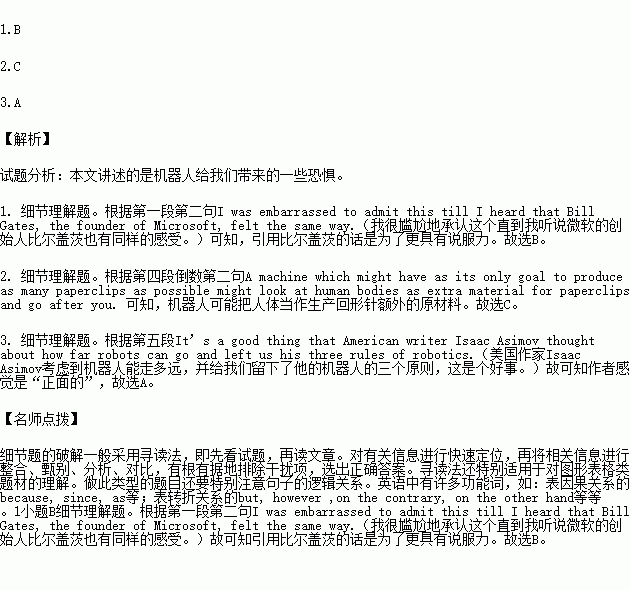
Robots make me nervous — especially the ones which seem to think for themselves. I was embarrassed to admit this till I heard that Bill Gates, the founder of Microsoft, felt the same way.

Gates said in an interview with the social networking and news website Reddit: “I am in the camp that is concerned about super intelligence. First the machines will do a lot of jobs for us and not be super intelligent. That should be positive if we manage well. A few decades after that though the intelligence is strong enough to be a concern.”

Well, maybe I don’t have to worry about my computer and kitchen equipment yet. After I use them I can always pull the plug. But in the future, machines might find a way to prevent us from switching them off. There’s a terrible thought!

Maybe the problem with computers too clever for us is not that they are evil like some we’ve seen in sci-fi movies. What could put us in danger is that they might be too efficient. That’s what philosopher Nick Bostrom from Oxford University believes. He says that machines are indifferent to humans and in pursuit of their own goals, the destruction of people might be just additional damage. Bostrom gives us an example: A machine which might have as its only goal to produce as many paperclips as possible might look at human bodies as extra material for paperclips and go after you. Because it is, well, a machine, it would not take pity on you.

It’s a good thing that American writer Isaac Asimov thought about how far robots can go and left us his three rules of robotics. They state that a robot may not hurt a human being or allow the human being to come to harm.

I’m glad my machines at home are “dumb”. All my cleaner wants to take over is the carpet in my living room. Let’s hope they don’t create an appliance which wants to take over the world!

1.The author quoted Bill Gates’ words in Paragraph 2 in order to make the text ________.

A. better-known

B. more persuasive

C. better-organized

D. more interesting

2.An intelligent paperclip machine would harm us because ________.

A. it is much cleverer than us

B. it would take over the world

C. it would see us just as material

D. it has the strong feeling of destroying us

3.How does the author feel about Isaac Asimov’s rules of robotics?

A. Optimistic.B. Sympathy.C. Disappointed.D. Regretful.
练习册系列答案
相关题目

阅读下面短文,从短文后各题所给的四个选项(A、B、C和D)中,选出可以填入空白处的最佳选项,并在答题卡上将该项涂黑。

What can't be overlooked is that a mother's greatest gift is the smallest details of her child's life freely shared. Can you imagine that?

In the midst of my housework in the , I was surprised to find the front door was open. Julie, our oldest child, came in. She’d been married for three months. I was still trying to her living elsewhere. Much to my , Sometimes I even set her place at the table. Julie handed me a small bunch of daffodils (水仙花) and said, "Guess what!" as she opened the refrigerator to see what was inside. As I put the flowers in water, I answered , "What?"

She began telling me some small of her new life as she made a sandwich. We sat at the kitchen table, and I watched her eat, hanging on her every . It was a visit in fact Julie had to go to work. I thanked her for the flowers and for ; then I walked to the door with her and as she drove out of the driveway.

When coming back to the kitchen, I sat and looked at the daffodils. My daughter’s visit set me thinking a lot. It was as bright and as the early spring daffodils. Suddenly, I picked up the phone and my mother’s number. She lived a hundred miles away. When she , I said, "Guess what!"

"What?" she answered . Like Julie I didn’t have any big , just little details of the day. But I’d like to come to in the last hour how a small talk could be. Just before I hung up , my mother said, "You my day."

1. A. Study B. Kitchen C. bedroom D. balcony

2. A. get used to B. run out of C. put up with D. look up to

3.A. Gratitude B. Sadness C. Admiration D. excitement

4.A. Unfortunately B. Unwillingly C.Uninterestingly D. unconsciously

5.A. Confidently B. Frequently C. Happily D. patiently

6.A. Details B. Experiments C. Theories D. jokes

7.A. It B. Herself C. them D. him

8. A. Plan B. Hobby C. Word D. letter

9.A. Difficult B. practical C. Short D. boring

10.A. Unless B. While C. Though D. since

11.A. stopping by B. dropping out C. giving in D. getting across

12.A. Celebrated B. Waved C. Bothered D. searched

13. A. Clean B. Pure C. Mile D. dear

14.A. Dialed B. Copied C. Reserved D. obtained

15.A. Returned B. Complained C. Answered D. left

16.A. Peacefully B. Hopefully C. Generally D. formally

17. A. Achievements B. Customs C. News D. ambitions

18.A. Recommend B. Understand C. Explain D. declare

19. A. Precious B. Steady C. Familiar D. complex

20. A. Realize B. Treat C. Organize D. Make

As a boy, Sanders was much influenced by books about the sea, but by the age of fifteen he had decided to become a doctor rather than a sailor. His father was a doctor. So he was often with the doctors and got along very well with them. When he was fourteen, he was already hanging around the hospital where he was supposed to be helping to clean the medicine bottles, but was actually trying to listen to the doctors’ conversations with patients in the next room.

During the war Sanders served in the army as a surgeon(外科医生). “That was the happiest time of my life. I was dealing with real sufferers and on the whole making a success of my job.” In Rhodes he taught the country people simple facts about medicine. He saw himself as a life-saver. He had proved his skill to himself and had a firm belief that he could serve those who lived simply, and were dependent upon him. Thus, while in a position to tell them what to do he could feel he was serving them.

After the war, he married and set up a practice deep in the countryside, working under an old doctor who hated the sight of blood. This gave the younger man plenty of opportunities to go on working as a life-saver.

1.When he was a small boy, Sander was influenced by books about ________.

A. the hospitalB. the warC. the seaD. the countryside

2.At the age of 14, Sanders ________.

A. worked as a doctor in the hospital

B. got along well with the patients

C. was interested in talking with doctors and patients

D. helped to clean the medicine bottles in the hospital

3.When the war was over, he ________.

A. had the happiest time of his life

B. started to hate the sight of blood while working

C. served the countrymen under an old doctor

D. had few chances to be a “life-saver” because he was younger

The BBC was founded in 1922, including radio and television services. It is based at Broadcasting House in London.

The BBC is controlled by some governors chosen by the government, but these people have freedom and the government can’t interfere(干扰). That is, the BBC is supposed not to be the mouthpiece(代言人) of the government. It has to be as fair as possible in giving radio and television time to, for example, political parties and religious groups.

There is a kind of interesting service in British-rental services. Many people prefer to rent their television sets instead of buying them.

The rent for a black and white set is about 80 pence a week. The rent of a color set is more than twice that of a black and white set. If the sets go wrong, people can have them repaired free of charge or replaced immediately.

Everyone has to buy a yearly license, since there is no advertising on BBC radio or television. It is from the sale of licenses that the BBC gets most of its money. A license for a black and white set costs 8 pounds, and for a colour set 18 pounds a year.

There are four specialized radio channels, which broadcast different kinds of programmes. Radio I is mainly pop music.Radio 2 deals with light music, sports and other programmes. Radio 3 broadcasts serious music, talks on serious subjects etc.News broadcasts are mainly given by Radio 4.

There are special programmes for Northern Ireland, Scotland, Wales, and certain parts of England.It also broadcasts programmes about Britain—in many different languages as well as in English to all parts of the world.

1.The officials in charge of the BBC ________.

A.must say what the government wants to say

B.should give more time to political parties than to religious groups

C.are elected by the citizens from all over the country

D.can decide things without the permission of the government

2.If he wants to watch TV at home, everyone ________.

A.has to buy a television set of his own

B.must rent a TV set

C.has to buy a license once a year

D.can change his damaged TV set for a new one without payment

3.How does BBC get most of its money?

A.It gets money from all kinds of advertisements.

B.The BBC depends on the rent of TV sets.

C.The BBC gets money mainly by selling licenses and TV sets.

D.It gets its money mainly by selling licenses.

阅读下面短文,从短文后各题所给的四个选项(A、B、C、D)中,选出可以填入空白处的最佳选项,并在答题卡上将该项涂黑。

Travis laughed as he tore at the wrapping paper on his birthday present. He was so ________! Finally, he would have the coolest pair of name-brand basketball shoes.

All the guys on his team were wearing the name-brand shoes of a popular basketball ________, Chuck Hart. ________ Hart was criticized for his poor sportsmanship and infamous ________, he was a great player. In fact, Travis wasn't thinking about Hart's behavior; he had only expected to see Hart’s ________ on the side of the box. The first indication that something was ________ came as he tore away the last piece of paper. Not Hart’s. The new shoes were the name-brand of another player, Robert Ryann, who was ________ for his amazing work in the community.

Travis’s hands ________; his heart stopped. It wasn't that the Ryann shoes weren’t nice, but what would his friends think? They were the wrong shoes and Travis would be ________ by the other players. When he looked up into his dad’s eyes, however, Travis ________ he would not tell him. "Thanks, Dad. I was really hoping for shoes," Travis said as he pulled the shoes out of the box.

Next morning his dad drove him to school. When they ________ in front of his destination, Travis slowly opened the car door. Just then, his dad stopped him.

“Hey, Travis, wait a minute, look...” his dad said ________, “Travis, I know those aren’t the shoes you had hoped for, but I saw the names of the two guys and made a(n)________. The guy whose name is on those shoes,” he said, pointing down at Travis’s feet, “is someone I ________. Do you know how often Ryann has found himself in ________?”

“No,” Travis said.

“Never. He’s never talked back to his coach or started a fight, and he’s a team player. You could have acted like a (n) ________ when you didn’t get the shoes you wanted, Travis, but you were ________ and made the best of it. You have such a good ________, like the guy whose name is on these shoes. I’m hoping that someday, your name will be on the coolest pair of shoes I’ll ever see.”

When Travis looked down at his feet, he saw the shoes ________. His dad had used his mind and heart to give the son a thoughtful ________.

1.A.surprisedB.ashamedC.excitedD.worried

2.A.teamB.playerC.coachD.game

3.A.UnlessB.IfC.BecauseD.Although

4.A.skillB.performanceC.behaviorD.action

5.A.nameB.photoC.signD.model

6.A.strangeB.wrongC.trueD.funny

7.A.knownB.encouragedC.adoptedD.influenced

8.A.fellB.frozeC.shookD.folded

9.A.questionedB.noticedC.teasedD.attacked

10.A.hopedB.believedC. decidedD.wished

11.A.pulled upB.put upC.took upD.turned up

12.A.peacefullyB.hesitantlyC.delightedlyD.naturally

13.A.choiceB.effortC.commentD.mistake

14.A.believeB.missC.admireD.remember

15.A.dangerB.surpriseC.sorrowD.trouble

16.A.teammateB.adultC.kidD.student

17.A.upsetB.rudeC.politeD.glad

18.A.qualityB.courageC.dreamD.belief

19.A.clearlyB.carefullyC. patientlyD.differently

20.A.giftB.lookC.hopeD.lesson

阅读下面短文,从短文后各题所给的四个选项(A、B、C和D)中,选出可以填入空白处的最佳选项,并在答题卡上将该项涂黑。

People from every corner flooded into the streets that Christmas Eve. "Frosty the Snowman," and "Jingle Bells" ________ in stores; on the pavements, the street singers performed happily. Everyone, was ________ by someone else, delighted and cheerful. I was alone.

As one of 8 kids of a Brazilian family, brought up in America's crowded apartment, I'd spent several years searching for aloneness. Now, ________, at 27, a college student after the ________ with my girlfriend, every cell inside me wanted to be alone, ________ not at Christmas. My family had ________ to Brazil and my friends were ________ with their own lives. Dusk was approaching, and the fact that I had to return to my ________ home made me sad. Lights from windows blinked, and I hoped someone would ________ from one of those homes to invite me inside with a Christmas tree decorated with shiny fake snow and ________ presents.

At a market, I felt more ________ when people were buying lots of goods, which ________ the gifts we received as children in my mind. I missed my family and wanted to cry for wanting to be alone and for having achieved it.

Outside the church, a manger(小耶稣) had been set ________. I stood with others watching the scene, some of them ________ themselves, praying. As I walked home, I realized that leaving Brazil was still a ________ experience as I struggled with what I had become in 15 years in America. I'd mourned the ________, but for the first time, I recognized what I’d gained. I was independent, ________ and healthy. My life was still ahead, full of ________.

Sometimes the best gift is the one that you give yourself. That Christmas, I gave myself ________ for what I'd obtained up to now and promise to go forward. It is the best gift I've ever got, the one that I most ________.

1.A. sharedB. playedC. servedD. held

2.A. accompaniedB. employedC. attendedD. supported

3.A. usuallyB. extremelyC. reallyD. eventually

4.A. breakupB. dateC. sympathyD. concern

5.A. soB. butC. andD. or

6.A. movedB. slippedC. cameD. returned

7.A. pleasedB. satisfiedC. occupiedD. bored

8.A. shabbyB. emptyC. warmD. cozy

9.A. turn upB. hang outC. go awayD. break in

10.A. dealtB. discountedC. wrappedD. donated

11.A. tiredB. nervousC. excitedD. upset

12.A. called upB. called forC. called onD. called in

13.A. downB. upC. asideD. about

14.A. huggingB. bowingC. crossingD. bending

15.A. greatB. joyfulC. painfulD. potential

16.A. casesB. limitsC. lossesD. worries

17.A. lonelyB. educatedC. shyD. wealthy

18.A. possibilityB. sightC. sadnessD. hardship

19.A. surpriseB. defeatC. prizeD. credit

20.A. selectB. valueC. saveD. admit

One of the most important things in the world is friendship. In order to have friends, you have to be a friend. But how can you be a good friend at school?

Listen — Listen when they are talking. Don’t say anything unless they ask you a question. Sometimes it’s not necessary for you to have anything to say; they just need someone to talk to about their feelings.

Help them — If your friend is ever in need of something, be there to help them. You should try to put them first, but make sure you don’t do everything they want you to do. Try to take an extra (额外的) pencil or pen with you to classes in case (以防) they forget one. Have a little extra money in your pocket in case they forget something they need.

Be there for them — Try to make something for your friend to help make them feel better in hard times. Making cards and encouraging them are among the nicest things you can do for a friend. Marilyn Monroe, a famous U.S. actor, once said, “I often make mistakes. Sometimes I am out of control. But if you can’t stay with me at my worst, you are sure not to deserve (值得) to be with me at my best.” Always remember this! If you don’t want to stay with your friends when they’re in hard times, then you don’t deserve to be with them when they’re having a good time!

Make plans — Try to make plans with your friends. Go shopping, go for ice cream, have a party, go to a movie and so on. Take time to know each other even better by doing something you both enjoy. By planning things together, you both can have a good time. And you’ll remember these things when you’re all old!

1.While your friend is talking to you about his or her feelings, you should ________.

A. give him or her some advice

B. just listen unless asked

C. calm him or her down

D. share your feelings as well

2.When we provide help for our friends, we should ________.

A. try to do everything for them

B. put them before ourselves

C. change their bad habits first

D. ignore their faults

3.What can we learn from Marilyn Monroe’s words?

A. Life without a friend is death.

B. A friend is easier lost than found.

C. A friend in need is a friend indeed.

D. A man is known by his friends.

4.What is the passage mainly about?

A. How to find a good friend.

B. How to help friends in trouble.

C. How to be a good friend.

D. How to make more friends.

违法和不良信息举报电话:027-86699610 举报邮箱:58377363@163.com

精英家教网