题目内容

此题考察主语从句、宾语从句、表语从句,请用适当连接词填空,每空一词。

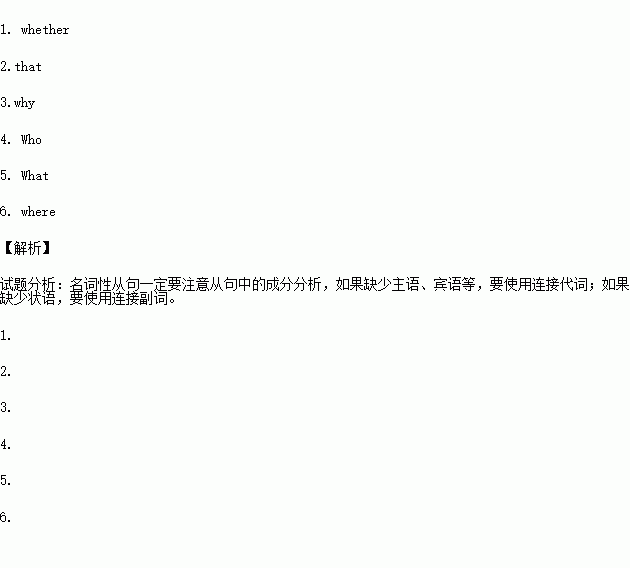
1.He wasn’t sure _____________ he should stay or leave.

2. I have made it clear ____________ I will not give up the plan.

3.Andy worked very hard, and that was ___________ he got an A.

4.___________ will go to the meeting makes no difference.

5. ___________ I am worried about is that I can’t afford the cost.

6. Do you remember the parking lot near the cinema? That is ___________ I met her.
练习册系列答案
相关题目

China Daily Oct.11,2008-TheMinistry Of Health has called for more awareness from the public on the mental health of the young as part of efforts to mark World Mental Health Day which fell on Friday.

More than 15 percent of Chinese youths have been found with mental problems and about 30 million young people under 17 are suffering from depression,the Shanghai-based Wenhui Daily reported.The World Health Organization estimates that before 2020,the rate of children with mental problems will increase to 50 percent ,and mental problem will become a major factor behind deaths and illness in the young worldwide.

Dang Xianhong,the spokesperson for the Beijing Municipal Health Bureau,said rapid social change is one of the reasons behind the rising number of youngsters with psychological problems.If these mental dispenses are not addressed on time, science of crimes,drug-taking and other dangerous behaviors are expected to rise.Experts said mental diseases could be caused by many factors,such as the inability to handle interpersonal relations well, unstable emotions and pressures from an overload of studies.A number of experts have also said the one child policy is another reason leading to poor mental health in the young.Children are said to be too “spoiled” and “selfish” in a one child family.

It’s reported that schools in many cities are rolling out measures to help students maintain their mental well-being.Yin Jingmiao, a teacher of the Beijing No,105 Middle School,told China Daily that the school invites psychologists to provide counseling to students three times a month.“Students can be arranged to have 40-minute counseling sessions.” Yin said.“The school also gives lectures on mental health to senior grade students before they take the national college entrance exams to help ease any anxiety arising from the tests.”

1.Which of the following can be the best title for the passage?

A.Efforts to Mark World Mental Health Day

B.Public Awareness on Youngsters’ Mental Diseases Expected

C.How to Maintain Mental Well-being

D.Seriousness of Youngsters Mental Health Problems

2.The writer intends to tell us in the second paragraph that _____.

A. mental problems will become as serious as deaths and illness

B. only young people are suffering from mental health problems

C. mental health problems of the young are becoming a popular problem

D. the rate of children with mental problems will increase to 50 percent

3.Which could be the consequence if the problem is left untreated?

A.Inability to handle interpersonal relations.

B.Unstable emotions.

C.Drug taking and other dangerous behaviors.

D.Rapid social changes

4.Why is Beijing No. 105 Middle School mentioned in the passage?

A.To provide the students with counseling sessions.

B.To give an example showing how mental problems are dealt with.

C.To help ease the anxiety arising from college entrance exams.

D.To call on other schools to learn from No.105 Middle Schoo1.

阅读下列短文,从每题所给的四个选项(A、B、C和D)中,选出最佳选项。

“A Long Walk Home”-----life as Eli Reed saw it

American photographer and photojournalist Eli Reed has been documenting “life as I saw it” for more than 40 years. His career retrospective(回顾), “Eli Reed: A Long Walk Home”, is an extraordinary search of beauty while recording hardship. With a heart of love, Reed uses a style that uncovers humanity at every turn. According to Reed, “A Long Walk Home” is about what it means to be a human being. It all began with a photo he took of his mother and his memory of her smile.

Raised in New Jersey, Reed was originally a painter. Primarily self-taught in photography, he became a freelance photographer in 1970. After producing some impressive photos that drew much attention, he joined the famous company Magnum Photos---the first black photographer invited to do so.

His photos are remarkable in their lack of judgment of the people or the situations he comes across. In Beirut, Lebanon, a man removes a tree branch from a car in a recently bombed parking lot. An old man wrapped in a sheet plays a drum in front of a sign reading “God Is the Way” while National Guardsmen lift their guns during a war in Miami. A young boy upside down with his legs in the air in a Kenyan refugee camp, his determined look faces the camera. In Harlem, New York, a group of laughing children take over an abandoned car, using it as a jungle gym.

When another photographer might have focused on the sobriety of these situations, Reed’s camera smiles. His images show how humans cope, rise above, and carry on. This is what gives “A Long Walk Home” its power. Considering the places Reed has been to, there are very few photos of guns or obvious violence. Instead, Reed focuses on the varied human responses to hardship.

We smile along with Reed in a gesture of compassion and solidarity. We recognize our fellow human beings.

1.Why did Eli Reed produce his work “A Long Walk Home”?

A.To pursue his love of photography

B. To keep memories of his mother

C. To help people who are suffering

D. To search for the meaning of life

2.According to the passage, Magnum Photos_____________.

A. employed Reed in 1970

B. was located in New Jersey

C. only had white employees originally

D. taught Reed the art of photography

3. In his work “A Long Walk Home”, Reed’s photos_____________.

A. aim to draw others’ sympathy

B. reflect the strength of humans

C. were taken only in America

D. focus on war and violence

4.What does the underlined word “sobriety” in Paragraph 4 probably mean?

A. seriousness B. cause

C. value D. warmth

阅读理解Here is an astonishing and significant fact: Mental work alone can’t make us tired. It sounds absurd. But a years ago, scientists tried to find out how long the human brain could labor without reaching a stage of fatigue(疲劳). To the amazement of these scientists, they discovered that blood passing through the brain, when it is active, shows no fatigue at all! If we took a drop of blood from a day laborer, we would find it full of fatigue toxins(毒素) and fatigue products. But if we took blood from the brain of an Albert Einstein, it would show no fatigue toxins at the end of the day.

So far as the brain is concerned, it can work as well and swiftly at the end of eight or even twelve hours of effort as at the beginning. The brain is totally tireless. So what makes us tired?

Some scientists declare that most of our fatigue comes from our mental and emotional attitudes. One of England’s most outstanding scientists, J.A. Hadfield, says, “The greater part of the fatigue from which we suffer is of mental origin. In fact, fatigue of purely physical origin is rare.” Dr. Brill, a famous American scientist, goes even further. He declares, “One hundred percent of the fatigue of sitting worker in good health is due to emotional problems.”

What kinds of emotions make sitting workers tired? Joy? Satisfaction? No! A feeling of being bored, anger, anxiety, tenseness, worry, a feeling of not being appreciated---those are the emotions that tire sitting workers. Hard work by itself seldom causes fatigue. We get tired because our emotions produce nervousness in the body.

1.What surprised the scientists a few years ago?

A. Fatigue toxins could hardly be found in a laborer’s blood.

B. The brain could work for many hours without fatigue.

C. Albert Einstein didn’t feel worn after a day’s work.

D. A mental worker’s blood was filled with fatigue toxins.

2.According to the author, which of the following can make sitting workers tired?

A. Challenging mental work. B. Endless tasks.

C. Unpleasant emotions. D. Physical labor.

3.What’s the author’s attitude towards the scientists’ idea?

A. He argues against them. B. He doubts them.

C. He agrees with them. D. He hesitates to accept them.

4.We can infer from the passage that in order to stay energetic, sitting workers need to ________.

A. have some good food. B. enjoy their work

C. exercise regularly D. discover fatigue toxins

阅读下面短文,掌握其大意,从短文后所给的四个选项(A、B、C和D)中,选出可以填入空白处的最佳选项。

Music can make us feel happy or peaceful, or move us to tears. As an orchestra conductor(指挥), Amy Anderson allows people to experience many________that music can give.

Anderson fell in love with________as a child. She began playing the piano at seven. She bought many videos________by the world’s great orchestras and conductors and________listened to them for hours. During a concert, the audiences see the________of a conductor and the arm movements he or she uses. What audiences do not see is all the work the conductor has done before the________. However, a few months before a concert, Anderson studies the music by________it on the piano. She listens to recording, reads about the musician’s life, and reviews some________events that would have influenced the musician. Her goal is to present the music as the musician________.

While conducting, Anderson uses her whole body to________how the music should sound and feel. Her________are strong when the music is________and gentle when the music is peaceful. As she conducts, Anderson listens out for the________with the balance of different kinds of instruments or voices.

To________young musicians to understand how to play the music, Anderson tells them to imagine a________and relaxing walk or a ship being tossed(颠簸) by waves. “It is music’s ability to________people that I like most,” says Anderson. She has seen audiences at her concerts clap their hands together. ________, listeners are moved to tears by the music. After one concert in Serbia, the audiences________around the orchestra’s buses and showed their________for the musicians. Anderson is happy to be a conductor, because music can________people’s spirits and bring joy into ordinary days.

1.A. feelings B. characters C. thoughts D. changes

2.A. painting B. art C. music D. dance

3.A. kept B. recorded C. praised D. directed

4.A. never B. gradually C. finally D. always

5.A. face B. head C. look D. back

6.A. schedule B. performance C. task D. meeting

7.A. putting B. beating C. playing D. repeating

8.A. important B. strange C. meaningless D. unpleasant

9.A. designed B. expected C. impressed D. ordered

10.A. prove B. recognize C. learn D. express

11.A. ideas B. accents C. movements D. voices

12.A. energetic B. magical C. wonderful D. lively

13.A. signals B. problems C. sounds D. challenges

14.A. encourage B. force C. remind D. help

15.A. short B. quick C. calm D. heavy

16.A. influence B. tell C. watch D. meet

17.A. Firstly B. Frequently C. Fortunately D. Lately

18.A. ran B. drove C. walked D. gathered

19.A. kindness B. care C. appreciation D. understanding

20.A. lift B. follow C. show D. bring

违法和不良信息举报电话:027-86699610 举报邮箱:58377363@163.com

精英家教网