题目内容
A person has been badly injured in a car accident. It is necessary to give him a blood transfusion because he has lost a great deal of blood in the accident. However, special care must be taken in selecting new blood for him. If the blood is too different from his own, the transfusion could kill him.
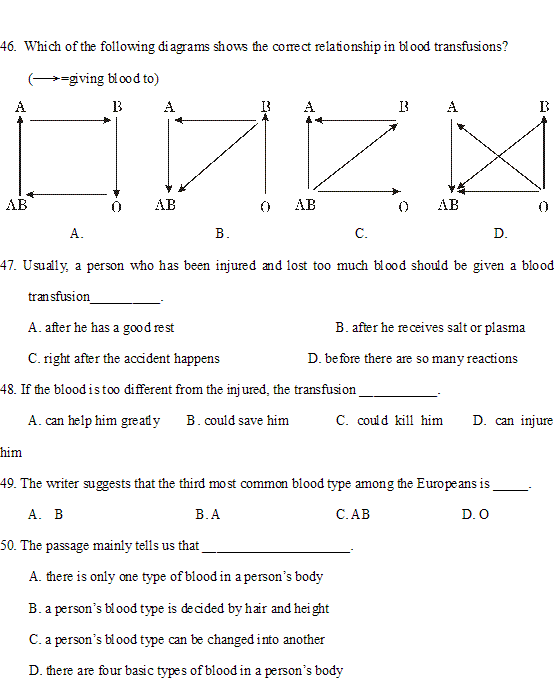
There are four basic types of blood: A, B, AB and O. A single test can tell us a person’s blood type. Everybody is born with one of these four types of blood. Blood type, like hair color and height, is inherited from parents. Because of the substances contained in each type, the four groups must be transfused carefully. Basically, A and B cannot be mixed. A and B cannot receive AB, but AB may receive A or B. O can give to any other group; so it is often called the universal donor. For the opposite reason, AB is sometimes called the universal recipient(领受者). However, because there can be so many reactions in transfusions, patients usually receive only salt or plasma (血浆) until their blood can be matched as exactly as possible in the blood bank of the hospital. In this way, it is possible to avoid any bad reactions to the transfusion.
There is a relationship between your blood type and your nationality. Among the Europeans, about 42 percent have type A while 45 percent have type O. The rarest is type AB. Other races have different percentage. For example, some American Indian groups have nearly 100 percent type O.

Oyster
What is an Oyster card?
Oyster is the easiest way to pay for journeys on the bus ,Tube ,tram,Docklands light Railway (DLR),London Overground and National Rail journeys in London You can store your travel cards, Bus & Tram Pass,season tickets and credit to pay for journeys as you go.
Where to get an Oyster card?
There are a number of ways for you to get an Oyster card :
? At over 3,900 Oyster Ticket stops
? At Tube and London Overground station ticket offices
? At some National Rail stations
? At London Travel information Centres
? Online at tfl. gov. uk/oyster
How to use an Oyster card?
To pay the correct fare on the Tube ,DLR,London Overground and National Rail services,you must always touch m on the yellow Oyster card reader at the start of your journey,and touch out at the end. ff you don’t, a maximum cash Oyster fare will be changed When using the bus or tram, you must only touch in at the start, but not at the end of your journey.
What happens if I don’t visit London very often?
Don’t worry. Any pay as you go credit on your card will not expire (过期),so you can keep it for your next visit or lend it to a friend.
Fares
Traveling by Tube from Central London (Zone l)to Heathrow (Zone 6)
Adult Oyster single fare
£ 4. 20 Monday to Friday 06:30 - 09:30 and 16:00 一 19:00
£ 2. 70 at all other times including public holidays
Adult single cash fare £ 5.00
For further information,visit tfL.gov. uk /fares.
【小题1】You can get an Oyster card at the following plaices EXCEPT_____
| A.on the website | B.at an Oyster Ticket stop |
| C.at a post office | D.at a Tube station |
| A.They are limited in use to the owners themselves. |
| B.On National Rail services you must touch them on the reader twice. |
| C.They are not suitable for those who don’t visit London often. |
| D.Oyster card Tube fares cost more on public holidays than on weekdays. |
| A.f 18.90 | B.£ 29.40 | C.£21.90 | D.f26.40 |
A journal B. travel brochure C. textbook D. novel
Part B: Vocabulary 9%
|
A.claim |
B.second |
C.opposite |
D.count E. best |
F. negative G. failures H. defined I. mark J. reliable
We might be surprised at the progress made in every field of study, but the methods of testing a person’s knowledge and ability remain as primitive as ever they were. It is really extraordinary that after all years, educationists have still failed to devise something more 41 than examinations. For all the 42 that examinations test what you know, it is common knowledge that they more often do the exact 43. They may be a good means of testing memory, or the knack of working rapidly under extreme pressure, but they can tell you nothing about a person’s true ability.
As anxiety-makers, examinations are 44 to none. That is because so much depends on them. They are the 45 of success or failure in our society. Your whole future may be decided in one fateful day. It doesn’t matter that you weren’t feeling very well, or that your mother died. Little things like that don’t 46: the exam goes on. No one can bring out the 47 in him when he is in terror, or after a sleepless night, yet this is precisely what the examination system expects him to do. The moment a child begins school, he enters a world of fierce competition where success and failure are clearly 48 and measured. Can we wonder at the increasing number of “dropouts”: young people who are written off as 49 before they have started a career? Can we be surprised at the suicide rate among students?