Columbus College,241 Queen Elizabeth

 Drive,Kowloon City

    Memo

 To:All Staff

 From:Jakie Mok,Secretary;Sports Development Committee

 Date:May 20,

    A week ago,“Sports for Life”programme was sent to the parents,requiring them to select a sport they wanted their child to play.Since then,our staff have received lots of calls from parents asking for more information about it.Here is a memo(备忘录)for your reference when you answer the phones.

Sports 1:Basketball

    We expect that this will be the most popular of the four sports.Therefore,students should be advised to sign up as soon as possible.Students will take a private bus to and from Kwun Tong Sports Park.To cover the cost of hiring a bus,each student will have to pay $10 each time.There will be four basketball courts available for our use with one teacher watching over each game.

Sports 2:Gym

    We will be using St.Peter's Memorial Park.There are two reasons for choosing this park.First,it is not very busy and crowded before 6:00 pm.Second,it has lots of trees with plenty of shade.Students must bring along two bottles of water to prevent thirst.Three activities,skipping,jogging,outdoor aerobics(有氧运动),all of which are free of charge,will be arranged.And there will be a teacher on duty for each of the activities.

Sports 3:Hiking

Hiking(远足)will take place at Kowloon Peak.The activity will start at 2:30 pm and finish 90 minutes later.Three teachers will accompany the students,and a hiking instructor will accompany each group of 15 hikers.Each instructor will cost $75/hr.Students are advised to bring plenty of water and sunscreen.

Sports 4:Swimming

     The Kowloon City Aquatic Centre is a 10­minute walk from our school.Four teachers will go to the pool and conduct the goings­on from the poolside.We will only be able to reserve the pool for one hour(i.e.2:45 pm to 3:45 pm).Only students skilful at swimming can take up this activity.The pool will have two lifeguards present.Girls must wear a swimming suit.The cost is $10 per visit.

56.Which of the following is TRUE according to the passage?

A.Students selecting basketball had better register early.

B.Students participating in gym should arrive at 6:00 pm.

C.Hiking usually begins at 2:30 pm and lasts 2 hours.

D.Students having swimming suits can take up swimming.

57.It can be inferred from the passage that ________.

A.students taking part in basketball will walk to the courts

B.every student can gain admission to one of the four sports

C.hiking students can have a regular rest in the shade of trees

D.students taking up the four sports should bring bottles of water

58.It can be concluded that ________.

A.each sport will take only one hour

B.students will be charged for the four sports

C.all the sports will take place at Kowloon Peak

D.teachers will accompany students on each sport

59.The purpose of the memo is to ________.

A.attract students' interest in the programme

B.require the parents to select a sport for their child

C.help the staff explain the programme to the parents

D.remind teachers and lifeguards to be present on time


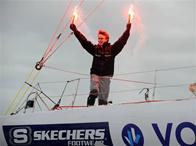
LONDON, England(CNN)--- The youngest person to sail solo around the world returned home Thursday from his 30,000-mile, 282-day ocean journey.
Mike Perham, 17, sailed into Lizard Point in Cornwall, the southernmost point in Britain, at 9:47 a.m., his race team said.
“It feels absolutely brilliant,” Mike told CNN by phone hours before crossing the finish line. “I'm really, really excited to be going across the line at last. It doesn't feel like long since I crossed it first.”
Mike set off on his round-the-world trip on November 18, 2008. He has been sailing his yacht single-handedly, though a support team has been sailing next to him along the way.
The teen has now achieved the title of Youngest Sailor to Circumnavigate the Globe Solo, according to the Guinness World Records.
Mike learned how to sail when he was seven years old from his father, Peter and at age 14, he sailed across the Atlantic alone.
The teenager's school --- which Mike describes as “highly supportive” of his trip --- has redesigned his coursework to fit in with his trip. It also gave him some coursework to do during “quiet moments,” according to Mike's Web site.
There haven't been many of those quiet moments. Repeated autopilot failures forced him to stop for repairs in Portugal, the Canary Islands, South Africa, and twice in Australia, according to his Web site.
Bad weather in the Southern Ocean --- between Australia and Antarctica --- forced Mike to battle 50ft waves and 57 mph winds. He said at one point, a “freak wave” picked up the boat and turned it on its side.
“My feet were on the ceiling at the time,” he told CNN. “That was a really hairy moment, and I was certainly thinking, ‘Why am I here?’ But we took the sails off and the day after I thought, ‘This is brilliant!’”
Mike describes his father as his biggest hero, always supportive of what he wanted to achieve. Peter Perham said he wasn't too worried about his son facing dangerous situations at sea, as long as he knew what to do and stayed safe.
49. Mike Perham returned to Britain in ________.
A. August      B. September         C. October             D. November
50. Mike Perham is ________ that went on the round-the-world trip in the world up till now.
A. the first      B. the bravest    C. the luckiest    D. the youngest
51. We can infer from the passage that ________.
A. the English school is the same as ours
B. the English school doesn’t care for students
C. the English school has a humane management
D. the English school gives students a lot of course work
52. The passage mainly tells us ________.
A. Mike’s exciting sail trip around the globe
B. how Mike’s father taught him to sail a boat
C. why CNN wanted to report the news to the public
D. the introduction of the Guinness World Records

It was early morning. Peter Corbett helped Mark Wellman out of his wheelchair and onto the ground. They stood before El Capitan, a huge mass of rock almost three-quarters of a mile high in California’s beautiful Yosemite Valley. It had been Mark’s dream to climb El Capitan for as long as he could remember. But how could a person without the use of his legs hope to try to climb it?

Mark knew he couldn’t finish the climb alone, but his friend Peter, an expert rock climber, would be there to lend a helping hand. He and Mark thought that it would take seven days to reach the top.

Peter climbed about 100 feet up and hammered a piton(岩钉) into the rock. Fastening one end of a 165-foot rope to the piton, he let one end of the rope fall down. Mark caught the rope and fastened it to his belt with a special instrument. This instrument would allow Mark to move upward, but would prevent him from falling even as much as a single inch. He next reached above his head and fastened a T-shaped bar to the rope, using the same kind of instrument.

Mark took a deep breath, pushed the T-bar up almost as far as his arms could reach, and began the first of the 7, 000 pull-ups needed to reach the top. High above, Peter let out a cheer. “You’re on your way.”

Seven years before, at the age of twenty-one, Mark had fallen while mountain climbing, injuring his backbone. The fall cost him the use of his legs, but he never lost his love of adventure or his joyful spirit.

For the first four days the two men progressed steadily upward without incident. But on the fifth day an unbearably hot wind began to blow, and as time went by, it became stronger and stronger, causing Mark to sway(摇摆) violently on his rope. But Mark kept on determinedly pushing up the T-bar and pulling himself up. In spite of that, he had to admit that he felt a lot better when the wind finally died down and his body touched solid rock again.

It took them one day more than they had expected, but on July 26 at 1:45 in the afternoon, the crowd of people waiting on the top went wild with joy as the two heads appeared. Mark Wellman had shown that if you set your heart and mind on a goal, no wall is too high, no dream impossible.

1.What had Mark Wellman long desired to do?

A. To finish one of the most difficult rock climbs in the world.

B. To be the first to climb El Capitan.

C. To climb the highest mountain in California.

D. To help his friend Peter climb El Capitan.

2.How did Mark climb the mountain?

A. He fastened the rope to his wheelchair.

B. He hammered in pitons so that he had something to hold on to.

C. He held on to the T-bar and Peter pulled him up.

D. He pulled himself up using a T-bar and special equipment.

3. How did Mark lose the use of his legs?

A. He lost his footing and fell from the side of a mountain.

B. He fell during his first attempt on El Capitan.

C. His legs were broken by falling rocks.

D. While working out in the gym, he injured his backbone.

4.What was the worst problem Mark had during the climb?

A. He struck against the rock and hurt his arms.

B. A strong wind blew him away from the rock.

C. He kept falling several inches.

D. While swaying in space, he became terrified.

5.How did Mark react to difficulties during the climb?

A. He admitted that he was frightened.

B. He often worried about his friend’ s condition.

C. He was able to remain clam and determined.

D. He was joking to cheer himself up.


违法和不良信息举报电话:027-86699610 举报邮箱:58377363@163.com

精英家教网